Callum McGregor Breaks Silence as Celtic Face Turbulent Night Following Shock Defeat and Boardroom Exit

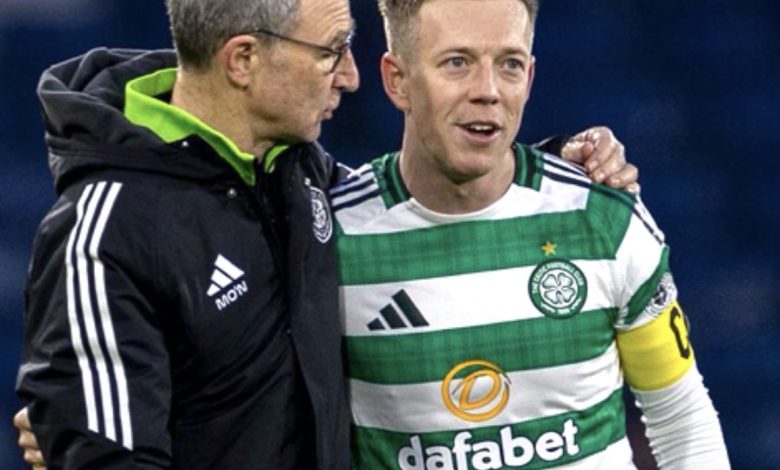
Moments of crisis often reveal the true leadership within a football club. For Celtic FC, a night that began with a damaging 2–0 defeat to Dundee United quickly escalated into something far more profound—an off-field development that has shaken the foundations of the club.
Yet amid the uncertainty, one figure stepped forward almost immediately.
Callum McGregor became the first Celtic player to publicly respond, releasing a statement just minutes after the club confirmed a significant departure behind the scenes. In doing so, the captain not only addressed the result but also attempted to steady a fanbase now grappling with both sporting disappointment and structural concern.
His words, timing, and tone have since become a focal point in understanding where Celtic stand—and where they may be heading.
Timeline: From Full-Time Whistle to Captain’s Response
The Defeat That Sparked It All
Celtic’s 2–0 loss to Dundee United was not just another defeat—it was a performance that exposed recurring issues.
- Lack of midfield control
- Defensive vulnerability in transition
- Minimal attacking cohesion
Within seconds of the final whistle, frustration rippled across the stands and online platforms. Supporters voiced concerns that extended beyond tactics, questioning ambition and long-term planning.
The Shock Announcement
Then came the turning point.
Within minutes of the match ending, Celtic FC released an official update confirming a major departure at the club’s structural level—specifically involving investors.
The timing was striking. It transformed the narrative from a poor result into a full-blown institutional moment.
McGregor Steps Forward
As confusion spread, it did not take long for leadership to emerge.
Callum McGregor became the first player to address the situation publicly. In modern football, where players often wait for media guidance, this immediacy stood out.
His statement was measured, composed, and carefully constructed—yet carried an underlying urgency.
The Statement: Tone, Message, and Meaning
While the full wording of McGregor’s message centred on unity and responsibility, its deeper significance lies in three key elements:
1. Acknowledgement of Failure
McGregor did not deflect blame.
He openly recognised that the performance against Dundee United fell below the standards expected at Celtic. This admission is crucial in moments of crisis, as it aligns leadership with supporter sentiment.
2. Call for Unity
The captain emphasised togetherness—between players, staff, and supporters.
In times of off-field instability, dressing room cohesion becomes even more important. McGregor’s message was clearly aimed at preventing fractures within the squad.
3. Subtle Reassurance Amid Uncertainty
Without directly addressing the investor departure in detail, McGregor’s tone suggested awareness of its significance.
By speaking early, he provided a sense of stability—an indication that the players are not detached from the broader situation.
Tactical Context: Why the Defeat Matters
To fully understand the weight of McGregor’s statement, it’s important to revisit the match itself.
Midfield Breakdown
As Celtic’s captain and central midfielder, McGregor sits at the heart of the team’s system.
Against Dundee United:
- Passing lanes were restricted
- Tempo control was lost
- Transitions became chaotic
This placed additional pressure on both defence and attack.
Defensive Disorganisation
Celtic’s backline struggled to maintain shape, particularly during counter-attacks. The gaps between full-backs and centre-backs were repeatedly exploited.
Lack of Cutting Edge
Despite spells of possession, Celtic created few clear chances. The absence of clinical finishing compounded their problems.
In this context, McGregor’s leadership becomes even more significant—because the issues are not isolated; they are systemic.
Dressing Room Dynamics: Leadership Under Pressure
In elite football, the captain’s role extends far beyond the pitch.
McGregor’s rapid response suggests:
- Awareness of dressing room morale
- Recognition of fan unrest
- Understanding of the club’s broader instability
This is particularly important given the timing of the investor departure.
When off-field uncertainty emerges, players often look inward. Leadership becomes the anchor that prevents distraction from affecting performances.
Fan Reaction: Mixed Emotions Toward the Captain
Supporters have responded strongly to McGregor’s statement—but not uniformly.
Positive Reactions
Many fans praised his leadership:
- “At least the captain is speaking up”
- “He understands what this club means”
For these supporters, McGregor represents continuity and accountability.
Critical Voices
Others, however, believe words are not enough:
- “We need performances, not statements”
- “Leadership must show on the pitch”
This divide reflects a broader tension within the fanbase—between patience and frustration.
The Bigger Picture: Investor Departure and Its Impact
While McGregor’s statement provided immediate reassurance, it cannot be separated from the wider context.
The departure of investors introduces several uncertainties:
Financial Stability
Investor backing influences:
- Transfer budgets
- Wage structures
- Infrastructure investment
Any disruption could affect Celtic’s competitiveness, particularly in European competitions.
Strategic Direction
Investors often play a role in shaping long-term planning. Their exit raises questions about:
- Future ownership structure
- Decision-making processes
- Overall vision
Psychological Effect on Players
Even if not directly involved, players are aware of these developments.
Uncertainty at board level can:
- Create distractions
- Affect confidence
- Influence future decisions, including transfers
Nigerian Perspective: Why This Resonates Beyond Scotland
Celtic’s global reach ensures that developments like this are closely followed far beyond the UK.
For Nigerian fans:
- The club has a history of connections with African players
- Current discussions around players like Kelechi Iheanacho have heightened interest
McGregor’s leadership, therefore, is not just a local matter—it shapes how the club is perceived internationally.
Stability attracts talent. Instability raises doubts.
Leadership Comparison: McGregor in Context
Celtic have had notable captains in the past, each defining their era differently.
McGregor’s leadership style can be characterised as:
- Calm rather than confrontational
- Measured rather than emotional
- Consistent rather than reactive
His quick statement aligns with modern expectations of leadership—where communication is as important as performance.
What Happens Next?
Immediate Priorities
Celtic must:
- Respond positively in their next fixture
- Address tactical weaknesses
- Maintain dressing room unity
Medium-Term Focus
The club will need to:
- Clarify the implications of the investor departure
- Reassure supporters
- Stabilise internal structures
Long-Term Questions
- Can Celtic maintain competitiveness without disruption?
- Will further changes follow at board level?
- How will this affect transfer strategy?
Conclusion
Callum McGregor’s decision to speak out so quickly was not accidental—it was necessary.
In a moment where Celtic faced both sporting disappointment and structural uncertainty, the captain stepped forward to provide clarity, accountability, and a sense of unity.
But statements alone cannot resolve deeper issues.
The defeat to Dundee United exposed tactical weaknesses. The investor departure revealed underlying instability. Together, they represent a critical juncture for Celtic Football Club.
McGregor has done his part—for now.
What follows will determine whether this moment becomes a turning point or the beginning of a deeper crisis.