Few moments in Scottish football ignite controversy quite like a decision in a clash between Rangers F.C. and Celtic F.C.. The rivalry is already the fiercest in the country, and when refereeing decisions become part of the storyline, the debate quickly spirals beyond the pitch. That is exactly what has happened after a dramatic moment involving a disallowed goal by Rangers attacker Fernandez, a decision that sparked outrage among fans, pundits, and even officials at the club.
For days after the match, the debate refused to fade. Supporters dissected screenshots, pundits slowed down replays frame by frame, and social media filled with heated arguments about whether the goal should have stood. Many insisted the goal was perfectly legitimate, claiming that Fernandez was clearly not offside when the decisive moment occurred.
Now, the situation has taken another dramatic twist.
The governing body of Scottish football, the Scottish Professional Football League (SPFL), has finally responded to the mounting pressure. And according to their explanation, the reason the goal was ruled out is not what most fans initially believed.
But what has truly set the football world buzzing is the emergence of new viral footage that appears to shed fresh light on the moment.
A Moment That Stopped the Stadium
The controversial moment unfolded during a tense passage of play inside the penalty area. Rangers had pushed forward aggressively, desperate to break the deadlock in what was already shaping up to be a classic Old Firm encounter.
A cross was delivered into the box, chaos erupted among defenders and attackers, and Fernandez managed to get himself into a dangerous position. As the ball ricocheted through bodies, it eventually found its way into the back of the net.
For a brief moment, the stadium erupted.
Rangers players celebrated. Fans leapt to their feet. It looked like the decisive breakthrough had arrived.
But then came the twist.
The assistant referee raised the flag.
The goal was ruled out.
Almost instantly, confusion spread across the pitch. Rangers players surrounded the officials, demanding an explanation. From their perspective—and from what many replays seemed to show—Fernandez had timed his run perfectly.
So why was the goal disallowed?
The Viral Footage That Sparked a Firestorm
In the hours following the match, clips from the incident began circulating online. One particular angle quickly went viral.
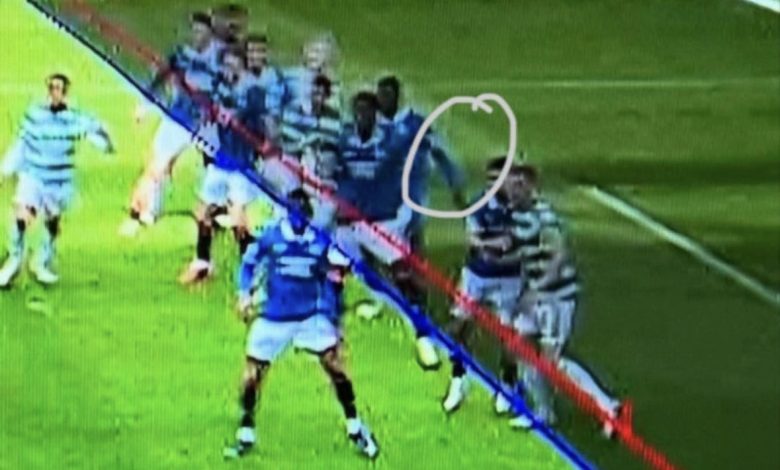
The footage appeared to show a line of players inside the box with Fernandez positioned almost perfectly level with the last defender. Supporters of Rangers F.C. argued that the still frames clearly proved there was no offside offence.
Adding fuel to the debate were markings drawn on the image highlighting players’ positions. One detail stood out: the line seemed to be aligned with a defender’s arm.
Fans quickly began repeating a phrase that soon spread everywhere online:
“The arms don’t count.”
According to the Laws of the Game, only body parts that can legally score a goal should be considered when judging offside. Arms and hands are excluded. That meant, if the defender’s arm was the only part closer to goal, Fernandez would not be offside.
The clip was shared thousands of times within hours. Supporters demanded answers.
Was this a clear refereeing mistake?
Or was something else being missed?
SPFL Steps In
Amid the growing uproar, the Scottish Professional Football League released an official response addressing the controversy and responding to concerns raised by Rangers F.C..
In their statement, the league explained that the decision was not based solely on Fernandez’s position relative to the defender’s arm.
Instead, officials determined that another element of the attacking phase of play had influenced the ruling.
According to the SPFL, match officials believed Fernandez was interfering with play from an offside position during the build-up, even before the ball ultimately reached him.
That distinction is crucial.
In football’s offside laws, a player does not need to touch the ball to be penalised. If a player in an offside position impacts the ability of defenders or the goalkeeper to play the ball, the offence can still be called.
The SPFL argued that Fernandez’s positioning and movement in front of defenders obstructed their attempt to clear the ball, which justified the assistant referee’s decision to raise the flag.
Rangers’ Furious Response
Despite the explanation, the controversy has refused to disappear.
Officials at Rangers F.C. were reportedly furious after reviewing the footage themselves. Many within the club believe the goal should have been allowed to stand.
From their perspective, the decision represents yet another example of inconsistent officiating in high-profile matches.
Fans have echoed those frustrations across social media.
Some argue the explanation does not match what can be seen in the footage. Others believe the league’s response only raises more questions about how such decisions are evaluated.
Debates have raged about the role of referees, the use of technology, and the interpretation of offside rules in Scottish football.
The Technical Rule Behind the Chaos
To understand why this moment has become so controversial, it helps to examine the rule at the centre of the debate.
Under the offside law, a player is considered offside if:
- Any part of the body that can score a goal is closer to the opponent’s goal line than both the ball and the second-last defender.
- The player becomes involved in active play.
However, involvement in play includes more than just touching the ball. It also covers:
- Blocking a defender’s line of vision
- Challenging an opponent for the ball
- Attempting to play the ball when doing so affects defenders
That grey area—what counts as “interfering with play”—is where controversies like this often arise.
Different referees can interpret the same moment in different ways.
And in a match between Rangers F.C. and Celtic F.C., those interpretations are scrutinised more intensely than anywhere else.
Social Media Explosion
As the explanation circulated, fans across Scotland—and beyond—continued analysing the footage.
Some supporters believe the new angle vindicates the officials’ decision.
Others are convinced the goal was wrongly disallowed.
Football analysts, former referees, and commentators have all weighed in with their own interpretations.
The clip has already been viewed millions of times, becoming one of the most discussed refereeing moments of the season.
A Rivalry That Amplifies Everything
Controversies in football happen every week, but when they involve the Old Firm rivalry, they take on a life of their own.
Matches between Rangers F.C. and Celtic F.C. carry enormous emotional weight. Every decision is magnified, every mistake debated endlessly.
For supporters, moments like this feel bigger than just a single goal.
They become part of the rivalry’s long and often heated history.
The Debate Isn’t Going Away
Even after the official explanation from the Scottish Professional Football League, the debate shows no signs of fading.
Fans are still analysing the viral clip frame by frame.
Pundits continue discussing whether the interpretation of “interfering with play” was correct.
And supporters of Rangers F.C. remain convinced that the decision changed the course of the match.
One thing is certain: the footage that spread across the internet has ensured that this incident will be remembered long after the final whistle.
Because in football—especially in the fiery rivalry between Rangers F.C. and Celtic F.C.—a single moment can spark a debate that lasts for years.
And judging by the reactions pouring in from fans, players, and pundits alike…
This one is far from over.