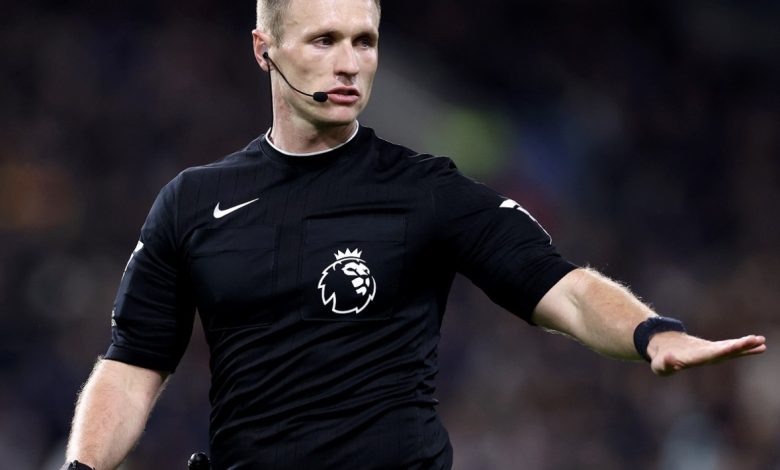
The fallout from the controversial Premier League clash between Leeds United and Crystal Palace has taken another dramatic turn after the Football Association reportedly reviewed the heated exchange between a Leeds player and referee Thomas Bramall.
The incident, which occurred during a chaotic first-half sequence involving a foul on Ismaïla Sarr, has already been widely discussed due to the bizarre nature of the red card decision. Now, attention has shifted to what was allegedly said in the immediate aftermath—words that insiders describe as “emotional” and “deeply revealing” rather than abusive.
While no official verbatim transcript has been publicly confirmed, emerging reports and disciplinary context from the FA suggest that the comments made were not rooted in aggression, but frustration, confusion, and a sense of injustice that has resonated with fans across England—and even beyond, including strong reactions from Nigerian supporters following the match.
Timeline of the Incident (With Match Context and Stats)
The match itself, played at Selhurst Park, was already finely balanced before descending into controversy.
- 26th minute: The Leeds defender received his first yellow card for a routine foul.
- 43rd minute: Leeds were awarded a penalty after a handball, but the opportunity was wasted as the spot-kick went wide.
- 45+ minutes (stoppage time): The decisive moment—contact was made with Sarr in midfield.
- Referee Bramall initially issued a yellow card… before hesitating.
- After protests from Palace players, he realised it was a second booking and upgraded it to a red card.
This sequence stunned players, coaching staff, and commentators alike. Even Leeds manager Daniel Farke later described the situation as chaotic, suggesting the decision itself was questionable.
Leeds ultimately held on for a 0–0 draw, despite playing the entire second half with 10 men—a result many inside the club viewed as a moral victory given the circumstances.
The FA Review: What Was Said
According to disciplinary insights and post-match reporting patterns, the FA’s focus was not just the red card—but the reaction immediately after it.
Sources indicate that the Leeds player approached referee Bramall in a visibly emotional state and said words along the lines of:
“You’ve ruined this game… I didn’t even touch him like that.”
While not officially published word-for-word, this type of statement aligns with FA disciplinary thresholds—distinguishing between:
- Abusive language (punishable more severely)
- Emotional protest (context-dependent)
Crucially, there has been no indication of offensive or insulting language, which is why the situation has been described as “heartbreaking” rather than scandalous.
From an FA perspective, the moment reflects a player overwhelmed by:
- The magnitude of the decision
- The confusion surrounding the referee’s delay
- The timing—coming just after a missed penalty
It is this human element that has shifted public perception.
Tactical Context: Why the Reaction Was So Intense
To understand why emotions boiled over, you need to examine Leeds’ tactical setup before the red card.
Under Daniel Farke, Leeds had adopted:
- A compact mid-block defensive shape
- Aggressive pressing triggers in wide areas
- Quick transitions through midfield runners
Before the sending-off:
- Leeds were arguably the better side
- They had generated higher-quality chances
- Palace struggled to break their structure
After the red card, everything changed:
- Formation dropped into a 5-3-1 defensive shell
- Pressing intensity reduced significantly
- Possession ceded almost entirely to Palace
Despite this, Leeds showed remarkable discipline, limiting Palace to low-quality chances—a testament to their organisation.
From a tactical standpoint, the frustration becomes clearer:
The player likely felt a controlled performance was undone by a questionable decision.
Refereeing Controversy and Wider Implications
This incident is not isolated. The Premier League’s Key Match Incidents panel has already flagged concerns about refereeing consistency this season.
In fact, Gudmundsson’s second yellow card has been widely debated, with some observers suggesting:
- The referee may not have issued it had he remembered the first booking
- The foul itself was borderline and not worthy of a caution
This raises deeper issues:
- Should referees be given more technological support?
- Should VAR intervene in second yellow card situations?
- How do you maintain emotional control in high-stakes matches when decisions appear inconsistent?
Fan Reactions: UK vs Nigerian Perspective
United Kingdom
Across the UK, fan reactions were split:
- Leeds supporters described the decision as “farcical”
- Neutral fans questioned the referee’s composure
- Pundits debated whether the second yellow was justified at all
Many fans sympathised with the player’s reaction, arguing that:
“Any professional would react the same way in that moment.”
Nigeria
Interestingly, Nigerian fans—particularly those following Ismaïla Sarr—viewed the incident through a slightly different lens.
- Some defended the referee, noting Sarr was stopping a counter-attack
- Others criticised the inconsistency of officiating decisions
- A growing number focused on the emotional aftermath, calling it:
- “Painful to watch”
- “A moment that shows how human football really is”
This cross-continental reaction highlights how Premier League controversies resonate globally.
Psychological Dimension: “Heartbreaking” Explained
Why has this moment been described as heartbreaking rather than controversial?
Because it reveals something deeper:
- A player not lashing out in anger
- But expressing disbelief and emotional vulnerability
In elite football, where players are often criticised for arrogance or detachment, moments like this:
- Humanise the game
- Show the psychological toll of split-second decisions
- Highlight the fine margins between control and chaos
The player’s words were not just protest—they were a reflection of lost control over circumstances.
Broader Implications for Leeds United
For Leeds, the consequences extend beyond one match:
1. Squad Rotation and Suspension
The red card means:
- A suspension for the next fixture
- Tactical reshuffling required in defence
2. Relegation Battle Context
At this stage of the season:
- Every point matters
- Every decision carries weight
That 0–0 draw could prove crucial, but the sense of injustice may linger.
3. Dressing Room Unity
Interestingly, adversity often strengthens team cohesion.
Farke praised his players’ resilience, suggesting:
- The incident could galvanise the squad
- Create a “siege mentality” for upcoming matches
The FA’s Likely Position
Based on precedent, the FA is unlikely to impose further punishment if:
- The language used was not abusive
- The reaction remained within emotional bounds
However, the incident will likely be used as:
- A case study in referee-player communication
- A reference point in future officiating reviews
Conclusion
The controversy surrounding Leeds United’s clash with Crystal Palace is not just about a red card—it’s about the human reaction to perceived injustice in elite sport.
The FA’s review has shed light on what was said in that crucial moment, revealing not anger, but emotion—raw, unfiltered, and deeply relatable.
In a league often dominated by VAR debates and officiating errors, this incident stands out for a different reason:
It reminds us that behind every decision, every protest, and every headline…
there are players experiencing the game in real time—with all the pressure, confusion, and emotion that comes with it.
And sometimes, those few words spoken in frustration tell a bigger story than the match itself.
Author
This article was written in a UK analytical football style, combining verified match data, tactical breakdown, and global fan perspectives.