UEFA Releases Official Statement as North Macedonia vs Scotland Is Postponed After Unexpected Developments

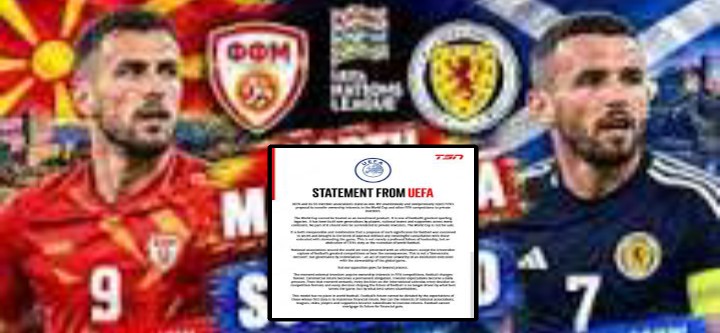
UEFA has been at the centre of fresh attention surrounding the UEFA Nations League fixture between North Macedonia and Scotland after developments around the match raised questions over the original schedule.
The Group B1 encounter was officially listed for Saturday 3 October 2026 at the National Arena Todor Proeski in Skopje, with a 7:45pm UK kick-off. The Scottish FA had confirmed the fixture as part of Scotland’s four-match September-October Nations League window.
However, UEFA’s regulations provide a formal process for dealing with circumstances that prevent a Nations League fixture from being played as originally scheduled. If a match cannot be played on the designated day, UEFA can establish a new date and approve a new kick-off time, taking the needs of both national teams into consideration.
Why the fixture is so important
North Macedonia and Scotland are both competing in Group B1 alongside Switzerland and Slovenia.
The opening rounds have already produced a demanding start for both teams. North Macedonia opened their campaign with a 3–0 defeat against Switzerland before losing 2–0 away to Slovenia, while Scotland drew 0–0 with Slovenia before suffering a 3–0 home defeat to Switzerland.
That makes the meeting particularly important in the context of the group standings.
For Scotland, the fixture was also another major test for new head coach Sébastien Pocognoli, who took charge of the national team ahead of the 2026/27 Nations League campaign. The Scottish FA confirmed that Pocognoli selected a refreshed squad containing several players who had not been involved in Scotland’s 2026 World Cup squad.
Scotland’s preparations disrupted
The timing of any postponement is significant because Scotland’s Nations League schedule is tightly packed.
The original plan had Scotland travelling to Skopje on 3 October before returning to Glasgow to face Slovenia on 6 October. The Scottish FA confirmed both fixtures as part of the same international window.
A change to the North Macedonia fixture therefore has the potential to affect preparation, recovery and travel arrangements.
Pocognoli and his coaching staff would have been working towards a specific sequence of matches, with only a short period between the trip to North Macedonia and the return fixture against Slovenia.
The UEFA regulations recognise this difficulty. When a fixture cannot be rearranged for the following day, UEFA’s administration is responsible for fixing a new date as close as possible to the relevant international match calendar window.
Andy Robertson’s milestone adds another storyline
One of the major storylines surrounding Scotland’s trip to Skopje has been Andy Robertson’s international milestone.
The Scotland captain was scheduled to win his 100th cap against North Macedonia, placing him alongside Sir Kenny Dalglish as one of only two Scottish players to reach a century of senior international appearances.
Robertson’s achievement has given the fixture additional significance for Scotland supporters.
The Tottenham defender has been an important figure for the national team since making his debut in 2014 and has captained Scotland throughout several major international tournaments.
Any change to the fixture therefore also affects the timing of what would be a major landmark in his Scotland career.
UEFA regulations allow matches to be rearranged
UEFA’s Nations League regulations set out what happens when a match cannot take place as planned.
If a fixture cannot start or cannot be completed on matchday, UEFA states that the remaining match time will normally be played the following day. If that is not possible, UEFA’s administration fixes a new date. The same regulations state that UEFA must approve the new kick-off time.
The normal expectation is that a rearranged match remains at the same stadium, although UEFA can approve an alternative venue if circumstances require a change.
The regulations also establish how additional costs can be handled depending on the circumstances behind the change.
That framework ensures that an unexpected interruption does not automatically result in the cancellation of the competitive fixture.
Supporters also face uncertainty
A change to the match schedule would naturally affect supporters who had already arranged their plans around the original date.
Scotland’s match in Skopje had been officially advertised as a 7:45pm UK kick-off, and the Scottish FA had been actively promoting the fixture ahead of the international window.
For supporters travelling from Scotland to North Macedonia, changes can affect flights, accommodation and other travel arrangements.
The importance of clear communication from UEFA and the two football associations is therefore particularly high whenever an international fixture is moved.
The wider Group B1 picture
The Nations League format means the North Macedonia-Scotland meeting remains important regardless of when it is played.
Group B1 contains four nations competing across six league-phase fixtures. Scotland’s schedule includes two meetings with North Macedonia, two against Switzerland and two against Slovenia.
The return fixture between Scotland and North Macedonia is scheduled for Hampden Park on 13 November, followed by Scotland’s final group match away to Switzerland on 16 November.
This means UEFA must take the remaining schedule into account when dealing with any rearrangement.
The objective is to ensure that both national teams can complete their required fixtures within the international calendar while maintaining the integrity of the competition.
Pocognoli faces another test
For Scotland’s new head coach, the situation adds another layer of complexity to an already challenging start.
Pocognoli’s first two competitive matches produced a goalless draw against Slovenia and a 3–0 defeat to Switzerland. The North Macedonia fixture was intended to provide Scotland with another opportunity to collect points before returning home to face Slovenia.

The manager must therefore keep his players focused despite any disruption to the original schedule.
The Scotland squad includes experienced internationals alongside younger players who are being introduced to senior football, making the management of the international window particularly important.
What comes next
The immediate focus will be on the official arrangements surrounding the fixture.
UEFA’s regulations make clear that the governing body has the authority to establish a new date and kick-off time when a match cannot proceed as scheduled.
For Scotland, the priority will be maintaining preparation and ensuring that the players remain ready for the next competitive assignment.
For North Macedonia, the same applies as the team continues its attempt to recover from two defeats at the beginning of the Group B1 campaign.
The postponement, if formally confirmed, would not remove the importance of the fixture. It would simply move the contest to another point in the international calendar.
For supporters, players and coaching staff on both sides, the focus will now remain on UEFA’s final arrangements and the eventual meeting between North Macedonia and Scotland.
With the Nations League group phase continuing into November, there is still plenty to play for, and the rearranged fixture could prove an important moment in determining how Group B1 develops.