UEFA RESPONDS TO NORTH MACEDONIA STATEMENT AS THE MAJOR REASON BEHIND SCOTLAND’S PENALTY
Scotland secured a dramatic 2-1 victory over North Macedonia in the UEFA Nations League, but the result has been overshadowed by a controversial penalty decision that ultimately decided the match.
The incident occurred late in the second half at Hampden Park, with the two sides level at 1-1. Scotland were pushing for a winner when Ben Gannon-Doak raced into the North Macedonia penalty area after being played through by substitute Oli McBurnie.
What followed immediately became one of the biggest talking points of the night.
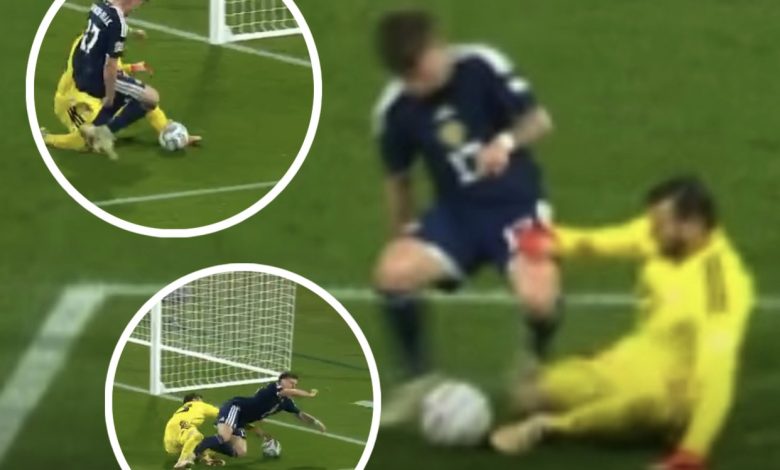
Gannon-Doak attempted to take the ball around North Macedonia goalkeeper Stole Dimitrievski, but his touch carried the ball towards the byline. The winger then went to ground as Dimitrievski moved across his path.
Initially, the referee was not convinced that an offence had taken place and allowed play to continue.
That appeared to be the end of the incident.
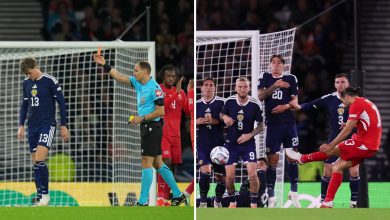
However, VAR intervened and recommended that the referee review the footage on the pitchside monitor. After watching the replay, the referee changed his decision and awarded Scotland a penalty.
John McGinn stepped forward and calmly converted from the spot, sending the goalkeeper the wrong way and giving Scotland a 2-1 lead.
The decision has since generated considerable debate, particularly among North Macedonia supporters, with the incident appearing to show limited contact from certain angles.
WHY WAS THE PENALTY GIVEN?
The key issue is that a penalty does not necessarily require a spectacular collision.
The referee’s decision was based on the assessment that Dimitrievski’s movement created an offence against Gannon-Doak as the Scotland player attempted to move around him inside the penalty area.
The Scottish FA’s official match report confirms that the referee initially waved play on before being advised by VAR to take another look. After reviewing the footage, he pointed to the penalty spot. (pre-prod.scottishfa.co.uk)
That sequence is important because it shows that the final decision was not made simply because Gannon-Doak went down. The referee was given the opportunity to reassess the incident using VAR footage before making the final call.
Sky Sports also reported that Dimitrievski was judged to have brought down Gannon-Doak after the VAR review, with the goalkeeper’s challenge becoming the decisive moment of the match. (Sky Sports)
NORTH MACEDONIA’S FRUSTRATION
From North Macedonia’s perspective, the controversy is understandable.
The goalkeeper appeared to have moved towards the ball while Gannon-Doak was already losing control of it. The Scotland winger’s heavy touch meant the ball was moving away from him, and there was an argument that the attacker had little chance of reaching it before it went out of play.
One live report described the situation as particularly contentious because Gannon-Doak’s touch had been heavy and the ball appeared to be heading towards a goal kick. (24NewsDesk)
That is why the replay has attracted so much attention.
The argument is not simply whether Gannon-Doak fell. It is whether Dimitrievski’s movement into his path amounted to an illegal challenge under the Laws of the Game.
VAR CHANGED EVERYTHING
The incident also highlights the growing influence of VAR in modern football.
The original decision was no penalty.
The referee had seen the incident live and initially decided there was insufficient grounds to award a spot-kick.
VAR then intervened.
After the review, the on-field decision was changed.
The Scottish FA’s account confirms that the referee went to the monitor after the VAR recommendation and subsequently awarded the penalty. (pre-prod.scottishfa.co.uk)
That process is likely to fuel further discussion because supporters can accept different interpretations of the same replay.
For Scotland, however, the decision proved decisive.
McGinn made no mistake from 12 yards, scoring his second goal of the evening and his 24th for Scotland.
McGINN BECOMES THE MATCH-WINNER
The penalty completed an extraordinary night for McGinn.
The Aston Villa midfielder had already given Scotland the lead in the 54th minute, finishing after good work from Che Adams.
North Macedonia responded just three minutes later through Elmin Rastoder, who headed home from Enis Bardhi’s corner to make it 1-1. (Scottish FA)
With Scotland struggling to find a way through, the controversial penalty eventually gave McGinn another opportunity.
He accepted it.
The midfielder sent his penalty straight down the middle while Dimitrievski dived away, restoring Scotland’s lead in the 74th minute.
Scotland held on for the remaining minutes to secure a 2-1 victory.
THE BIGGER QUESTION
Although North Macedonia may feel hard done by, the available evidence does not support the simple claim that the penalty was awarded because Gannon-Doak merely fell over.
The official match report confirms that VAR identified the incident for review, while multiple match reports describe Dimitrievski as having fouled or brought down the Scotland winger. (pre-prod.scottishfa.co.uk)
At the same time, the available reports do not currently show a published UEFA statement giving a detailed explanation of the exact contact or the precise VAR protocol behind the decision.
That distinction matters.
It is therefore fair to say that the penalty remains controversial, particularly because the contact appears minimal from some angles, rather than presenting an unverified UEFA explanation as fact.
For Scotland, though, there will be little desire to revisit the decision.
The 2-1 victory keeps their hopes of finishing second in Nations League Group B1 alive. Scotland now face Switzerland away on Monday, knowing they need a positive result and help from the other fixture to keep their promotion-play-off hopes alive. (Sky Sports)
The controversy may continue online, but one fact cannot be disputed: the VAR intervention changed the game, McGinn converted the resulting penalty, and Scotland left Hampden with all three points.