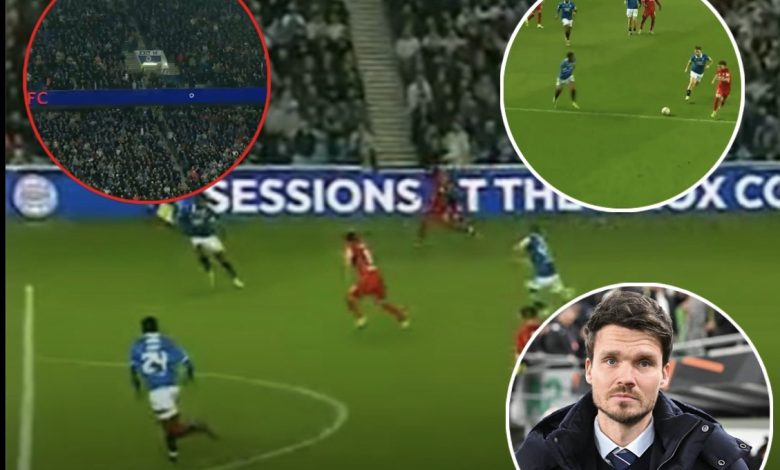
A convincing 4–1 victory for Rangers FC against Aberdeen FC should have been a night of celebration at Ibrox. Goals flowing, attacking cohesion visible, and three points secured in emphatic fashion—on paper, it was exactly the kind of performance supporters have been demanding in recent weeks.
Yet, as is often the case in modern football, the full-time whistle did not bring unity. Instead, it exposed a fracture within the fanbase. Despite the comfortable margin of victory, frustration simmered online and inside the stadium—directed not at the team collectively, but at one individual moment, one costly error, and one player increasingly under scrutiny.
The irony is striking: in a match where Rangers dominated large phases, it was a single defensive lapse in the 52nd minute that shifted the narrative entirely. What should have been remembered as a statement win is now being discussed as further evidence of a deeper issue—defensive reliability.
Match Timeline and Key Moments
The opening exchanges saw Rangers assert themselves early. Their structure, set up in a 4-2-3-1, allowed them to control midfield spaces and transition quickly into attack. The breakthrough came in the 35th minute, when a well-worked move resulted in the opening goal—reward for sustained pressure.
By halftime, Rangers had already established control, but the second half began with renewed intensity. Within minutes of the restart, the hosts doubled their advantage, followed shortly by a third goal that effectively killed the contest.
However, football rarely unfolds without incident.
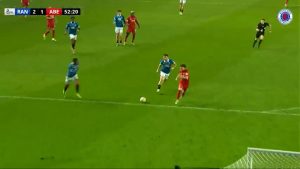
In the 52nd minute, Aberdeen pulled one back. It was not a moment of brilliance from the visitors, but rather a defensive breakdown—misjudgment, hesitation, and ultimately, punishment. The goal briefly shifted momentum and offered Aberdeen a lifeline.
Rangers responded professionally, restoring their dominance and eventually adding a fourth goal deep into stoppage time to seal a 4–1 victory. On the surface, it was comprehensive. But beneath that surface, the error lingered.
Tactical Analysis: Where the Game Was Won—and Nearly Compromised
From a tactical standpoint, Rangers executed much of their game plan effectively. The double pivot in midfield provided balance, allowing full-backs to push forward and create overloads in wide areas. Their attacking midfield trio rotated intelligently, pulling Aberdeen’s defensive shape apart.
Key strengths included:
- Vertical progression: Rangers moved the ball quickly through midfield lines, limiting Aberdeen’s ability to reset defensively.
- Wide overloads: Full-backs and wingers combined effectively, particularly on the right flank.
- Pressing structure: Aberdeen struggled to build from the back under sustained pressure.
However, the defensive phase told a different story.
The conceded goal highlighted recurring issues:
- Lack of communication in central defence
- Poor positional awareness under pressure
- Hesitation in decision-making during transitional moments
This was not an isolated incident but rather a continuation of a pattern that has concerned supporters in recent matches. Even in victory, these lapses undermine confidence.
The Turning Point: One Moment That Changed the Conversation
At 3–0, Rangers were cruising. The game appeared done. Then came the 52nd-minute incident.
A routine defensive situation escalated unnecessarily. Instead of clearing danger decisively, hesitation allowed an Aberdeen attacker to capitalize. The finish itself was straightforward—the opportunity was not.
Moments like these are often magnified not because of their immediate impact on the result, but because of what they represent. In this case, it symbolised vulnerability—an Achilles’ heel that opponents may increasingly look to exploit.
Fan Reactions: From Celebration to Frustration
Despite the emphatic scoreline, the reaction from sections of the Rangers support was far from positive.
Across social media platforms and fan forums, criticism was swift and direct. Some supporters praised the attacking display but expressed deep concern about defensive consistency. Others were less forgiving, singling out the individual involved in the error.
A recurring theme emerged:
- “We can’t keep ignoring these mistakes.”
- “At this level, that’s unacceptable.”
- “It’s costing us, even when we win.”
There was also visible frustration at what fans perceive as a lack of improvement. For many, patience is wearing thin—not because of one mistake, but because of repeated ones.
Notably, footage circulating after the match appeared to show the player in question acknowledging supporters, a gesture interpreted by some as an apology.
The Player at the Centre of the Storm
It is only at this stage that attention turns fully to the individual involved.
The defender in question—23-year-old centre-back Nasser Djiga—has become the focal point of criticism following the match.
Still relatively young and developing, Djiga arrived with promise and physical attributes suited to the Scottish Premiership. However, his performances have drawn mixed reviews, with consistency proving elusive.
The 52nd-minute error has intensified scrutiny:
- Questions over composure under pressure
- Concerns about decision-making in key moments
- Doubts regarding readiness for a starting role at a club with Rangers’ expectations
While it is important to contextualise his age and experience, Rangers is a club where margins are fine and expectations are relentless. Development often has to happen under intense pressure—and not all players adapt at the same pace.
Broader Context: Rangers’ Defensive Evolution
Rangers’ history is built on defensive resilience as much as attacking flair. From past title-winning sides to European campaigns, defensive organisation has been a cornerstone of success.
The current team, however, appears to be in transition.
A younger defensive core suggests a long-term strategy—building for the future rather than relying solely on experience. But this approach comes with risk:
- Inconsistency during development phases
- Increased susceptibility to individual errors
- Greater scrutiny from supporters accustomed to high standards
Matches like this encapsulate the dilemma. The team is clearly capable of dominant performances, yet still prone to moments that undermine that dominance.
Nigerian Perspective: Why This Story Resonates
From a Nigerian football audience perspective, stories like this resonate strongly. Nigerian fans often follow European clubs with passion, and Rangers has a growing global following.
There is also a broader connection:
- African players, including those from West Africa, frequently face heightened scrutiny when adapting to European leagues
- Development pathways can be uneven, particularly in high-pressure environments
- Fan reactions—both supportive and critical—can shape a player’s trajectory
While Djiga is not Nigerian, the narrative mirrors experiences of many African defenders breaking into top-level European football. The balance between patience and performance is a familiar debate.
Managerial Dilemma: Backing or Benching?
The coaching staff now face a critical decision.
Do they continue to back Djiga, trusting that experience will iron out mistakes? Or do they opt for a more experienced alternative to stabilise the defence?
Each option carries implications:
Backing the player:
- Encourages development and confidence
- Signals trust from management
- Risks further costly errors
Dropping the player:
- Sends a message about standards
- May improve short-term stability
- Could damage confidence and long-term growth
In elite football, these decisions often define both player careers and managerial tenures.
Statistical Reflection (Contextual Performance)
While full advanced metrics from providers like Opta are not publicly detailed here, general match indicators suggest:
- Rangers dominated possession and chances created
- Aberdeen’s goal came from a limited number of opportunities
- Defensive errors, rather than systemic breakdowns, were the primary issue
This distinction is crucial. Structural problems require tactical overhaul; individual errors require either coaching intervention or personnel changes.
Fan Culture and Expectation at Rangers
To understand the intensity of the reaction, one must understand the culture surrounding Rangers.
As one of Scotland’s most historically successful clubs, expectations are unwavering. The rivalry with Aberdeen itself has long been fiercely contested, adding emotional weight to every encounter.
Victory alone is not enough—performance matters. Consistency matters. Reliability matters.
And for defenders, the standard is simple: minimise risk, eliminate mistakes.
What Happens Next?
This match will not define Rangers’ season—but it may influence key decisions moving forward.
Key questions include:
- Will defensive errors persist in upcoming fixtures?
- How will the coaching staff respond tactically?
- Can Djiga recover confidence and form quickly?
The next few matches will be critical, not just for results, but for narrative.
Conclusion
A 4–1 victory should have been straightforward—a night of attacking brilliance and collective success. Instead, it has become a case study in how one moment can reshape perception.
For Rangers FC, the positives are clear: attacking cohesion, midfield control, and clinical finishing. But the negatives cannot be ignored.
For Nasser Djiga, this is a pivotal moment. Criticism is part of football at this level—but so is resilience. How he responds may ultimately define his future at the club.
For the fans, the message is equally clear: winning is essential, but trust is earned through consistency.
And right now, despite the scoreline, that trust remains fragile.