Scottish Premiership Releases VAR Audio of Alex Oxlade-Chamberlain Red Card Incident Against Motherwell F.C.

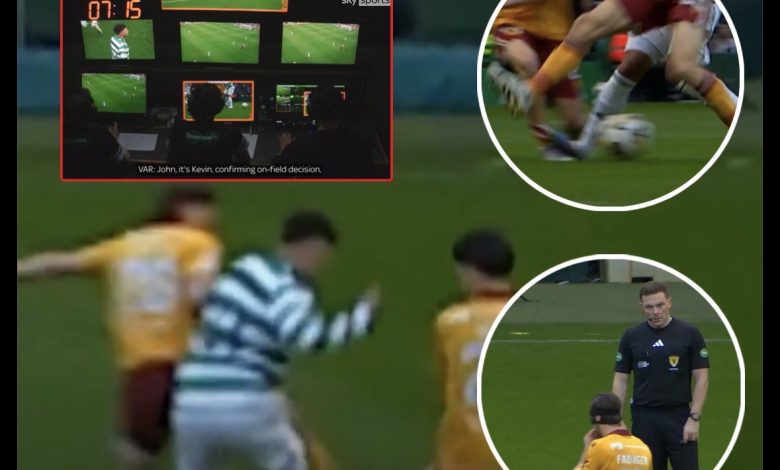
The Scottish Premiership has once again found itself at the centre of a refereeing storm following the release of VAR audio from a controversial flashpoint involving Celtic F.C. midfielder Alex Oxlade-Chamberlain.
What initially appeared to be a routine yellow-card incident during Celtic’s 3–1 victory over Motherwell F.C. has now escalated into a wider debate about officiating standards, consistency, and the perceived impartiality of referee John Beaton.
With the Scottish FA releasing the previously unheard communication between on-field officials and VAR, fans, analysts, and former players have been given rare insight into how such decisions are made in real time. Rather than settling the controversy, however, the audio has only intensified scrutiny—raising difficult questions about interpretation, consistency, and trust in officiating.
Match Context and Timeline of the Incident
The incident in question occurred early in Celtic’s league clash with Motherwell, a match that would ultimately play a significant role in the title race. Celtic entered the fixture under pressure, chasing crucial points to maintain momentum at the top end of the table.
Inside the opening minutes, Oxlade-Chamberlain lunged into a challenge on Motherwell winger Elijah Just. The tackle immediately drew attention—not only from players but from the crowd, who sensed the seriousness of the contact.
Key Timeline
- 7th minute – Oxlade-Chamberlain commits a high challenge on Elijah Just
- Immediate decision – Referee John Beaton issues a yellow card
- VAR review initiated – VAR official Kevin Clancy checks for potential red-card upgrade
- Final verdict – Yellow card upheld; no on-field review recommended
At the time, the decision seemed contentious but not extraordinary. However, the narrative changed dramatically once the VAR audio was made public.
What the VAR Audio Revealed
The release of VAR audio is part of an ongoing transparency initiative within Scottish football. In this case, the conversation between referee John Beaton and VAR official Kevin Clancy provided a detailed breakdown of their reasoning.
According to the audio, officials focused on three key criteria:
- Point of Contact
- Speed and Intensity
- Risk to Player Safety
The VAR team ultimately concluded that the challenge, while reckless, did not meet the threshold for “serious foul play.”
- The contact was described as largely “boot on boot”
- There was “no significant speed or intensity”
- The tackle did not “endanger the safety” of the opponent
As a result, the on-field decision of a yellow card was upheld without recommending a pitchside review.
From a regulatory standpoint, the decision aligned with IFAB guidelines, which differentiate between reckless challenges (yellow card) and those involving excessive force or danger (red card).
The “Orange Card” Debate
Following the release, Scottish FA Head of Refereeing Willie Collum offered further clarification, describing the tackle as an “orange card” incident—one that sits on the borderline between yellow and red.
Collum admitted that:
- A red card could have been justified
- But there was not enough evidence to overturn the referee’s initial call
- VAR intervention requires a “clear and obvious error”
This explanation, while technically sound, has done little to calm the backlash.
The concept of an “orange card” itself has become controversial, with critics arguing that it highlights the subjectivity still present in modern officiating.
Tactical Analysis: Why the Incident Matters
From a tactical perspective, the decision had a significant impact on the match.
Had Oxlade-Chamberlain been sent off:
- Celtic would have played over 80 minutes with 10 men
- Midfield balance would have been disrupted
- Motherwell could have exploited numerical superiority
Instead, Celtic maintained their structure and went on to secure a 3–1 victory.
Midfield Dynamics
Oxlade-Chamberlain’s role in midfield is built on:
- Ball progression
- Transitional pressing
- Physical duels
Losing him early would have forced a reshuffle, likely pushing Celtic into a more conservative shape.
Psychological Impact
There is also the psychological dimension:
- A red card early in the game often shifts momentum
- The opposition gains belief
- The referee’s authority becomes a talking point
In this case, the decision allowed Celtic to recover from an early setback and control the tempo of the match.
Fan Reactions: Scotland and Nigeria Perspectives
Scottish Fan Reaction
The reaction across Scotland has been deeply divided.
- Celtic supporters largely accepted the decision as correct
- Motherwell fans and neutral observers felt it was lenient
- Pundits described it as a “50-50 call”
Former referee Des Roache stated that a red card “would not have been controversial”, reinforcing the idea that the decision sat on a knife edge .
Meanwhile, broader criticism of refereeing standards has been growing. Rangers legend Barry Ferguson recently described officiating in Scotland as “well below the required level,” highlighting inconsistency as a major issue .
Nigerian Perspective
From a Nigerian audience—where the Scottish Premiership has a growing following—the reaction has been equally intense.
Fans in Nigeria often view European officiating through the lens of fairness and consistency. Social media discussions have echoed familiar themes:
- “If that was against a smaller club, it’s a red”
- “Big teams always benefit”
- “VAR should remove controversy, not increase it”
This reflects a broader global concern: VAR was introduced to eliminate debate, yet incidents like this continue to divide opinion.
Is Referee John Beaton Under Pressure?
Referee John Beaton is no stranger to controversy. Over the years, he has officiated several high-profile matches involving Celtic and Rangers, often finding himself at the centre of heated debates.
This latest incident has reignited accusations of bias—though, crucially, there is no evidence to support such claims.
Key Points
- The decision was backed by VAR
- The independent panel supported the yellow card outcome
- Officials followed established guidelines
However, perception often outweighs reality in football. Once fans begin to question neutrality, trust becomes difficult to rebuild.
Broader Implications for VAR in Scotland
This incident highlights several ongoing challenges with VAR implementation:
1. Subjectivity Remains
Even with video assistance, decisions still rely on human interpretation. Terms like:
- “Reckless”
- “Excessive force”
- “Endangering safety”
are inherently subjective.
2. Transparency vs Controversy
Releasing VAR audio is intended to increase transparency. However, it can also:
- Expose uncertainty
- Reveal disagreements
- Fuel further debate
3. Consistency Issues
Fans expect consistency across matches. Yet similar incidents often result in different outcomes, leading to frustration.
Statistical Context
Looking at disciplinary trends in the Scottish Premiership:
- Celtic rank mid-table for fouls per game
- Their red-card count remains relatively low
- Officials tend to favour contextual interpretation over strict enforcement
This suggests that referees are cautious about issuing red cards unless the threshold is clearly met.
The Role of Media and Narrative
The framing of incidents like this plays a crucial role in shaping public perception.
Headlines describing the decision as:
- “eye-opening”
- “controversial”
- “biased”
can influence how fans interpret events—even before seeing the footage.
In reality, the decision sits within a grey area of football law, where disagreement is inevitable.
Conclusion
The release of VAR audio surrounding Alex Oxlade-Chamberlain’s challenge against Motherwell F.C. has provided valuable insight into the decision-making process—but it has not delivered clarity.
Instead, it has reinforced a fundamental truth about football: even with advanced technology, the game remains open to interpretation.
Referee John Beaton followed protocol. VAR officials applied the rules. Independent panels backed the outcome.
And yet, the debate continues.
For the Scottish Premiership, this is both a challenge and an opportunity. Transparency is improving, but trust must follow. Until consistency is achieved, incidents like this will continue to dominate headlines—fueling arguments from Glasgow to Abuja and beyond.