The viral footage capturing one of the most contentious moments in recent Champions League history has ignited widespread fury among football fans, pundits, and former players alike.
In a high-stakes clash between Newcastle United and Barcelona, Anthony Elanga appeared to be clearly fouled inside the penalty area by João Cancelo, yet neither the on-field referee nor VAR intervened to award what many viewed as an obvious spot-kick.
The incident, frozen in time by sharp overhead camera angles, shows Cancelo positioned behind the speeding Elanga, arms wrapped around the Newcastle winger’s torso in a manner that impeded his run toward goal.
Elanga, attempting to stay on his feet while controlling the ball at his feet, goes down under the contact just inside the box, the ball rolling harmlessly away as play continues without interruption.
The image that has since exploded across social media platforms depicts the exact moment of collision: Cancelo, in his Barcelona colors, leans heavily into Elanga’s back, one arm hooked around the attacker’s waist while the other appears to pull at his shoulder.
Elanga, dressed in Newcastle’s black-and-white stripes, is forced onto one knee, his body twisted awkwardly as he reaches desperately for the ball positioned just in front of him on the green turf. In the background, a Barcelona player sprints away, perhaps unaware of the drama unfolding, while the lines on the pitch highlight the clear location inside the penalty area.
The expression on Elanga’s face conveys frustration and disbelief, his arms outstretched in appeal as the referee waves play on.
This non-call occurred during a tense phase of the match where Newcastle had been threatening on the counter, exploiting Cancelo’s struggles against Elanga’s blistering pace down the flank.
Throughout the game, Elanga had repeatedly skinned the Portuguese full-back, delivering dangerous crosses and forcing defensive adjustments from Barcelona’s backline. Cancelo, known for his attacking flair but occasionally vulnerable in one-on-one defensive situations, found himself under constant pressure.
The incident in question came as Elanga burst forward once more, receiving a threaded pass and accelerating toward goal. Contact was initiated from behind, with Cancelo seemingly using his body to halt the Swede’s momentum rather than contesting the ball cleanly.
Fans and analysts have dissected the footage frame by frame. The contact is unmistakable: Cancelo’s arms encircle Elanga in a classic holding offense, preventing him from maintaining balance or continuing his run. In modern football, where referees are instructed to penalize such “tug-and-pull” actions inside the box—especially when they deny a clear goal-scoring opportunity—the decision to let play continue has been labeled indefensible by many.
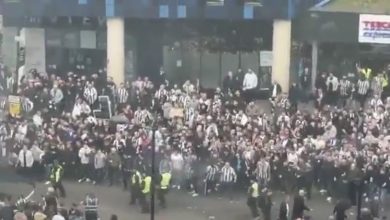
Newcastle players surrounded the referee in protest, with gestures pointing emphatically toward the spot, while the home crowd at St. James’ Park erupted in boos and chants questioning the integrity of the officiating. Even some neutral observers expressed astonishment at the lack of intervention, noting that similar incidents in other matches this season have resulted in penalties without hesitation.
The aftermath has only amplified the outrage. Social media erupted almost immediately, with clips of the moment garnering millions of views within hours. Hashtags like #PenaltyForElanga and #CanceloFoul trended globally, accompanied by memes, slow-motion replays, and side-by-side comparisons to other awarded penalties in the competition.
Former referees and pundits weighed in heavily, with one prominent ex-official stating that the foul met every criterion for a penalty: clear contact from behind, inside the area, impeding progress toward goal. “If that’s not a penalty, then what is?” became a common refrain. Newcastle supporters, already frustrated by a string of tight decisions in European fixtures, felt this was the tipping point, accusing officials of bias toward bigger clubs like Barcelona.
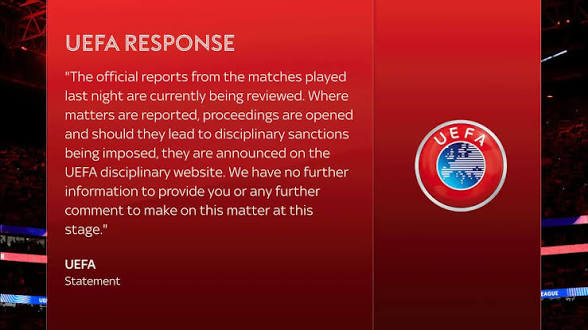
Adding fuel to the fire, UEFA issued a statement several days later addressing the growing controversy surrounding refereeing standards in the Champions League.
While not directly naming the Newcastle-Barcelona match, the governing body acknowledged “ongoing discussions” about consistency in penalty-area decisions and the role of VAR in high-profile games. The statement emphasized a commitment to “fairness and transparency,” promising a review of recent incidents to ensure protocols are applied uniformly.
However, the wording struck many as evasive, failing to offer any specific apology or admission of error in this particular case. Critics interpreted it as a “shocking” non-response—defensive rather than accountable—further enraging those who believed the Elanga incident warranted explicit acknowledgment.
Newcastle’s performance that night deserved far more than the point they salvaged. Eddie Howe’s side matched Barcelona stride for stride, creating chances through Elanga’s dynamism and the industry of midfielders like Sandro Tonali and Bruno Guimarães.
Elanga himself was a standout, his speed and directness causing constant problems for Cancelo, who picked up a booking later in the game for a separate challenge. The winger’s frustration was palpable post-match; in interviews, he diplomatically described the non-call as “disappointing” but refrained from harsher criticism, allowing the footage to speak for itself.
Barcelona, meanwhile, escaped with a draw that kept their qualification hopes alive, though the result felt somewhat fortuitous given the momentum shifts. João Cancelo, no stranger to controversy throughout his career, found himself at the center of debate once again. His defensive lapses against Elanga highlighted vulnerabilities that opponents may target in future ties, even as his attacking contributions remain valuable to Hansi Flick’s system.
The broader implications ripple far beyond this single match. Football’s officiating crisis—marked by inconsistent VAR interventions, delayed decisions, and perceived favoritism—continues to erode trust.
Supporters argue that elite competitions like the Champions League should set the gold standard, yet moments like this undermine that ambition. Calls for greater transparency, such as public explanations from referees or more open VAR audio releases, have intensified. Some even suggest technological enhancements, like automated offside lines extended to foul detection, though such ideas remain speculative.
In the end, the viral image of Elanga on his knee, ball tantalizingly close yet out of reach, with Cancelo looming over him, has become emblematic of a night when justice felt denied. Newcastle left the field proud of their display but robbed of what could have been a historic victory. Barcelona claimed a valuable point, but the shadow of controversy lingers.
As debates rage on forums, podcasts, and pub conversations worldwide, one truth stands clear: the footage doesn’t lie. It shows a foul, a penalty that wasn’t given, and a wave of fury that shows no signs of subsiding. Football fans demand better—and in this instance, they have every right to feel let down by the system meant to protect the game’s integrity.