
CELTIC FANS LEFT FUMING OVER WHAT SFA SAID ABOUT CELTIC BEEN DENIED A CLEAR PENALTY, VAR IS CORRUPT TO THE CORE
Scottish football has once again been thrown into a storm of controversy after a major refereeing decision during the recent clash between Celtic FC and Aberdeen FC sparked outrage among supporters. What began as a tense and competitive match quickly transformed into a heated debate about refereeing standards, VAR consistency, and the role of the Scottish Football Association in overseeing the integrity of the game.
At the center of the controversy is a moment that Celtic supporters believe was a clear penalty that was ignored by the match officials. Even more controversial, however, was the response that later came from the Scottish FA regarding the incident. Instead of calming the situation, the explanation only intensified the anger among fans, many of whom took to social media to express their disbelief.
The reaction was swift and explosive. Across online forums, fan pages, and football discussion platforms, supporters accused VAR officials of incompetence and bias, with some going as far as to label the system “corrupt to the core.”
What exactly happened in the match? Why did the decision cause such a strong reaction? And why has the response from the governing body only added fuel to the fire?
To understand the scale of the controversy, it is important to examine the match itself, the key moment that triggered the outrage, and the wider debate about VAR in Scottish football.
A High-Stakes Match Between Celtic and Aberdeen
Matches between Celtic and Aberdeen have long been fiercely contested in Scottish football. While Celtic remain one of the dominant forces in the league, Aberdeen have often played the role of a dangerous challenger capable of upsetting the established order.
This particular match carried significant importance for both sides.
Celtic entered the game with the pressure of maintaining their position near the top of the Scottish Premiership standings. Every point matters in the title race, especially when rivals such as Rangers FC remain within striking distance.
Aberdeen, meanwhile, were determined to prove they could compete against the league’s biggest teams. Playing against Celtic is always a massive occasion for the club, and the players were eager to show they could take something from the match.
From the opening whistle, the intensity was evident. Celtic dominated possession early on, controlling the tempo of the game and pressing Aberdeen deep into their own half.
Aberdeen, however, defended with discipline and looked dangerous on the counterattack. The match quickly developed into a tactical battle, with both sides searching for the breakthrough.
But while the football itself was entertaining, it was a single moment in the penalty area that would ultimately overshadow everything else.
The Moment That Sparked the Controversy
The key incident occurred during one of Celtic’s attacking moves inside the Aberdeen penalty area.
A Celtic player attempted to control the ball when it appeared to strike the arm of an Aberdeen defender. Immediately, Celtic players appealed to the referee, claiming the defender had handled the ball and that a penalty should be awarded.
From the stands and on television replays, many supporters believed the contact with the arm was obvious.
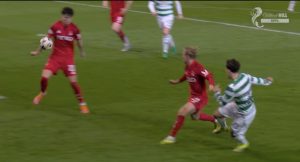
But the referee allowed play to continue.
Within seconds, attention turned to VAR.
Under modern football rules, potential penalty incidents involving handball can be reviewed by the video assistant referee to determine whether a clear error has been made.
Celtic fans waited for the familiar pause in play that often signals a review.
But the moment passed quickly.
No penalty.
No on-field review.
Play continued as if nothing had happened.
For many supporters watching, it was a moment of disbelief.
The Role of VAR in the Decision
VAR was introduced into Scottish football with the promise of reducing controversial errors and ensuring that crucial decisions were made correctly.
However, instead of eliminating debates, the technology has sometimes created even more confusion.
In this case, the absence of a penalty decision immediately raised questions.
Supporters wanted to know:
• Did VAR review the incident?
• If so, why was the referee not asked to check the monitor?
• Was the handball deemed accidental?
• Or did the officials believe the ball had struck a natural arm position?
Without clear communication, speculation quickly filled the gap.
And as replays of the incident circulated online, the anger among Celtic fans grew rapidly.
The Scottish FA Responds
Following the match, the controversy intensified when the Scottish Football Association issued a statement explaining the decision.
The governing body confirmed that VAR had reviewed the incident but concluded that the defender’s arm position was considered natural and therefore not a punishable handball under the current laws of the game.
From a technical standpoint, the explanation was based on the interpretation of the handball rule.
According to football’s laws, a handball is usually penalized if:
• The arm makes the body unnaturally bigger
• The arm is in an unnatural position
• The player deliberately handles the ball
In this case, officials believed the defender’s arm position was part of a natural movement while attempting to control the ball.
Therefore, the VAR team did not recommend a penalty.
Celtic Fans React With Fury
While the explanation may have satisfied officials, it did little to calm the reaction from supporters.
For many Celtic fans, the footage seemed to show the ball clearly striking the defender’s arm.
On social media platforms, thousands of comments appeared within hours of the statement being released.
Some supporters questioned how similar incidents in other matches had resulted in penalties.
Others argued that VAR had failed to apply the rules consistently.
The strongest reactions came from fans who felt the decision represented a broader pattern of questionable officiating in Scottish football.
The phrase “VAR is corrupt to the core” began trending among some fan communities, reflecting the depth of frustration and distrust that has developed.
While such accusations are often fueled by emotion, they highlight a growing problem in modern football: the erosion of trust between fans and officiating systems.
The Wider Debate About VAR
The controversy surrounding the Celtic penalty incident is far from an isolated case.
Across Europe, debates about VAR continue to dominate football discussions.
Supporters frequently complain about:
• Inconsistent interpretations of handball rules
• Long delays during reviews
• Lack of transparency about decisions
• Confusion over when VAR should intervene
While the technology was introduced to improve accuracy, many fans feel it has simply replaced one form of controversy with another.
In Scotland, where football passions run particularly high, these issues are magnified even further.
Transparency and Communication Problems
One of the biggest criticisms directed at refereeing bodies is the lack of transparency surrounding VAR decisions.
In many matches, fans inside the stadium have no idea what is being reviewed or why a particular decision has been made.
Some leagues have attempted to address this problem by:
• Broadcasting referee audio discussions
• Displaying VAR explanations on stadium screens
• Publishing detailed reports after controversial matches
In Scotland, however, such transparency measures are still limited.
As a result, when controversial decisions occur, fans are often left with more questions than answers.
The Impact on the Title Race
Beyond the controversy itself, the decision also had potential implications for the league table.
In tightly contested title races, even a single refereeing decision can influence the outcome of an entire season.
Had Celtic been awarded the penalty and converted it, the match could have taken a completely different direction.
Points gained or lost at key moments can ultimately determine which team lifts the trophy at the end of the campaign.
This reality is one reason why fans react so passionately to controversial calls.
Referees Under Pressure
It is also important to acknowledge the immense pressure referees face in modern football.
Every decision they make is analyzed from multiple camera angles and replayed repeatedly on television and online platforms.
Even with the help of VAR, officials must interpret complex rules in real time while managing the emotions of players, coaches, and supporters.
Mistakes are inevitable.
But when mistakes appear to happen repeatedly, confidence in the system begins to erode.
Calls for Reform
In the aftermath of the Celtic penalty controversy, calls for reform have grown louder.
Some fans and pundits believe Scottish football authorities should introduce measures such as:
• Greater transparency in VAR decision-making
• Public explanations from refereeing officials
• Consistent training and evaluation of VAR referees
• Clearer communication during matches
Whether such changes will be implemented remains uncertain.
But one thing is clear: the debate over VAR is far from over.
A Controversy That Will Not Disappear Quickly
The incident involving Celtic and Aberdeen is likely to remain a major talking point in Scottish football for weeks to come.
Supporters will continue analyzing the footage, debating the rules, and questioning the decisions made by officials.
For Celtic fans, the frustration lies not only in the missed penalty but also in the belief that the explanation provided by the governing body failed to address their concerns.
For the Scottish FA, the challenge is restoring trust in a system that many supporters increasingly view with skepticism.
Conclusion
Football has always been a sport filled with emotion, passion, and debate. Controversial refereeing decisions are nothing new.
But in the era of VAR, expectations have changed.
Supporters now believe that technology should eliminate obvious mistakes and provide clarity.
When it fails to do so, the backlash can be intense.
The controversy over the denied Celtic penalty against Aberdeen has once again exposed the fragile relationship between fans and the officiating system in Scottish football.
Whether the decision was correct or not, the reaction demonstrates a deeper issue — a growing lack of confidence in how VAR is being used.
Until greater transparency and consistency are introduced, moments like this will continue to spark outrage, debate, and accusations that echo far beyond the pitch.
And for many Celtic supporters, the feeling remains that on this particular day, justice was not served.











Post Comment