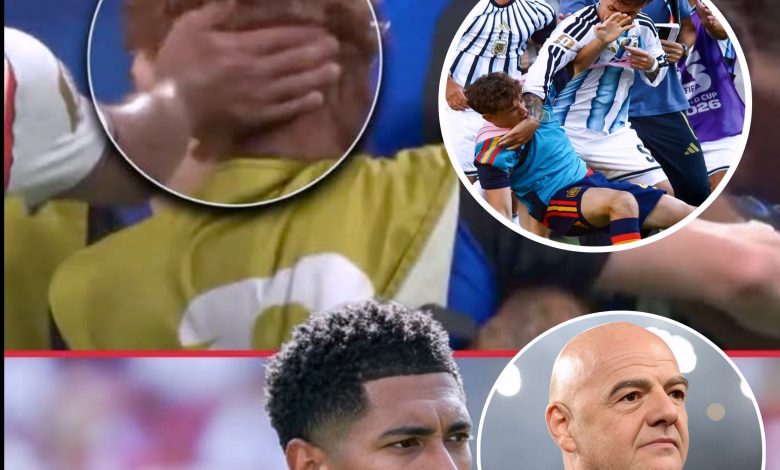
The 2026 FIFA World Cup delivered drama, heartbreak, and ultimately a Spanish triumph, but its closing chapters were stained by two high-profile post-match confrontations that forced football’s governing body into damage-control mode. Jude Bellingham’s slap of Argentina substitute Valentín Barco after England’s semi-final exit and the chaotic brawl involving Leandro Paredes, Gavi, and Eric García after the final combined to create a narrative of simmering tensions boiling over. Viral clips, heated debates about sportsmanship, and FIFA’s decision to appoint a disciplinary prosecutor painted a picture of a tournament where elite competition’s emotional intensity repeatedly spilled beyond the final whistle.
These were not isolated flashes of temper. They reflected deeper currents running through Argentina’s title defence, England’s painful near-miss, and Spain’s hard-fought victory. As investigations continued into late July 2026, the incidents raised familiar questions about where passion ends and misconduct begins, how governing bodies respond under the spotlight, and whether retrospective justice can ever fully restore the image of the game.
The semi-final flashpoint: Bellingham and Barco
England’s 2-1 semi-final defeat to Argentina in Atlanta was already a gut punch. Anthony Gordon’s second-half goal had given Thomas Tuchel’s side the lead. Then, late drama: Enzo Fernández equalised in the 85th minute and Lautaro Martínez struck the winner in stoppage time. Argentina, the defending champions, were through to the final. England were left to contemplate a third-place match most players would rather forget.
What followed on the pitch became the story. Unused substitute Valentín Barco, a 21-year-old former Brighton and Chelsea prospect then at Strasbourg, had already drawn attention. After Fernández’s equaliser he raced onto the field and celebrated aggressively in front of England players rather than joining the bulk of his teammates near the corner flag. John Stones shoved him away. Former England goalkeeper Paul Robinson, on commentary, called it “probably the worst example of sportsmanship we’ve seen at this World Cup.”
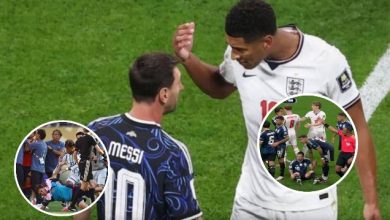
At the final whistle, as Argentina players celebrated and England processed elimination, Bellingham approached a group that included Barco. Footage showed the Real Madrid midfielder delivering a slap to the back of Barco’s head. A brief melee ensued. Players from both sides intervened. Nicolás Otamendi helped separate the pair. Bellingham was ushered away.
Context emerged quickly. Additional clips suggested Barco had provoked England players earlier and may have directed a comment in Spanish toward Bellingham after the whistle—words the Spanish-speaking England star understood. Reports described two provocations: the on-pitch celebration after the equaliser and a verbal jab afterward. Bellingham, already frustrated by the result and earlier physical challenges, reacted physically.
Under the Laws of the Game, deliberately striking an opponent on the head or face can constitute violent conduct unless the force is negligible. The slap appeared more petulant than brutal. Match officials took no on-field action. FIFA’s disciplinary committee retained the power to review it retrospectively. Speculation swirled about a possible ban for the third-place match against France, though many observers expected leniency given the force involved and the emotional circumstances. No immediate suspension materialised in the days that followed.
The incident fit a broader pattern of Bellingham’s competitive edge. The 23-year-old had already been involved in earlier tournament debates, including a mouth-covering gesture against Ghana that escaped sanction under the new “Vinicius Law” aimed at preventing hidden discriminatory language—unlike Paraguay’s Miguel Almirón, who was sent off for a similar action. Critics cried double standards; FIFA maintained the contexts differed. The Barco slap added another layer to discussions about star players, selective enforcement, and the fine line between fire and recklessness.
The final erupts: Paredes, García, and Gavi
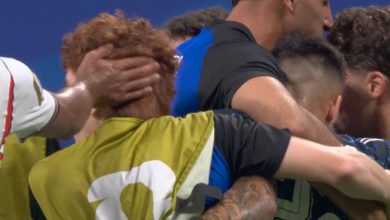
Four days later the stakes were higher. Spain defeated Argentina 1-0 after extra time in the final at MetLife Stadium, Ferran Torres scoring the winner. Argentina finished with ten men after Enzo Fernández’s second yellow in stoppage time of normal time. When the whistle blew, Spanish substitutes and staff flooded the pitch. What should have been pure celebration turned ugly.
Accounts and footage indicated the spark involved Nahuel Molina making contact with Spain captain Rodri as the midfielder celebrated. Eric García moved to intervene. Leandro Paredes, the veteran Boca Juniors midfielder who had come on at half-time, escalated dramatically. He grabbed García by the throat and forced him down. Unused substitute Gavi stepped in to defend his teammate. Paredes shoved Gavi, putting a hand in his face and sending the Barcelona midfielder to the turf. Thiago Almada was also involved in the scramble. Argentina coach Lionel Scaloni and staff tried to calm matters. Referee Slavko Vinčić and officials worked to separate the groups.
Initial match information systems briefly listed a red card for Paredes. FIFA later clarified this was an administrative error; no on-field sending-off had been issued after the whistle, and no automatic suspension applied. The governing body moved swiftly on another front. On Monday after the final it announced that, following review of match reports and in line with Article 36 of the FIFA Disciplinary Code, the Disciplinary Committee had appointed a Disciplinary and Ethics Prosecutor to investigate potential breaches related to the post-match incidents. Further details would follow the prosecutor’s report.
Gavi’s subsequent comments surprised many. Speaking to Spanish media, the young midfielder said he did not believe Paredes should be suspended. “I understand it’s not a good image for children, but I think there’s also that side to football, which is a bit more physical, more aggressive. The most logical thing would have been to send him off during the match, and that’s it. In the end, I think it’s all football, and it has to be that way.” Other reports noted additional involvement from Argentina staff, including assistant Roberto Ayala’s apparent clash with Dani Olmo.
The scenes drew widespread criticism. Argentina had already faced questions about aggressive play throughout the tournament. The final brawl reinforced perceptions of sore-loser behaviour after the defending champions fell short of a second consecutive title. Spain’s players largely focused on their achievement, though the images of Gavi on the ground and García being grabbed lingered.
FIFA under pressure: Statements, investigations, and the question of punishment
FIFA faced dual headaches. The Bellingham-Barco incident generated immediate viral outrage and calls for retrospective action. The final brawl, occurring on the biggest stage, demanded a formal response. The appointment of a prosecutor signalled seriousness. Under the Disciplinary Code, violent conduct can carry a minimum three-match suspension; assault (punching, kicking, grabbing by the throat) can trigger similar or longer bans. Fines and sanctions against the Argentine Football Association remained possible.
By late July 2026, no final punishments for either the slap or the brawl had been publicly detailed in available reports. Investigations take time: video review, match commissioner reports, player statements, and due process. FIFA has shown willingness to act retrospectively in other cases while also demonstrating flexibility—most controversially in suspending Folarin Balogun’s red-card ban earlier in the tournament after high-level intervention. Consistency remains a perennial criticism.
The “emergency statement” framing in some headlines captured the sense of urgency. FIFA’s actual communications were measured: confirmation of the prosecutor’s appointment for the final incidents and earlier acknowledgements that the Bellingham matter could be reviewed. The combination of two Argentina-related flashpoints—one in the semi-final against England, one in the final against Spain—amplified the narrative that the Albiceleste’s competitive intensity had crossed into unacceptable territory after the whistle.
Passion, provocation, and the modern game
High-stakes football has always produced heated moments. The 2026 incidents fit a continuum that includes previous World Cup melees, club rivalries that spill over, and individual flashpoints involving stars. What has changed is the speed and reach of footage. Every slap, shove, and throat grab is immediately global. Social media amplifies outrage, context is often secondary, and governing bodies feel pressure to respond visibly.
Barco’s celebrations and possible verbal provocation do not justify a slap, just as Molina’s initial contact or any perceived Spanish taunting would not justify Paredes’ reaction. Gavi’s defence of physicality in football acknowledges a truth many players accept: the game contains aggression. Yet the post-whistle setting removes the contest for the ball and places actions under different scrutiny. Children watch. Sponsors watch. FIFA’s brand as the guardian of the global game is at stake.
Player profiles add texture. Bellingham is a generational talent whose intensity is both asset and liability. Paredes is a combative midfielder with a history of disciplinary issues. Gavi, still young, has himself been involved in physical battles. García is a solid professional. These are not cartoon villains or saints; they are elite athletes operating at peak emotional and physical stress after months of preparation and the pressure of a World Cup.
Argentina’s path added layers. As defending champions they carried the burden of expectation. Their style under Scaloni has often been pragmatic and robust. Reaching the final again was an achievement; losing it in extra time after a late red card was devastating. England’s semi-final collapse after leading late was equally crushing. Spain’s victory was hard-earned and historic—their second World Cup after 2010. The brawl threatened to overshadow the crowning of new champions.
Broader implications and precedents
Retrospective bans can affect club careers and national team availability in upcoming windows. A multi-match suspension for Paredes would impact Argentina’s September fixtures. Any sanction on Bellingham, even if limited, would have been felt by England and Real Madrid. Association fines send signals about collective responsibility for player behaviour.
Past World Cups offer parallels: post-match scuffles, political gestures (FIFA was also examining Argentina’s earlier Malvinas banner), and debates over enforcement. The introduction of stricter rules around discriminatory language showed FIFA’s willingness to innovate. Applying similar consistency to physical post-match misconduct is the current test.
Critics argue that star power influences outcomes. High-profile players sometimes receive more leeway; others become examples. Transparency in the prosecutor’s eventual findings will matter. Publishing reasoned decisions, as FIFA does periodically for disciplinary cases, helps build trust even when the results are contested.
The lasting image of 2026
The 2026 World Cup will be remembered for Spain’s triumph, standout individual performances, and the drama of late goals and extra-time winners. It will also be remembered for the images of Bellingham’s hand connecting with Barco’s head and Paredes’ hands around García’s throat while Gavi hit the turf. Those clips became shorthand for the tournament’s darker emotional undercurrents.
FIFA’s investigation into the final incidents, the ongoing possibility of action over the semi-final slap, and the public debate they generated underscore a simple reality: the final whistle does not always end the contest. Emotions linger. Provocations land. Responses can cross lines. Governing bodies must then decide how firmly to draw those lines when the world is watching.
Football’s beauty has always included its capacity for high drama and raw feeling. Preserving that intensity while protecting the game’s integrity and image remains an unresolved tension. The events of July 2026—Bellingham’s slap, Paredes’ fight with Gavi and García, and FIFA’s subsequent moves—did not invent the problem. They simply made it impossible to ignore. As the prosecutor’s work continues and any official punishments eventually emerge, the conversation about where competitive fire becomes unacceptable conduct will continue long after the trophy has been lifted and the stadiums emptied.
In the end, the players involved will move on to club seasons and future international windows. The footage will remain. And FIFA’s handling of these cases will form part of the institutional record of a World Cup that delivered both glory and an uncomfortable reminder of how quickly the beautiful game can turn ugly when the stakes are highest and the emotions rawest.