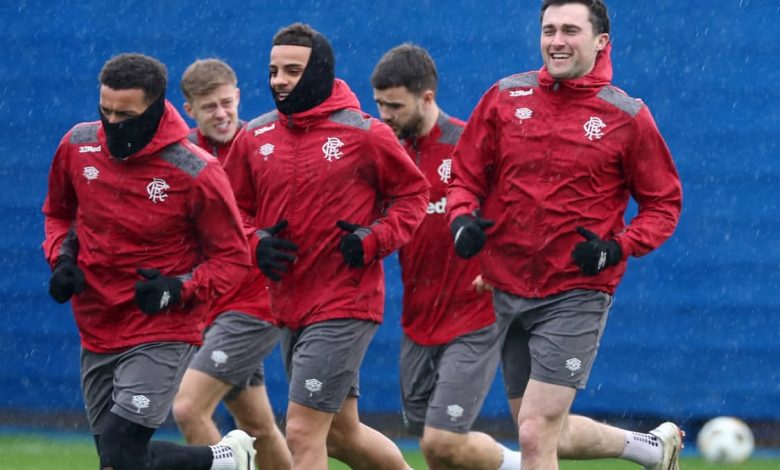
Rangers Star Falls Seriously Ill During Training – Ruled Out for Aberdeen Clash
Rangers’ preparations for a crucial Scottish Premiership encounter against Aberdeen have been significantly disrupted after one of their key attacking options, Andreas Skov Olsen, was struck down by illness during the final week of training.
The Danish international, who has quickly become an important component in manager Danny Röhl’s evolving system at Ibrox, is now highly unlikely to feature in the clash with the Dons. The timing could hardly be worse for a Rangers side attempting to maintain momentum in a tightly contested domestic campaign.
This latest setback adds to a growing list of fitness concerns within the squad, forcing Röhl into a tactical rethink ahead of what is shaping up to be a defining fixture in their season.
⸻
Illness Strikes at the Worst Possible Moment
The news emerged following Röhl’s pre-match press briefing, where he confirmed that Skov Olsen had missed the entirety of the week’s training schedule due to illness. The manager admitted uncertainty over whether the winger would recover in time to make the matchday squad, effectively ruling him out of serious contention.
Reports indicate that the player has been sidelined for five consecutive days, a period long enough to significantly impact match readiness even if symptoms subside before kick-off. 
From a performance perspective, this is not a minor disruption. In modern elite football, particularly within high-intensity systems like Röhl’s, missing even two or three days of tactical preparation can compromise a player’s ability to execute pressing triggers, positional rotations, and coordinated attacking patterns. Five days effectively resets that rhythm.
For Rangers, the absence of Skov Olsen is not simply about losing a name on the teamsheet—it removes a key tactical profile.
⸻
Tactical Importance of Skov Olsen in Röhl’s System
Since arriving in Glasgow, Skov Olsen has been utilised primarily as a right-sided attacker in a fluid front structure, often alternating between:
• A traditional winger role in a 4-2-3-1
• A narrow forward in a 4-2-2-2 shape
• An inside forward drifting into half-spaces to support central overloads
This versatility is critical to Röhl’s approach, which leans heavily on positional interchange and vertical transitions.
While official Opta metrics for this specific match cycle are not publicly disclosed, broader performance trends show that wide forwards in similar systems contribute heavily to:
• Final-third entries
• Progressive carries
• Shot-creating actions
In Skov Olsen’s case, his ability to stretch defensive lines horizontally allows Rangers to create central pockets for midfield runners such as Mohamed Diomande.
Without that width, Rangers risk becoming predictable—forced into central congestion where Aberdeen are typically compact and disciplined.
⸻
Selection Headache: A Growing Injury List
Skov Olsen is not the only concern. Röhl also confirmed that multiple first-team players are dealing with fitness issues, compounding the selection dilemma.
Among those affected:
• Mikey Moore – dealing with minor problems
• Tuur Rommens – also struggling with a knock
• Mohamed Diomande – recently returned to training but lacks match sharpness
There are even suggestions that as many as six players could miss the Aberdeen fixture, forcing potential structural adjustments. 
From a squad management standpoint, this is where depth is tested—not just numerically, but tactically.
⸻
Röhl’s System Under Pressure
Röhl’s tenure at Rangers has been defined by a commitment to structured pressing and rapid vertical play—principles heavily influenced by his background within the Red Bull football model.
However, such systems are notoriously fragile under injury pressure.
When key wide players are unavailable:
• Pressing traps become less effective
• Counter-pressing intensity drops
• Attacking transitions lose speed and width
In practical terms, this may force Röhl to:
1. Shift to a narrower attacking shape
2. Deploy less natural wide players in unfamiliar roles
3. Reduce pressing intensity to conserve energy across a depleted squad
Each of these compromises carries risk—especially against an Aberdeen side that has historically thrived on exploiting transitional spaces.
⸻
Aberdeen’s Opportunity
From an Aberdeen perspective, this development significantly alters the competitive balance.
Players like Jamie McGrath—who has previously delivered decisive moments against Rangers—will likely view this as an opportunity to exploit weakened defensive and transitional structures.
Aberdeen’s approach typically revolves around:
• Compact defensive blocks
• Quick vertical transitions
• Targeting wide defensive gaps
Without Skov Olsen’s defensive work rate and positional discipline, Rangers may be more vulnerable in these channels.
⸻
UK Football Context: Why This Matters
From a UK football analysis standpoint, this situation reflects a broader pattern seen across British football in recent seasons—the increasing impact of short-term illness and fitness disruptions on match outcomes.
Unlike long-term injuries, illnesses:
• Provide minimal preparation time for tactical adjustments
• Often affect multiple players simultaneously
• Disrupt training continuity across the entire squad
We have seen similar scenarios in the Premier League, where even minor illness outbreaks have forced late lineup changes and altered match dynamics.
For Rangers, operating within the intense scrutiny of Scottish football—with constant comparison to Celtic and pressure to maintain consistency—such disruptions can have disproportionate consequences.
⸻
African Influence: Diomande’s Potential Role
Interestingly, the absence of Skov Olsen could elevate the importance of Mohamed Diomande, one of the club’s key African talents.
Although he is only just returning to training, Diomande represents a different type of midfield profile:
• Progressive ball carrier
• Press-resistant under pressure
• Capable of breaking lines through dribbling
If fit enough to feature—even from the bench—he could become a crucial outlet in transitions, particularly if Rangers struggle to generate width.
This aligns with a broader trend in UK football, where African midfielders are increasingly valued for their athleticism, technical security, and transitional impact.
⸻
Historical Context: Illness and Rangers Disruptions
This is not the first time Rangers have seen their season disrupted by unexpected health issues.
Historically, the club has dealt with similar scenarios:
• Chris Burke missed significant time due to illness early in his career
• Goalkeeper Jack Butland previously suffered a serious medical issue that sidelined him for key fixtures 
These incidents underline a key reality: health-related absences often have ripple effects beyond the individual player, impacting team cohesion and tactical stability.
⸻
Tactical Adjustments: What to Expect Against Aberdeen
Given the current situation, several tactical adaptations are likely:
1. Wider Role for Alternative Attackers
Players such as Djeidi Gassama or Oliver Antman could be deployed to replicate Skov Olsen’s width, though neither offers identical qualities.
2. Increased Responsibility on Full-Backs
With reduced natural width in attack, full-backs will likely be asked to:
• Provide overlapping runs
• Deliver crosses into the box
• Maintain defensive balance
3. Central Overloads
Röhl may attempt to compensate by overloading central areas, relying on quick combinations rather than wide progression.
⸻
The Psychological Factor
Beyond tactics, there is also a psychological dimension.
Late injury or illness news can:
• Disrupt player focus
• Alter pre-match routines
• Increase pressure on replacements
For a Rangers squad already managing expectations, maintaining composure will be essential.
⸻
Conclusion: A Defining Test of Squad Depth
The illness of Andreas Skov Olsen may appear, on the surface, as a routine pre-match setback. In reality, it represents a significant tactical and psychological challenge for Rangers at a critical stage of the season.
With multiple players unavailable and system integrity under strain, this Aberdeen clash becomes more than just another league fixture—it is a test of:
• Squad depth
• Tactical flexibility
• Managerial adaptability
For Röhl, the coming 90 minutes will offer a clear indication of how resilient his Rangers side truly is.
And in a season where margins are increasingly fine, the absence of a single key player—particularly one as tactically important as Skov Olsen—could prove decisive.