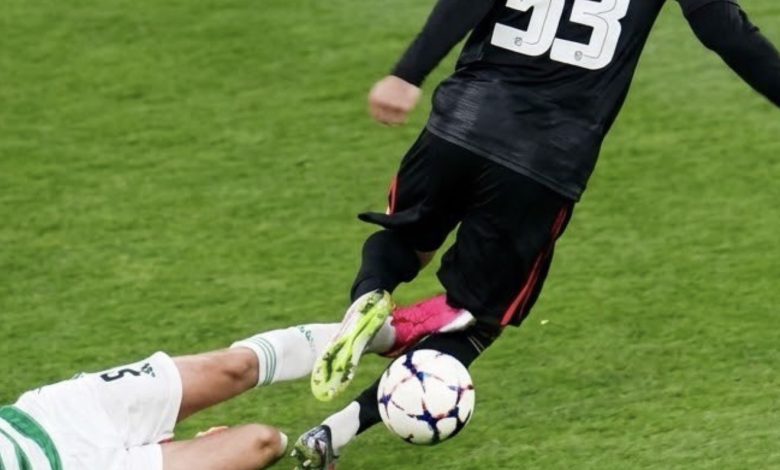
UEFA Explains Why Benjamin Nygren Escaped Red Card Against Beşiktaş After Controversial Challenge
Benjamin Nygren’s challenge on Beşiktaş defender Emirhan Topçu has become one of the major talking points following Celtic’s dramatic 3-2 victory in the UEFA Europa League.
The incident occurred during Thursday night’s meeting at Celtic Park, where Martin O’Neill’s side produced a memorable comeback to claim their first three points in the competition.
However, despite Celtic supporters celebrating the victory, the controversial challenge involving Nygren attracted considerable attention, particularly among Beşiktaş supporters, who believed the Celtic midfielder should have been sent off.
The Swedish midfielder was shown a yellow card after the challenge, but that decision did not satisfy the Turkish side.
Beşiktaş players immediately protested to referee Sascha Stegemann, insisting that the nature of the challenge deserved a much stronger punishment.
The photograph of the incident has since circulated among supporters, with many questioning how Nygren remained on the pitch.
What actually happened during the challenge?
Nygren found himself in possession inside the Beşiktaş penalty area but took a heavy touch, allowing Topçu an opportunity to intervene.
As the Beşiktaş defender attempted to challenge for the ball, Nygren stretched into the challenge, making contact with his opponent.
Topçu went to ground, and Beşiktaş players immediately surrounded the referee, demanding a red card.
Stegemann, however, decided that a yellow card was sufficient punishment.
According to the match reports, the decision was made on the pitch and the booking remained unchanged. Celts Are Here +1
Why wasn’t Nygren sent off?
This is where the Laws of the Game become important.
Under the IFAB Laws of the Game, a player can be sent off for serious foul play when challenging an opponent for the ball using excessive force or endangering the safety of an opponent.
However, not every dangerous-looking challenge automatically qualifies as a red-card offence.
The referee must consider several factors, including:
- The intensity and force of the challenge.
- Whether the player endangered the safety of his opponent.
- The nature of the contact.
- Whether the challenge involved excessive force or brutality.
A yellow card can therefore be issued when the referee considers the offence reckless rather than serious foul play.
In Nygren’s case, referee Sascha Stegemann judged the challenge to be worthy of a booking rather than a sending-off.
VAR was also available during the match, with Benjamin Brand serving as the video assistant referee and Patrick Hanslbauer as his assistant.
Potential straight-red-card incidents fall within VAR’s remit. However, VAR intervention requires the relevant threshold to be met, including a clear and obvious error or a serious missed incident.
There was no intervention to upgrade Nygren’s yellow card to a red. Celts Are Here +1
An important clarification: There is no independently verified public UEFA statement confirming that UEFA formally responded to Beşiktaş or issued an official explanation specifically about this incident. The available reporting establishes that the referee booked Nygren and VAR did not intervene. It would therefore be misleading to present the referee’s decision as a confirmed UEFA disciplinary statement.
Beşiktaş supporters were furious
The decision has naturally generated debate among supporters of both clubs.
For Beşiktaş fans, the biggest frustration is that they believe their player was exposed to a dangerous challenge without the opposition player receiving the maximum punishment.
Some supporters have questioned whether the referee would have made the same decision had the incident involved a different player or happened in another area of the pitch.
Celtic supporters, meanwhile, can point to the fact that the referee saw the incident and made his decision, with VAR not identifying grounds for intervention.
Nevertheless, the debate demonstrates how difficult disciplinary decisions can become when a match involves two teams fighting for important European points.
Celtic went on to produce a remarkable comeback
Interestingly, the controversial incident happened during a particularly important period of the contest.
Beşiktaş had taken the lead through Junior Olaitan after he converted a rebound from his saved penalty.
Celtic were struggling to find a way back into the match, and the Turkish visitors appeared to be in a strong position.
However, Martin O’Neill’s substitutions completely changed the direction of the evening.
Callum Osmand came off the bench and scored to bring Celtic level, while Camilo Durán subsequently put the Scottish side ahead.
Orkun Kökçü later equalised for Beşiktaş, but Durán struck again to secure a dramatic 3-2 victory for Celtic.
It was a result that gave O’Neill’s team their first points in the Europa League campaign. TNT Sports +1
The final verdict: Was a yellow card enough?
There is no doubt that the challenge has generated a serious debate, particularly because of the nature of the contact visible in the photograph.
However, the important question is not simply whether the tackle looked dangerous.
It is whether the contact met the legal threshold for serious foul play and whether the referee’s decision was sufficiently wrong to justify VAR intervention.
Stegemann opted for a yellow card, and VAR allowed that decision to stand.
For Beşiktaş, that will remain a frustrating moment in a match they eventually lost. For Celtic, Nygren remaining on the pitch meant they avoided losing another player during an already difficult European encounter.
What do you think?
Was Benjamin Nygren lucky to escape with just a yellow card, or did the referee make the correct decision?
Should VAR have intervened?
Sources: Celts Are Here – Nygren red-card controversy · Duhuliye – Beşiktaş reaction · UEFA match officials · Sky Sports match report.