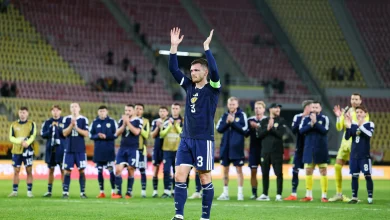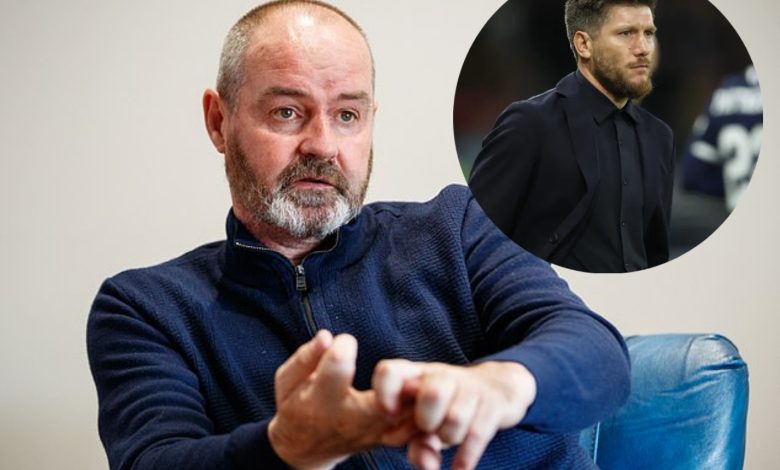
Sébastien Pocognoli’s difficult first night at Hampden Park has put the spotlight firmly back on his predecessor Steve Clarke, with the message Clarke gave Scotland’s new manager before his reign began now taking on added significance.
Pocognoli suffered his first defeat as Scotland head coach on Tuesday night as Switzerland ran out 3-0 winners in Glasgow, leaving the Belgian manager still waiting for his first victory after taking over from Clarke.
But before Pocognoli had even taken charge of his first competitive match, he revealed that he had spoken to Clarke on the phone — and the former Scotland boss left him with a message of support.
Now, following Scotland’s painful defeat to Switzerland, those words have resurfaced.
Clarke made contact with his successor
Clarke’s seven-year spell in charge of Scotland came to an end following the national team’s exit from the 2026 World Cup, with Pocognoli subsequently appointed as his replacement.
The Belgian did not inherit an easy situation.
He arrived with Scotland preparing for a new Nations League campaign and immediately began making significant changes to the squad, including bringing several younger and uncapped players into the setup.
Before his first match, Pocognoli revealed that he had spoken with Clarke and described the conversation as a positive experience.
“He was very kind, very… humble,” Pocognoli said of Clarke, explaining that the former manager wanted him to know that he was behind the team.
Clarke also told Pocognoli that he had been happy during his time in the job but felt that it was the right moment for him to leave. He then wished his successor all the best.
For Pocognoli, the conversation provided an important link between the previous Scotland regime and the new era.
He also made it clear that he wanted to build on what had already been achieved rather than simply dismiss everything that came before him.
“I will try to be as successful as the previous staff because we want to play in a big tournament,” Pocognoli said.
But the Switzerland defeat has changed the mood
Pocognoli’s first two competitive matches have now produced a goalless draw against Slovenia followed by a 3-0 defeat to Switzerland.
The result against Switzerland was particularly painful because Scotland’s evening effectively unravelled inside the opening 15 minutes.
Jack Hendry was shown a red card after bringing down Dan Ndoye, with the referee initially awarding a penalty before VAR determined that the offence had occurred outside the penalty area.
Ricardo Rodríguez then stepped up and fired the resulting free-kick into the net.
Scotland were forced to play with 10 men for almost 80 minutes and struggled to cope with Switzerland’s quality.
Nico Elvedi doubled the visitors’ advantage early in the second half before Zeki Amdouni completed the scoring in the closing stages.
The Scottish FA’s official match report confirms the final score as Scotland 0-3 Switzerland, with Rodríguez, Elvedi and Amdouni all finding the net.
For Pocognoli, it was a brutal introduction to life at Hampden.
Pocognoli refused to blame his players
Despite the heavy defeat, the new Scotland boss did not turn on his players.
Instead, he highlighted their response after being reduced to 10 men and insisted that the team had shown the attitude he wanted to see.
“It was a frustrating night,” Pocognoli said after the match.
He acknowledged that the early red card created the worst possible scenario, but praised the players for continuing to fight.
Pocognoli said he had watched their attitude closely and believed they had stuck together rather than allowing the situation to completely destroy their performance.
He also described the red card as something the entire team had to take responsibility for.
“The red card of Jack is all of our red card. We stay together,” he said, according to reports.
That response could become an important part of Pocognoli’s early tenure.
Before taking charge, the Belgian had spoken about wanting Scotland to become a team that attacks together, presses aggressively and defends collectively.
Against Switzerland, circumstances made that extremely difficult.
The Clarke comparison is already unavoidable
The defeat has inevitably brought comparisons with the Clarke era.
Clarke left Scotland after seven years in charge, during which he guided the country to major tournaments and established a period of relative continuity around the national team.
Pocognoli was brought in to begin a new chapter.
That means every difficult result during his early months in charge is likely to be viewed against what came before.
The Guardian noted after Tuesday’s defeat that Scotland still displayed some of the longstanding problems associated with the national team, while also stressing that judging Pocognoli after a match in which Scotland played almost 80 minutes with 10 men requires context.
That is where Clarke’s message to Pocognoli becomes particularly interesting.
The former manager did not reportedly offer criticism or attempt to distance himself from the team.
Instead, he told his successor that he was behind Scotland and wished him well.
Pocognoli knows the pressure is already building
The new manager had already acknowledged before the Nations League campaign that taking charge of Scotland would bring enormous responsibility.
He described his nerves before his first match as “positive nervousness” and spoke about his excitement at becoming Scotland head coach.
He also admitted that introducing a new tactical approach would take time.
Pocognoli has stressed the importance of aggressive pressing, quick transitions and collective defending, but he also recognised that results ultimately matter.
That reality has arrived immediately.
Scotland have now played two Nations League matches without scoring and have collected just one point.
Their next opportunity to respond comes away to North Macedonia on Saturday.
Pocognoli therefore has very little time to dwell on the Hampden defeat.
And Clarke’s message could take on a different meaning
When Pocognoli revealed his conversation with Clarke before his first game, it appeared to be little more than a respectful handover between two managers.
Now, after a difficult start, the words have taken on a different significance.
Clarke’s reported message was not a warning, criticism or public challenge.
It was support.
He reportedly wanted Pocognoli to know that he was behind the team and wished him all the best as he attempted to take Scotland forward.
That makes the situation particularly intriguing because Pocognoli now has to prove that the new era can produce results while dealing with the inevitable comparisons to the man he replaced.
And after a 3-0 defeat in his first Hampden match, the pressure will only increase.
Scotland have to respond quickly
There is no time for Pocognoli to feel sorry for himself.
The Nations League schedule has handed Scotland another immediate test, with North Macedonia next on the agenda.
The Belgian manager will now have to work out how to restore confidence, improve Scotland’s attacking threat and ensure Tuesday’s collapse does not become the beginning of a damaging run.
Pocognoli has already insisted that the experience against Switzerland needs to become part of the team’s “DNA” and ultimately make them stronger.
That is the challenge facing him now.
The defeat was unquestionably painful, but the response over the next few matches will determine how quickly Pocognoli can establish his own identity.
And somewhere in the background is Clarke’s message — the outgoing manager telling his successor that he was behind Scotland and wishing him well.
For now, Pocognoli’s task is simple: turn those words of support into a new beginning for the national team.