THOMAS TUCHEL TRAINING CAMP INCIDENT SPARKS CONTROVERSY AFTER ‘SLAP JOKE’ MISFIRES – PLAYERS STEP IN TO DEFUSE TENSION

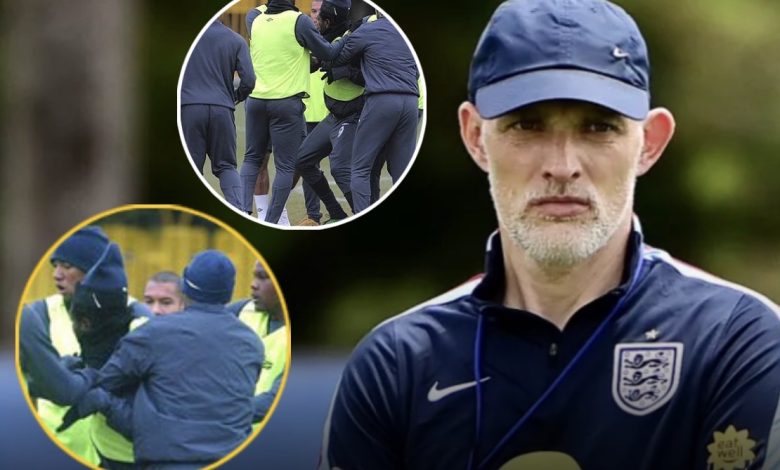
Reports emerging from England’s national team training camp have triggered widespread debate after a viral clip allegedly showed manager Thomas Tuchel involved in a misunderstood “slap joke” with a 26-year-old England attacker, leading to a brief but tense confrontation that required senior players to intervene.
While the footage remains unverified in full context, it has already spread rapidly across social media platforms, dividing opinion among fans, pundits, and former professionals. Some describe it as harmless banter that went wrong, while others believe it reflects deeper concerns about boundaries, respect, and authority within elite football environments.
What is clear, however, is that the moment has placed renewed scrutiny on England’s camp atmosphere ahead of a crucial international window, with questions being asked about leadership style, player-manager relationships, and dressing room control.
THE INCIDENT THAT WENT VIRAL
According to multiple social media uploads circulating online, the incident occurred during what appeared to be a light-hearted training session at England’s preparation camp.
The clip allegedly shows Tuchel engaging in what was described by observers as a “playful slap gesture” directed at one of the squad’s 26-year-old attacking players, whose identity has not been officially confirmed by the England setup.
At first glance, the interaction appears casual—typical of the relaxed exchanges often seen in training environments where managers and players joke during downtime. However, the situation reportedly escalated when the attacker misinterpreted the gesture as disrespectful or excessive physical contact.
Eyewitness-style accounts on social platforms claim the player immediately reacted angrily, stepping away and voicing his displeasure. Within seconds, teammates allegedly moved in to calm the situation, preventing it from developing into a more serious confrontation.
The video ends abruptly, leaving much of the context unclear and fueling speculation across football communities.
HOW THE SITUATION ESCALATED
Sources close to online commentary suggest that the misunderstanding stemmed from differences in perception between competitive banter and professional boundaries.
In elite football environments, managers often use humour, physical gestures, or motivational techniques to build rapport. However, such interactions can sometimes be misread, particularly in high-pressure international camps where players are sensitive to respect and hierarchy.
In this case, the “slap joke” was reportedly intended as light-hearted encouragement or teasing following a training drill. But the attacker—described as a senior Premier League forward in his mid-20s—may have interpreted it as unnecessary or humiliating in front of teammates.
Once the reaction escalated, several senior squad members allegedly stepped in quickly, separating the individuals involved and ensuring the moment did not spiral into a prolonged dispute.
No official disciplinary action has been reported, and the England camp has not released a formal statement addressing the incident.
DRESSING ROOM DYNAMICS UNDER THE SPOTLIGHT
Incidents like this, even when minor or misunderstood, often become magnified due to the intense scrutiny surrounding international football teams.
Tuchel, known for his demanding tactical discipline and emotional intensity on the touchline, has previously been described as a manager who blends strong authority with personal engagement. His approach has delivered success at club level, but also occasionally sparked debate about player relationships.
Within the context of this incident, analysts have been quick to question whether his communication style may require adjustment in a national team environment, where players gather less frequently and group chemistry must be built quickly.
Former professionals have often noted that international camps differ significantly from club settings:
- Limited time together increases sensitivity
- Hierarchy is less established
- Players arrive with club loyalties and egos intact
- Misinterpretations happen more easily
In such an environment, even a seemingly harmless joke can take on unintended meaning.
PLAYER RESPONSE AND QUICK INTERVENTION
What prevented the situation from escalating further, according to circulating accounts, was the swift intervention of senior players within the squad.
Teammates reportedly moved quickly to calm both sides, encouraging dialogue and de-escalation. This intervention is being viewed positively by many observers, who argue it demonstrates leadership within the squad.
Rather than allowing division to form, the players allegedly ensured the situation remained contained and temporary.
This kind of internal crisis management is often seen as a sign of maturity within elite teams, particularly in tournament settings where unity is essential.
However, critics argue that the incident itself should not have occurred in the first place, suggesting it highlights a potential mismatch in communication styles between management and players.
SOCIAL MEDIA REACTION: DIVIDED OPINION
As expected, the viral nature of the clip has led to sharply divided reactions online.
SUPPORTERS OF TUCHEL’S APPROACH
A section of fans defended the manager, arguing that modern football has become overly sensitive and that such interactions are common in elite dressing rooms.
Many pointed out that managers often use humour and physical gestures to build camaraderie, and that the incident is being blown out of proportion due to social media amplification.
Some comments suggested:
- “It’s just banter gone wrong, nothing serious.”
- “Players and managers interact like this all the time.”
- “People are overreacting because it’s Tuchel.”
CRITICS OF THE INCIDENT
On the other hand, critics believe the situation highlights a deeper issue regarding boundaries between authority figures and players.
They argue that even light physical contact from a manager can be misinterpreted, especially in a high-pressure elite environment.
Some fans expressed concern that:
- Respect lines may have been crossed
- The player’s reaction suggests discomfort
- Such incidents can damage trust within the squad
A few pundits also questioned whether such behaviour would be acceptable in modern elite sports culture, where professionalism and personal space are increasingly emphasised.
NIGERIAN AND AFRICAN FAN PERSPECTIVE
Across Nigerian football communities online, reactions have also been lively. Many fans viewed the incident through a cultural lens, comparing it to common dressing room banter seen in African football environments, where physical humour is often more openly accepted.
Some Nigerian supporters argued that the reaction from the player may be exaggerated, suggesting that in many locker rooms across Africa, similar gestures would not even be noticed.
Others, however, took a more balanced view, noting that elite European environments operate under different expectations and that misunderstandings are inevitable when cultural norms differ.
This global split in interpretation has only intensified the debate, making the incident trend across multiple regions.
WHAT THIS MEANS FOR ENGLAND’S CAMPAIGN
Beyond the viral drama, the bigger concern for England is whether the incident could affect squad unity going forward.
While no long-term fallout has been confirmed, moments like these can sometimes linger if not addressed properly. Team chemistry is often cited as one of the most important factors in international tournaments, where margins between success and failure are extremely small.
Key questions now being asked include:
- Will the manager clarify his intentions to the squad?
- Has trust been affected, even slightly?
- Will players feel more cautious in interactions going forward?
Football history is filled with examples of minor training ground misunderstandings becoming exaggerated narratives when teams struggle in matches. Conversely, successful teams often use such incidents as bonding moments that ultimately strengthen unity.
ANALYSIS: A MISUNDERSTANDING, NOT A MAJOR CRISIS
From a broader perspective, most analysts agree that the situation—based on current information—appears to be more of a misunderstanding than a serious disciplinary issue.
In elite football, emotional exchanges are common. Training ground intensity, competitive personalities, and high expectations often lead to brief moments of friction.
What matters most is how quickly such situations are resolved and whether they affect performance on the pitch.
In this case, the rapid intervention of teammates and the absence of any official escalation suggest that the situation was contained effectively.
However, the viral nature of modern media means even minor incidents can take on a life of their own.
CONCLUSION
The alleged “slap joke” incident involving Thomas Tuchel and a 26-year-old England attacker has sparked widespread discussion, but at its core appears to be a classic case of misinterpreted humour in a high-pressure environment.
While social media continues to amplify the moment, the lack of official confirmation or disciplinary response suggests that the England camp is treating it as an internal misunderstanding rather than a serious conflict.
Still, the episode highlights the delicate balance modern managers must maintain between authority, approachability, and cultural sensitivity within elite squads.
As England continue their preparations, attention will now shift away from off-field narratives and back to performance—but the incident will likely remain a talking point in football circles for days to come.