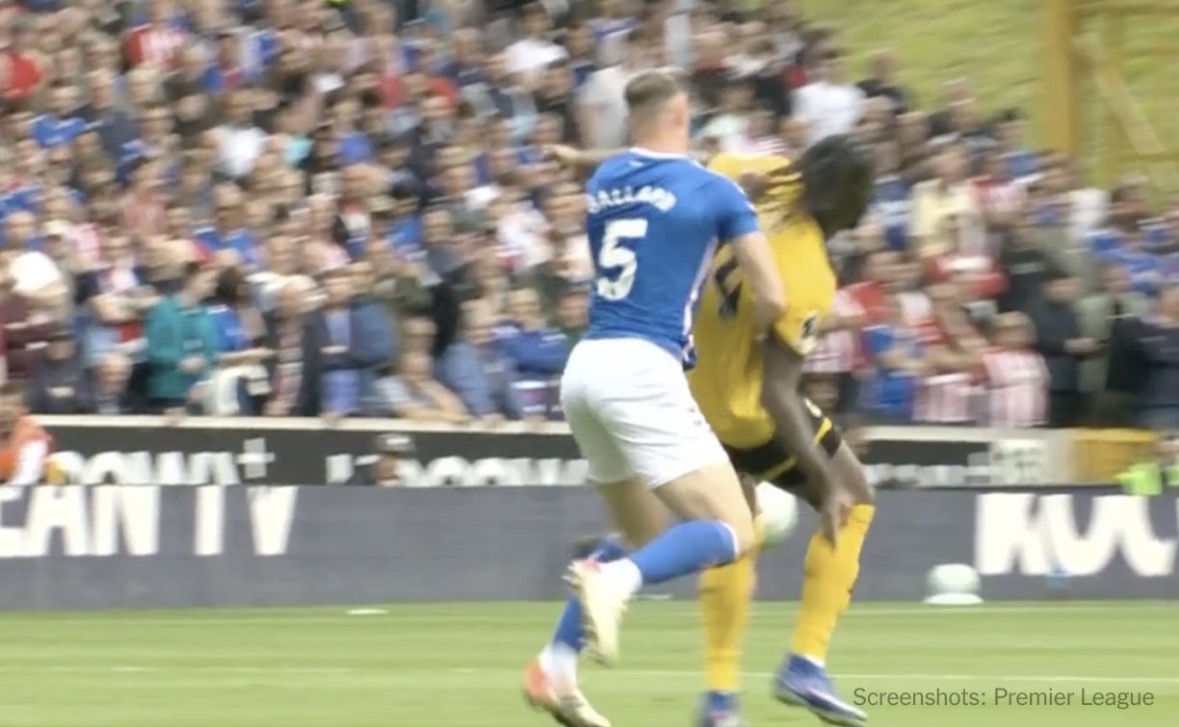
FA Statement Deepens Dan Ballard Controversy After Wolves vs Sunderland Flashpoint
The fallout from the dramatic Premier League clash between Wolverhampton Wanderers and Sunderland AFC has escalated significantly after the The Football Association released a major statement addressing the controversial red card shown to Sunderland defender Dan Ballard.
What initially appeared to be a routine disciplinary decision has now spiraled into one of the most debated refereeing incidents of the 2025/26 Premier League season—particularly because it involved Nigerian international striker Tolu Arokodare, whose involvement has amplified attention across both UK and African football audiences.
With the FA now stepping in, the situation has gone from bad to worse for Ballard, Sunderland, and even the wider conversation around football’s laws.
The Incident That Sparked Chaos
The controversy stems from a pivotal moment in the first half of the match at Molineux. Sunderland had started brightly, taking an early lead, and looked in control. However, everything changed in the 24th minute.
Ballard, engaged in an aerial duel with Arokodare, appeared to pull the striker’s hair—an action that immediately drew attention. The referee initially allowed play to continue but was later instructed to review the incident via VAR.
After consulting the pitchside monitor, the decision was clear: straight red card.
Under current IFAB laws, hair-pulling is classified as violent conduct, regardless of intent. That interpretation left the referee with little room for discretion.
The dismissal forced Sunderland to play with 10 men for over an hour, ultimately contributing to a 1-1 draw—a result that significantly dented their hopes of pushing toward European qualification.
FA Statement: “Zero Tolerance” Approach Confirmed
In the aftermath, the FA released a firm and uncompromising statement reinforcing the decision and doubling down on its stance.
According to the governing body, any act involving pulling an opponent’s hair will continue to be treated as violent conduct, regardless of whether it appears accidental or minimal.
The FA emphasized three key points:
- Player safety and respect remain paramount
- Hair-pulling is viewed similarly to striking or grabbing the face
- Consistency in officiating is critical, especially in the VAR era
This effectively shuts down any hope Sunderland had of appealing the red card or seeking leniency.
Even more damaging for Ballard, reports suggest the FA is reviewing whether additional retrospective punishment could be applied, depending on how the incident is categorized internally.
This has turned what was already a costly red card into a potentially season-defining disciplinary saga.
Why the Punishment Feels “Harsh” to Many
Despite the FA’s firm stance, backlash has been widespread.
Pundits, fans, and even Sunderland’s coaching staff have all questioned whether the punishment fits the offence.
One of the main arguments is intent.
Replays suggested Ballard’s eyes were fixed on the ball during the aerial duel, and the contact with Arokodare’s hair may have been incidental rather than malicious.
Sunderland manager Régis Le Bris admitted the rule had technically been applied correctly—but described it as “hard to accept” given the nature of the incident.
This has sparked a wider debate:
- Should accidental hair contact really be treated the same as violent conduct?
- Is the law too rigid?
- Does VAR remove necessary context from decisions?
Arokodare’s Role and the Nigerian Spotlight
For Nigerian fans, the involvement of Tolu Arokodare has added another layer of intrigue.
The Wolves striker, who has been steadily building his reputation in the Premier League, found himself at the center of controversy—not for his performance, but for his reaction.
Some observers suggested Arokodare may have exaggerated the incident, although there is no official confirmation of simulation.
Still, this is not the first time he has been involved in a similar situation. Earlier in the season, another defender was sent off for pulling his hair—raising questions about whether players with long hair are being unfairly targeted or inadvertently influencing decisions.
For Nigerian audiences, the moment has sparked heated debate online:
- Was Arokodare simply protecting himself?
- Or did he “sell” the foul to ensure punishment?
Either way, his presence has ensured the story resonates far beyond England.
VAR: The Real Villain?
While the red card itself has been debated, many believe the real issue lies with VAR.
Without video review, the incident might have gone unnoticed or been judged less harshly.
Instead, slow-motion replays magnified the contact, leaving officials with a binary decision: red card or nothing.
Critics argue that VAR:
- Removes context from physical duels
- Overemphasizes minor contact
- Forces referees into strict interpretations
This has led to renewed calls for reform, with some suggesting that VAR should only intervene in clear and obvious violent acts, not borderline incidents like this one.
Tactical Impact on the Match
From a footballing perspective, the red card completely altered the game.
Before the dismissal:
- Sunderland were leading
- They controlled possession
- Wolves looked disjointed
After the red card:
- Sunderland dropped deeper
- Wolves gained confidence
- The momentum shifted entirely
Wolves eventually equalized in the second half, capitalizing on their numerical advantage.
It’s not an exaggeration to say the decision decided the outcome of the match.
A Growing Pattern in Modern Football
This incident is not isolated.
Ballard’s dismissal is part of a growing trend in the Premier League, where hair-pulling has led to multiple red cards this season.
Players like Michael Keane and Lisandro Martínez have also been punished for similar offences.
This raises a broader concern:
Football laws may not have fully adapted to modern realities—especially with players increasingly wearing longer hairstyles.
Some pundits have even suggested radical solutions:
- Mandatory hair ties or buns
- Rule changes to downgrade minor hair pulls to yellow cards
- Introducing intent-based judgments
While these ideas may sound extreme, they highlight the level of frustration within the game.
Fan Reactions: Fury, Confusion, and Division
Fan reaction has been explosive.
Across social media, opinions are deeply divided.
Some supporters argue:
“Rules are rules. You pull hair, you go.”
Others strongly disagree:
“That’s never a red card in a million years.”
The controversy has also reignited long-standing frustrations with officiating consistency.
Many fans pointed out that similar incidents involving shirt-pulling or grappling often go unpunished—or at most receive a yellow card.
So why is hair different?
That question remains unanswered.
What Happens Next for Ballard?
For Dan Ballard, the consequences are severe.
At minimum:
- He will serve a suspension
- He misses crucial upcoming matches
- His team’s European hopes take a hit
At worst:
- The FA could extend the suspension
- His reputation could suffer
- Increased scrutiny in future matches
For a defender known for physicality, this incident could force a change in playing style—especially when dealing with players like Arokodare.
The Bigger Picture: A Law Under the Microscope
This controversy has exposed a major flaw in football’s rulebook.
While the law is clear, its application raises serious concerns:
- Should all contact be treated equally?
- Should intent matter more?
- Is VAR making the game too robotic?
The FA’s statement suggests no immediate changes are coming.
But pressure is building.
And if incidents like this continue, reform may become inevitable.
Conclusion
What started as a single moment in a routine Premier League match has evolved into a full-blown controversy involving players, officials, fans, and now the FA itself.
Dan Ballard’s red card was not just a turning point in a match—it has become a symbol of a deeper issue within modern football.
With the FA standing firm, the message is clear:
The rules will be enforced strictly—no matter how harsh they may seem.
But whether that approach is sustainable is another question entirely.
One thing is certain—this debate is far from over.











Post Comment