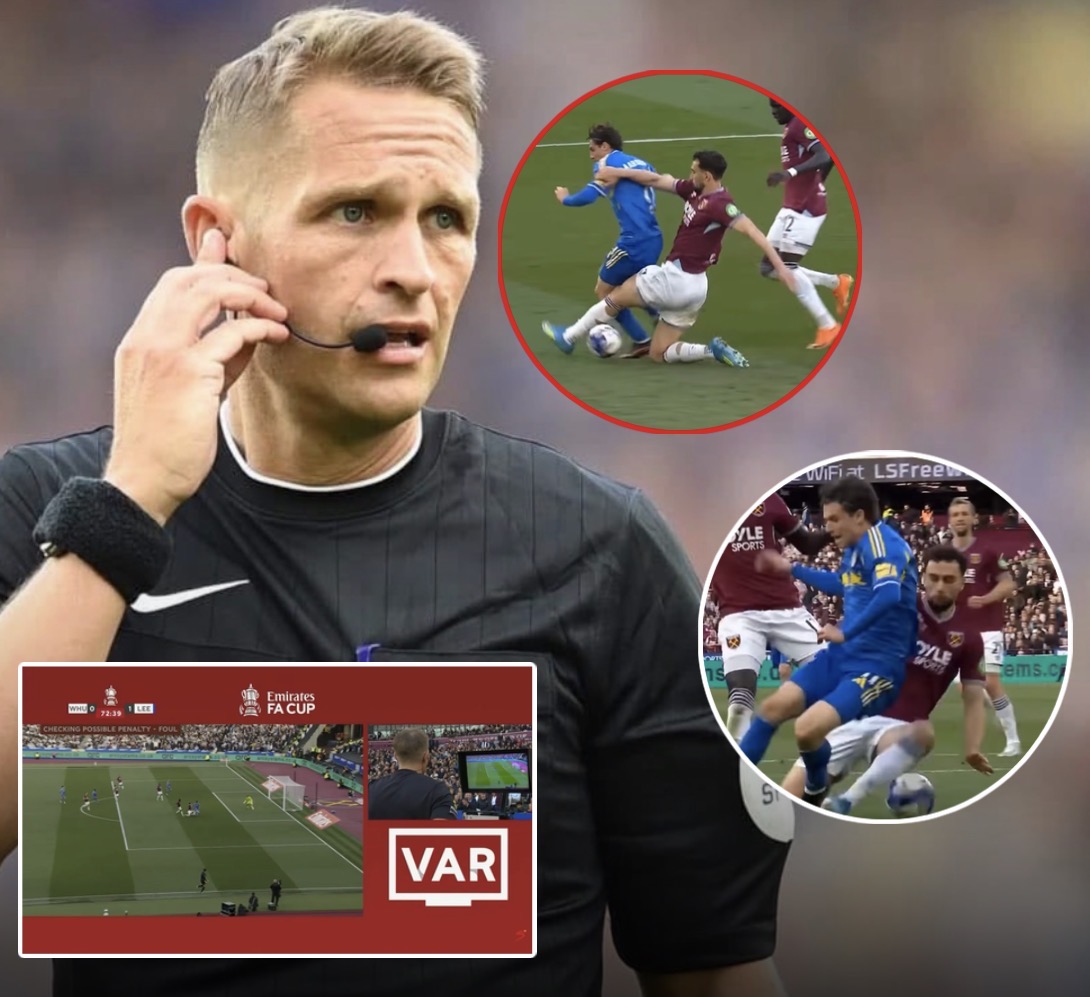
VAR audio release explains controversial Leeds United penalty decision in dramatic FA Cup clash with West Ham United
The fallout from the explosive FA Cup quarter-final between West Ham United and Leeds United has taken a dramatic new turn after the release of VAR audio explaining the most controversial moment of the match — the penalty awarded to Leeds that has since divided fans, pundits, and even former referees.
What initially looked like a routine VAR intervention has now become one of the most fiercely debated officiating decisions of the 2025/26 season. The audio, now circulating widely, reveals the exact reasoning behind the call — and it has only intensified the outrage among West Ham supporters, many of whom remain convinced the decision was fundamentally wrong.
This article breaks down the incident, the VAR explanation, tactical context, fan reactions across the UK and Nigeria, and the broader implications for officiating in English football.
Match Context: A Game Packed With Chaos
The match itself was nothing short of extraordinary. Leeds raced into a 2-0 lead before West Ham staged a stunning stoppage-time comeback to force extra time.
- Goals from Ao Tanaka and a penalty by Dominic Calvert-Lewin put Leeds in control
- West Ham responded late through Mateus Fernandes and Axel Disasi
- Extra time saw disallowed goals and mounting tension
- Leeds eventually triumphed via penalty shootout
However, beyond the drama, one moment stood out — the penalty awarded to Leeds that shifted momentum and ultimately shaped the narrative of the match.
The Controversial Penalty Incident
The incident occurred when a Leeds attacker drove into the penalty area under pressure from a West Ham defender. Initial replays suggested minimal contact — certainly not enough, in the eyes of many, to justify a penalty.
Yet after a VAR check, the on-field referee pointed to the spot.
According to match reports, the decision was based on a sliding challenge deemed to have “brought down” the Leeds player, prompting intervention from the VAR team.
At the time, West Ham players reacted furiously, surrounding the referee, while the home crowd erupted in disbelief.
VAR Audio Breakdown: What Was Actually Said
The release of the VAR audio has now shed light on the thought process behind the decision — and it’s this explanation that has stunned fans.
Key Takeaways from the Audio
- Focus on Point of Contact
VAR officials reportedly identified a “clear point of contact” between defender and attacker, even though it appeared minimal in real time. - Interpretation of “Careless Challenge”
The challenge was judged not by its force, but by its legality. Even slight contact was deemed sufficient if it impeded the attacker’s movement. - No Requirement for Heavy Contact
Crucially, the VAR team emphasized that intensity is not always required for a foul — a principle rooted in the laws of the game. - “Clear and Obvious Error” Threshold
The audio suggests VAR did not see the referee’s decision as a mistake — meaning it did not overturn it.
This aligns with official VAR protocol, where decisions are only changed if there is a “clear and obvious error.”
Why Fans Are Furious
Despite the technical explanation, the reaction has been overwhelmingly negative — particularly from West Ham supporters.
Core Arguments from Fans
- “Minimal contact ≠ foul”
Many argue that football is a contact sport and such challenges occur frequently without punishment. - Inconsistency
Fans pointed to similar incidents earlier in the match that were not penalized. - Game-changing impact
The penalty directly contributed to Leeds taking control of the match. - Lack of common sense
Critics believe the decision prioritized technical interpretation over real-game context.
UK Fan Reaction: Outrage and Confusion
Across UK football circles, the reaction has been explosive.
Pundits and former referees have questioned whether VAR is being applied too rigidly, stripping referees of the ability to interpret the flow of the game.
Some analysts highlighted a growing issue:
- Decisions are becoming overly forensic
- Small details are being magnified beyond their actual impact
This has led to a broader debate about whether VAR is improving fairness — or simply introducing new forms of controversy.
Nigerian Perspective: Passion Meets Frustration
In Nigeria, where Premier League fandom runs deep, the reaction has been just as intense.
Many Nigerian fans — particularly those who support West Ham or simply value physical football — have echoed similar frustrations:
- “That’s never a penalty in African football”
- “VAR is killing the game”
- “Referees should use common sense, not slow motion”
Interestingly, some neutral fans defended the decision, arguing that modern football rules are becoming stricter and players must adapt.
This split highlights a cultural divide in how football is interpreted globally — with African audiences often favoring a more physical, less technical style of officiating.
Tactical Impact: How the Penalty Changed the Game
From a tactical perspective, the penalty had significant consequences.
Before the Decision
- West Ham were growing into the game
- Leeds were under increasing pressure
After the Penalty
- Leeds regained control and confidence
- West Ham were forced to chase the game
- Defensive structure broke down
The psychological impact was just as important as the scoreline.
The Bigger Problem: VAR Consistency
This incident is not isolated.
Recent reports have already highlighted growing concerns about VAR inconsistency, with multiple incorrect decisions recorded this season.
Key Issues
- Different interpretations of similar incidents
- Lack of transparency (despite audio releases)
- Over-reliance on slow-motion replays
- Confusion over “clear and obvious” standard
The Leeds-West Ham controversy has now become a case study in these wider problems.
Should VAR Audio Be Released More Often?
One positive takeaway from this situation is the increased transparency.
Releasing VAR audio allows fans to understand the reasoning behind decisions — even if they disagree.
Pros
- Greater accountability
- Insight into decision-making
- Reduced speculation
Cons
- Can increase controversy if reasoning feels flawed
- Exposes inconsistencies more clearly
Final Verdict: Right Decision, Wrong Feeling?
Technically, the decision may be defensible under the laws of the game.
But football is not played in slow motion — and this is where the controversy lies.
The gap between law and interpretation is becoming increasingly visible.
Conclusion
The VAR audio release has done exactly what it was meant to do — provide clarity.
But instead of settling the debate, it has ignited an even bigger one.
For West Ham United fans, the decision feels like a robbery.
For Leeds United, it’s simply part of the game.
And for football as a whole, it raises a critical question:
Is VAR making the game fairer — or just more complicated?
One thing is certain — this incident will be talked about for years to come, not just because of the decision itself, but because of what it represents in the modern era of football officiating.











Post Comment