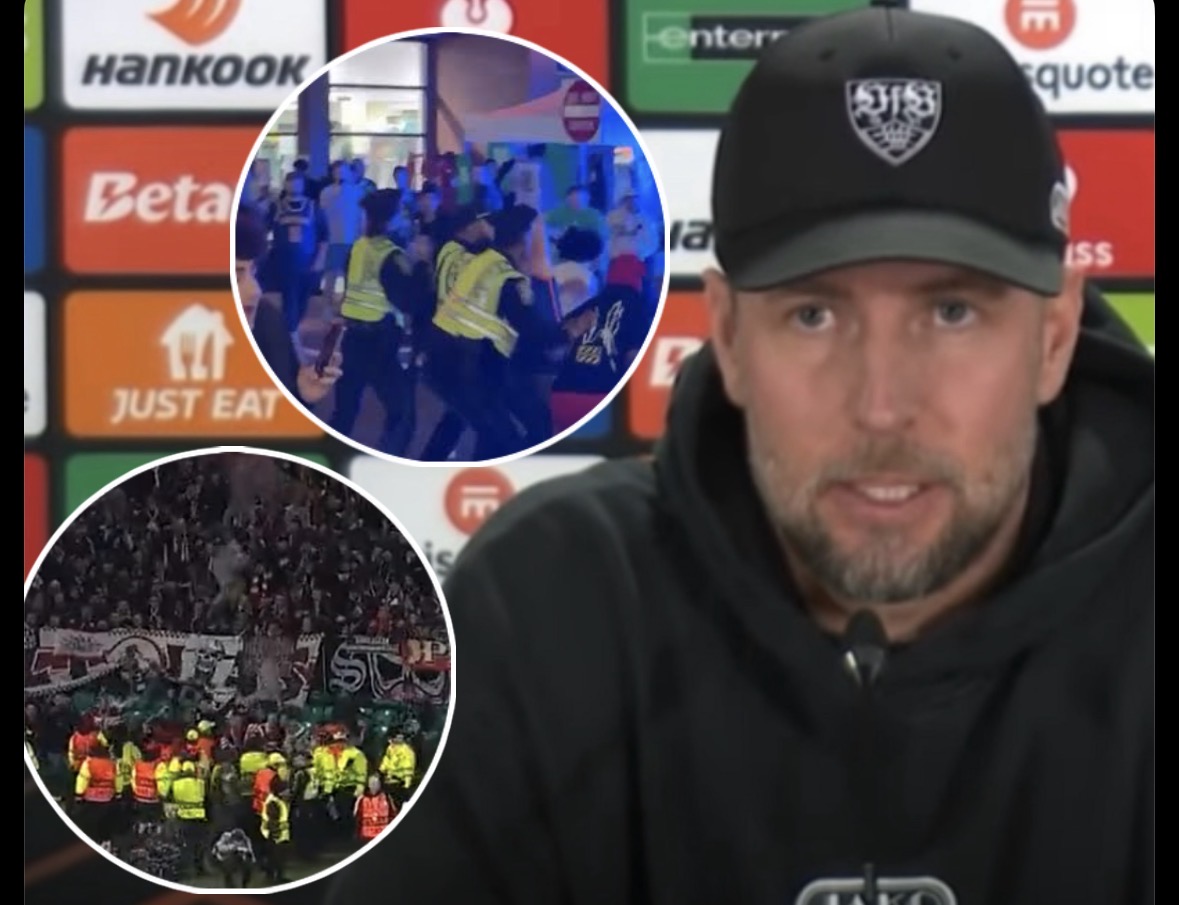
THE FOOTAGE EVERYONE HAS BEEN TALKING ABOUT CELTIC FANS FIGHT AND LEAVE VFB STUTTGART PLAYER BLEEDING FROM HIS HEAD IN HORRIBLE SCENES
Views: 631
European nights are supposed to be about passion, noise and unforgettable drama. But what unfolded after the final whistle between Celtic F.C. and VfB Stuttgart has left fans stunned, furious and divided across the continent.
What started as a heated clash on the pitch reportedly spiraled into shocking scenes off it — and now viral footage circulating online has taken the controversy to an entirely new level.
Allegations are flying. Tempers are boiling. And at the center of it all is a furious manager who didn’t hold back.
HORRIBLE SCENES AFTER THE WHISTLE
As supporters were still digesting the result, tensions allegedly erupted in areas surrounding the stadium. Video clips shared across social media appear to show chaotic moments involving stewards, police and fans in heated exchanges.
Even more disturbing are claims that a VfB Stuttgart player was left bleeding from his head following an altercation in the aftermath of the match. While the full circumstances remain unclear and investigations are ongoing, the images have sparked outrage in Germany and beyond.
The short clips — filmed on mobile phones and quickly spread across platforms — show a visibly distressed player being escorted away, with what appears to be blood on his forehead. Security personnel can be seen rushing to contain the situation as shouting echoes in the background.
It’s the kind of scene European football dreads. And now it’s dominating headlines.
THE MANAGER WHO DIDN’T STAY SILENT
When Sebastian Hoeneß, manager of VfB Stuttgart, stepped up for his post-match press conference, many expected him to focus on the performance.
Instead, he delivered something far more explosive.
Visibly frustrated, Hoeneß addressed the incidents directly. Without naming individuals, he strongly condemned what he described as unacceptable behavior.
But it was his now-viral three-word message that truly ignited the firestorm.
“Most toxic atmosphere.”
Those three words have since been dissected, debated and shared thousands of times.
Was he referring to the entire fanbase? A specific section? The heated end-of-game chaos?
Interpretations vary — but one thing is certain: the comment has struck a nerve.
CELTIC SUPPORTERS HIT BACK
Celtic fans, known across Europe for their passionate backing of their club, were quick to respond.
Many supporters took to social media insisting the situation is being exaggerated or misrepresented. Some claim the footage does not show the full context of what happened, while others argue that visiting players and staff contributed to escalating tensions.
For decades, Celtic Park has been celebrated as one of the most intimidating — yet electric — atmospheres in European football. The club’s supporters pride themselves on their noise, loyalty and history.
To hear it labeled “toxic” by an opposing manager? That’s a line many feel has crossed into disrespect.
WHAT REALLY HAPPENED?
Here’s where things get complicated.
As of now, official statements from both clubs have been measured and cautious. Neither side has confirmed the full details behind the alleged injury to the Stuttgart player. Authorities are reportedly reviewing footage from security cameras to establish exactly how events unfolded.
Was the injury the result of crowd trouble?
Did a confrontation occur in a restricted area?
Or is there more to the story that hasn’t yet surfaced?
In the age of viral clips and instant reactions, partial footage can shape narratives before investigations are complete.
But perception can be powerful — and right now, perception is driving the story.
EUROPEAN FOOTBALL’S DARK SIDE
Incidents like this inevitably reopen old wounds about crowd control, fan behavior and player safety during continental competitions.
Clubs across Europe have faced sanctions in recent years for supporter misconduct. From fines to stadium closures, governing bodies have taken a tougher stance when violence or dangerous behavior occurs.
If investigations confirm that misconduct led to a player being injured, consequences could follow. That possibility alone has raised anxiety among supporters who fear punishments that could impact future European nights.
The bigger issue? How quickly tensions can boil over in emotionally charged environments.
THE THREE WORDS THAT WON’T GO AWAY
“Most toxic atmosphere.”
It’s short. It’s sharp. And it has become the headline everywhere.
Some analysts believe Hoeneß was speaking in the heat of the moment, reacting to what he had just witnessed. Others argue that managers must choose their words carefully, especially when addressing passionate fanbases.
The German media has largely defended him, emphasizing the seriousness of a player reportedly being left bleeding. Meanwhile, Scottish outlets have highlighted the long-standing reputation of Celtic supporters for creating intense but largely positive environments.
Football culture differs across nations. What one side sees as fierce support, another might interpret as hostility.
And that cultural clash may be fueling the current storm.
A NIGHT THAT OVERSHADOWED THE FOOTBALL
Lost in all the controversy is the match itself — the tactical battles, the goals, the moments that should have defined the evening.
Instead, the narrative has shifted entirely.
The alleged post-match chaos has become the dominant story. Comment sections are flooded. Debates rage on sports radio. Pundits are split.
Some call for calm and patience until official findings are released. Others demand immediate accountability.
But almost everyone agrees on one thing: scenes like this are damaging for the image of European competition.
CELTIC’S RESPONSE — MEASURED BUT FIRM
While avoiding direct confrontation, Celtic sources have reportedly indicated they will fully cooperate with any investigation. The club has historically emphasized supporter responsibility and stadium safety.
Behind the scenes, there may also be frustration at the public labeling of their fanbase.
Because in modern football, reputation matters.
European campaigns bring global exposure. Viral controversy can travel further than any goal scored on the pitch.
WHAT HAPPENS NEXT?
Several potential outcomes loom:
- Official investigations by governing bodies.
- Possible disciplinary measures if wrongdoing is confirmed.
- Clarifications or further comments from either manager.
- Or perhaps even reconciliation statements once tensions cool.
For now, the viral footage continues to circulate, with millions forming opinions before the full story is known.
FOOTBALL’S PASSION — AND ITS LIMITS
There is no denying that European nights are fueled by emotion. Stadiums shake. Fans sing for 90 minutes straight. Rivalries feel personal.
But when emotion spills into chaos, the consequences can be severe.
If a player has indeed been injured in off-field disturbances, it’s a sobering reminder of how quickly celebration can turn into something darker.
And that’s why this story has resonated so deeply.
It’s not just about a three-word message.
It’s about where the line between passion and toxicity is drawn.
FINAL THOUGHTS: A CONTROVERSY FAR FROM OVER
The coming days will be crucial. Investigations will clarify facts. Statements may soften or escalate positions.
But one thing is undeniable: this match will be remembered not for the football played — but for what allegedly happened when it ended.
The viral clips.
The bleeding player.
The furious manager.
The three words that won’t disappear.
“Most toxic atmosphere.”
Whether those words stand the test of investigation — or spark further backlash — remains to be seen.
For now, the football world watches.
And waits.





Post Comment