There are moments in football that go beyond tactics, beyond structure, and even beyond the final scoreline—moments that leave fans, analysts, and opponents asking the same question: how did he even think of that?
That was exactly the case at Ibrox Stadium as Rangers FC dismantled Aberdeen FC in a commanding 4–1 victory. While the result itself underlined Rangers’ attacking superiority, the true talking point emerged from one extraordinary piece of innovation.
At the heart of it was captain James Tavernier—a player already renowned for his leadership and goal contributions—who produced a “never-before-seen” free-kick routine that left the Aberdeen goalkeeper completely deceived.
In a game filled with quality, it was this single moment of brilliance that elevated the performance from dominant to unforgettable.
Match Context: Rangers in Control
From the opening whistle, Rangers imposed themselves with authority. Their structure, built around a 4-2-3-1 system, allowed them to control both possession and territory. Aberdeen, known for their physicality and resilience, found themselves pinned back early.
The opening goal arrived after sustained pressure, with Rangers exploiting space between Aberdeen’s defensive lines. As the match progressed, the home side’s attacking fluidity became increasingly evident, with overlapping runs, quick transitions, and intelligent positioning causing constant problems.
By the time Rangers extended their lead, Ibrox was already sensing a statement performance. However, no one could have predicted the moment that would soon define the match.
The Moment: A Free-Kick That Changed Everything
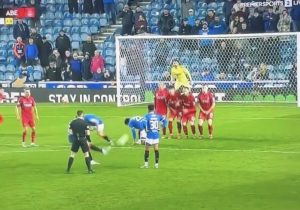
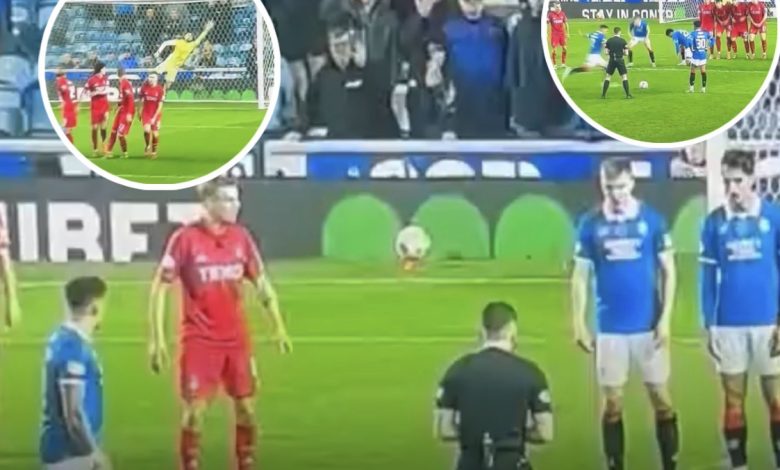
Midway through the game, Rangers were awarded a free-kick in a dangerous position—just outside the penalty area, slightly right of centre. It was the kind of situation where fans expect a direct shot or a standard set-piece routine.
Instead, what followed stunned everyone.
Rather than striking the ball with his usual power and precision, Tavernier executed a disguised, almost improvised routine. As Aberdeen set their defensive wall and the goalkeeper adjusted his positioning, expecting a conventional attempt, Tavernier subtly altered the rhythm of the play.
He delayed his run-up—just enough to disrupt the goalkeeper’s timing—before delivering a cleverly disguised effort that caught everyone off guard. The ball trajectory, combined with the deception in movement, wrong-footed the goalkeeper completely.
By the time the shot crossed the line, the reaction inside Ibrox was a mix of disbelief and admiration.
This was not just a goal—it was innovation in real time.
Tactical Breakdown: Why It Worked
To understand the brilliance of the moment, it’s important to break down the tactical elements behind it.
1. Manipulation of the Defensive Line
Aberdeen’s wall was positioned to block a traditional shot. Tavernier’s delay forced hesitation within the wall, disrupting their timing and coordination.
2. Goalkeeper Deception
Goalkeepers rely heavily on cues—body shape, run-up speed, and striking angle. By altering these cues, Tavernier effectively removed the goalkeeper’s ability to anticipate the shot.
3. Element of Surprise
Modern football is heavily analysed, with most set-piece routines studied in advance. This particular execution appeared completely unscripted, making it impossible for Aberdeen to prepare for.
4. Technical Execution
Innovation alone is not enough—it must be matched with precision. Tavernier’s technique ensured that the deception translated into a perfectly placed finish.
Leadership in Action
As captain of Rangers FC, Tavernier’s influence extends beyond defensive duties. He is often the team’s driving force in attacking situations, particularly from set pieces.
This moment encapsulated his leadership:
- Taking responsibility in a key moment
- Demonstrating creativity under pressure
- Delivering when it matters most
In high-level football, leadership is often defined by actions rather than words. Tavernier’s free-kick was a perfect example.
Aberdeen’s Collapse at Ibrox
While Rangers deserve full credit for their performance, it is equally important to examine Aberdeen’s response.
Following the free-kick goal, Aberdeen’s structure appeared to unravel. Their defensive organisation weakened, and their ability to press effectively diminished.
Key issues included:
- Loss of compactness between defensive lines
- Reduced intensity in midfield challenges
- Growing vulnerability to wide attacks
The psychological impact of Tavernier’s goal cannot be understated. Moments of brilliance often have a ripple effect, and in this case, it seemed to drain belief from the visitors.
By the time Rangers added further goals, the outcome felt inevitable.
Fan Reactions: A Moment to Remember
Supporters inside Ibrox and across social media were quick to react.
Many described the free-kick as:
- “Genius-level thinking”
- “Something you only see in training—never in a match”
- “Pure captain’s moment”
For fans, it was more than just a goal—it was entertainment, creativity, and a reminder of why football captivates millions.
Even neutral observers acknowledged the uniqueness of the execution, with discussions focusing on whether this could inspire similar routines across the game.
Nigerian Perspective: Creativity and Street Football Influence
From a Nigerian football perspective, moments like this resonate deeply.
Football culture in Nigeria often emphasises creativity, improvisation, and flair—qualities frequently developed in informal settings such as street football. Tavernier’s free-kick echoed that spirit:
- Thinking outside conventional structures
- Using instinct and improvisation
- Turning a routine situation into something extraordinary
It is this blend of structure and creativity that defines modern football at its highest level.
Statistical Context: Tavernier’s End Product
While the free-kick will dominate headlines, it also adds to Tavernier’s already impressive statistical output.
Known for his goal contributions as a defender, he consistently ranks among the top-scoring defenders in European football. His ability to influence games in attacking phases sets him apart from traditional full-backs.
This goal further reinforces:
- His importance in set-piece situations
- His reliability in high-pressure moments
- His value as both a leader and a match-winner
Broader Implications for Rangers
For Rangers FC, this performance sends a strong message.
1. Tactical Flexibility
The willingness to innovate suggests a team that is evolving, not just relying on established patterns.
2. Confidence in Key Players
Moments like this build belief—not just in the individual, but across the squad.
3. Psychological Edge
Opponents may now approach set-piece situations with increased uncertainty, unsure of what to expect.
What This Means Moving Forward
As the season progresses, Rangers will look to build on performances like this. However, consistency remains key.
Questions moving forward include:
- Can Rangers maintain this level of attacking creativity?
- Will opponents adapt to counter such innovations?
- How can the team balance flair with defensive stability?
The answers will shape their trajectory in both domestic and European competitions.
Conclusion
Football is often described as a game of fine margins—but occasionally, it becomes a stage for brilliance.
James Tavernier’s free-kick against Aberdeen FC was not just a goal; it was a statement. A statement of creativity, intelligence, and leadership.
In a match where Rangers FC dominated, this single moment elevated the performance into something memorable—something that will be discussed long after the final whistle.
For fans at Ibrox, it was a reminder of why they come to the stadium. For players, it was an example of what is possible. And for football as a whole, it was proof that even in a highly analysed sport, there is still room for the unexpected.