After much deliberation, FIFA explains why Argentina will not be punished over the anti-England banner controversy

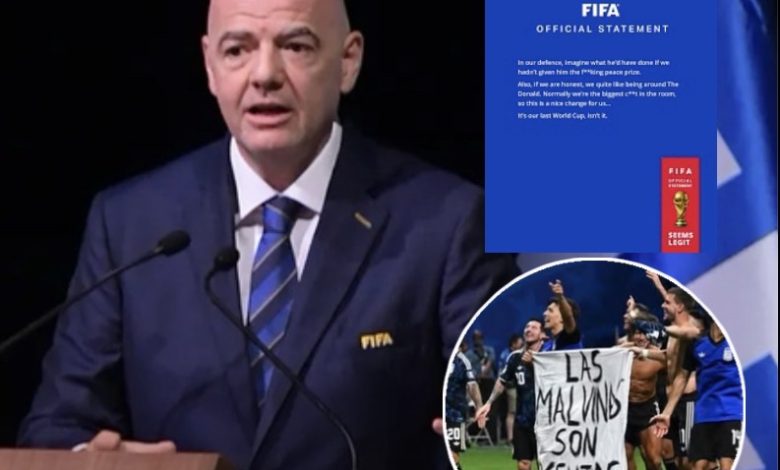
FIFA has finally addressed one of the biggest talking points of the 2026 World Cup, bringing an end to days of intense speculation surrounding the anti-England banner displayed by Argentina supporters following their dramatic semi-final victory. After conducting an internal review and carefully assessing all available evidence, football’s governing body confirmed that Argentina would not face any disciplinary action, a decision that has immediately divided opinion across the football world.
The controversy erupted shortly after Argentina defeated England 2-1 in a fiercely contested World Cup semi-final. While much of the post-match conversation initially focused on Lionel Scaloni’s tactical masterclass and Argentina’s resilience under pressure, attention quickly shifted to sections of the Argentine support, where a large anti-England banner became visible during the celebrations.
Images of the banner rapidly spread across social media, prompting thousands of supporters, former players and football pundits to question whether FIFA would intervene. Many England fans believed the display crossed the line and expected sanctions similar to previous punishments handed out for political or offensive messages at major international tournaments.
Over the following days, FIFA remained silent, fuelling further speculation that disciplinary proceedings were underway behind closed doors.
Following what FIFA described as a comprehensive review, officials concluded that the incident did not breach the organisation’s disciplinary regulations to a level that justified sporting sanctions against the Argentine Football Association.
According to FIFA’s explanation, investigators considered several key factors before reaching their verdict.
Firstly, officials determined that the banner represented the actions of a limited number of supporters rather than an organised action coordinated by the Argentine Football Association or members of the national team. FIFA’s disciplinary framework generally distinguishes between isolated fan behaviour and conduct directly encouraged or endorsed by participating teams.
Secondly, FIFA reportedly found no evidence that Argentine players, coaching staff or federation officials promoted, displayed or encouraged the banner during the celebrations. As a result, responsibility could not automatically be transferred to the national association.
Finally, FIFA concluded that while the banner generated considerable controversy and offended many England supporters, the available evidence did not meet the threshold required for disciplinary measures under its current regulations.
The announcement has done little to calm emotions.
England supporters have reacted with frustration, arguing that FIFA has been inconsistent in its handling of fan-related incidents over recent tournaments. Many pointed to previous cases in which associations were fined for crowd behaviour, insisting that similar standards should have been applied regardless of the country involved.
Others questioned whether football’s governing body had missed an opportunity to send a stronger message against provocative displays capable of inflaming rivalries on the international stage.
Across social media, debate intensified almost immediately after FIFA released its explanation.
Some supporters defended the decision, arguing that football has always been accompanied by passionate rivalries and emotional displays from fans. They believe governing bodies should avoid punishing entire nations for the behaviour of a relatively small section of supporters unless there is clear evidence of organised misconduct.
Others, however, insisted that football’s biggest tournament should maintain the highest possible standards and that controversial banners risk damaging the image of the competition.
The incident has inevitably added another chapter to the long-running football rivalry between England and Argentina.
Few international rivalries carry as much historical weight. Decades of unforgettable World Cup encounters have created intense emotions on both sides, from iconic matches to dramatic knockout contests that remain deeply embedded in football history.
Although today’s players largely focus on football rather than politics or historical disputes, supporters often bring those emotions into the stands, creating an atmosphere unlike almost any other fixture in world football.
This latest controversy once again demonstrated how quickly events away from the pitch can dominate headlines, even after a thrilling semi-final filled with outstanding football.
Argentina themselves have remained focused on preparing for the World Cup final, refusing to allow the disciplinary discussion to distract from what could become another historic achievement.
Players have largely avoided commenting publicly on FIFA’s decision, choosing instead to concentrate on training and recovery ahead of the tournament’s biggest match.
England’s camp has also avoided escalating the situation, preferring to focus on recovering from the disappointment of missing out on another World Cup final despite an impressive campaign.
The decision nevertheless raises wider questions for FIFA moving forward.
As football continues to become increasingly global, governing bodies face growing pressure to apply disciplinary regulations consistently while balancing freedom of expression, supporter culture and tournament integrity.
Supporters, clubs and national associations will undoubtedly examine future disciplinary decisions through the lens of this controversy, comparing outcomes whenever similar incidents arise.
If FIFA wishes to avoid accusations of inconsistency, many believe clearer guidance surrounding supporter conduct and federation responsibility may become necessary before future international competitions.
For now, however, the matter appears officially closed.
Argentina will not receive a fine, points deduction or any other sporting sanction over the anti-England banner controversy. FIFA believes its investigation found insufficient grounds to proceed with disciplinary action, despite acknowledging the widespread debate generated by the incident.
Whether that explanation satisfies football supporters is another question entirely.
For England fans, the verdict is likely to remain a source of frustration, particularly given the emotional nature of the rivalry and the expectations surrounding FIFA’s disciplinary standards.
For Argentina, the decision removes a significant distraction at the most important stage of the tournament, allowing full attention to remain on their pursuit of another World Cup triumph.
Yet the wider conversation will almost certainly continue long after the final whistle of the tournament. FIFA may have delivered its explanation, but among millions of supporters around the world, opinions remain firmly divided over whether justice has truly been served.