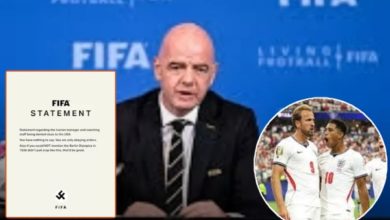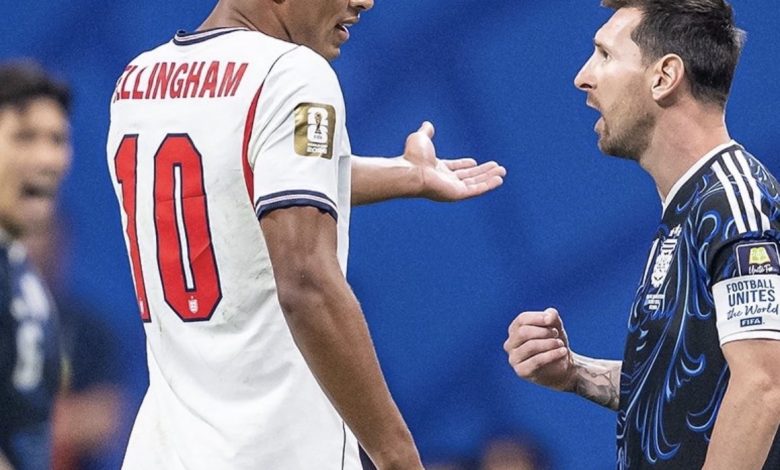
The world of football is no stranger to drama, especially when two of the game’s biggest stars collide on the pitch. A recent image circulating widely on social media depicts England midfielder Jude Bellingham in a tense confrontation with Argentina legend Lionel Messi during what appears to be a high-stakes match, overlaid with bold text claiming that FIFA has issued a punishment against Bellingham for comments allegedly made to Messi, while accusing the governing body of bias. The meme-style graphic, featuring FIFA President Gianni Infantino, has fueled heated debates online. But what really happened? Is there any substance to the claims of punishment and institutional bias? This comprehensive article delves deep into the incident, its context within the 2026 FIFA World Cup, the history of on-pitch altercations, FIFA’s disciplinary processes, and the broader implications for football governance.
The On-Pitch Incident: What We Know
The encounter between Bellingham and Messi took place during the semi-final of the 2026 FIFA World Cup between England and Argentina. In a match charged with national pride, physical intensity, and the weight of history—recalling past England-Argentina clashes like the 1986 and 1998 World Cups—cameras captured a heated exchange between the young English star and the Argentine icon.
According to multiple reports and Bellingham’s own post-match comments, the interaction stemmed from a disputed foul. Bellingham approached Messi to discuss an uncalled or contentious challenge. “We were discussing a foul, actually,” Bellingham explained. “But it was nothing bad. I’m sure everyone will do their thing and make it a big deal.” He emphasized respect for Messi, describing it as a privilege to share the pitch with one of football’s greatest players, and noted the emotional toll of England’s defeat.
Viral clips showed Bellingham gesturing animatedly while Messi responded. Social media quickly amplified the moment, with some users speculating wild claims: that Bellingham insulted Messi, referenced Cristiano Ronaldo, or made derogatory remarks. One debunked rumor suggested Bellingham told Messi “Ronaldo is better,” but credible sources found no evidence supporting this. Instead, it was a typical on-field flare-up common in competitive football.
Adding fuel to the fire, separate footage emerged of Bellingham appearing to slap or make contact with Argentina substitute Valentín Barco later in the match. This has prompted discussions about potential FIFA scrutiny, but it is distinct from any verbal exchange with Messi.
The Viral Meme and Claims of Punishment
The image in question transforms this sporting moment into a narrative of injustice. It features Bellingham in an England kit facing Messi, inset photos of a smiling player (possibly a teammate or past moment), the FIFA logo, and Infantino. The caption reads: “AFTER MUCH DELIBERATION THE FIFA HAVE FINALLY ISSUED THE PUNISHMENT FOR JUDE BELLINGHAM OVER WHAT HE SAID TO MESSI, FIFA IS BIAS.”
As of the latest reports, no official FIFA punishment has been issued specifically for anything Bellingham said to Messi. FIFA disciplinary actions typically follow formal complaints, referee reports, or video review by the FIFA Disciplinary Committee. Minor on-field words rarely result in sanctions unless they involve discriminatory language, incitement, or match officials. Bellingham has a history of passionate play, including a previous incident where he covered his mouth while speaking to Ghana’s Jordan Ayew at Euro 2024, avoiding a red card under new rules targeting offensive gestures.
The meme taps into long-standing perceptions of FIFA bias, particularly favoring South American or European powerhouses, or star players like Messi. Critics often point to past decisions, such as refereeing controversies in World Cups or the handling of high-profile cases involving players like Diego Maradona or more recently, various yellow/red card inconsistencies.
FIFA’s Disciplinary Framework: How Punishments Work
To understand whether a punishment is plausible, it’s essential to examine FIFA’s rules. The FIFA Disciplinary Code outlines sanctions for misconduct, ranging from warnings and fines to suspensions. Article 13 covers unsporting behavior, while Article 11 addresses insulting language or gestures.
For verbal exchanges:
- Referees can issue yellow cards for dissent.
- Post-match, the FIFA Disciplinary Committee reviews incidents via reports from match officials, team submissions, or third-party complaints.
- Evidence includes video footage, lip-reading analysis (sometimes used but not always reliable), and witness statements.
In Bellingham’s case, no immediate red card was shown during the Messi exchange. Post-match comments from Bellingham downplayed it as non-malicious. Absent a formal complaint from Argentina or compelling video evidence of severe insults, a significant ban is unlikely. The alleged “slap” on Barco might trigger review, potentially leading to a fine or short suspension, but that’s speculative at this stage.
FIFA has faced accusations of bias throughout its history. From the 2002 World Cup controversies to Qatar 2022 hosting debates and corruption scandals (notably the 2015 arrests), the organization has worked to rebuild trust under Infantino. Reforms include VAR, stricter anti-racism protocols, and transparency initiatives. However, fan skepticism persists, especially in rivalries involving Messi, whose global popularity amplifies any perceived favoritism.
Broader Context: Bellingham’s Rise and England’s Campaign
Jude Bellingham, born in 2003, has rapidly become one of football’s brightest talents. Transitioning from Birmingham City to Borussia Dortmund and then Real Madrid, he won major trophies and earned individual accolades. At the 2026 World Cup, his leadership in midfield was pivotal for England, though they fell short against a resilient Argentina side featuring an aging but inspirational Messi.
England’s campaign highlighted generational talent—Bellingham alongside players like Phil Foden and Declan Rice—challenging the narrative of post-Gareth Southgate transition struggles. The semi-final loss was heartbreaking, but Bellingham’s sportsmanship post-match, praising opponents, contrasted with the meme’s portrayal.
Messi, in his likely final World Cup, continued to defy age with moments of brilliance. His legacy as an eight-time Ballon d’Or winner and 2022 World Cup champion remains untouchable, making any “disrespect” narrative emotionally charged for fans.
History of On-Field Confrontations and Sanctions
Football has seen numerous high-profile incidents:
- Zidane’s headbutt on Materazzi in the 2006 World Cup final led to a red card and subsequent scrutiny.
- Luis Suárez’s bite on Chiellini resulted in a multi-match ban.
- Verbal racism cases, like those involving John Terry or recent incidents, have drawn lengthy suspensions.
Verbal spats between stars like Beckham and opponents or Ronaldo-Messi era tensions rarely escalated to bans without egregious content. FIFA’s approach has evolved with technology; AI-assisted lip-reading and enhanced video analysis are increasingly used, but thresholds for punishment remain high for non-discriminatory exchanges to avoid stifling passion.
Claims of bias often arise in South America vs. Europe contexts. CONMEBOL and UEFA have historically wielded influence, but Infantino’s administration emphasizes global equity, expanding tournaments and investing in African and Asian football.
Public Reaction and Social Media Amplification
The meme exemplifies how social media distorts reality. Platforms like Instagram, TikTok, and X (formerly Twitter) spread unverified clips rapidly. Hashtags around #BellinghamMessi and #FIFABias trended, with fans divided: English supporters defending Bellingham’s competitiveness, Argentine fans protective of Messi, and neutrals calling for calm.
Bellingham’s response focused on football: acknowledging the loss and moving forward. Such maturity counters the outrage cycle. Experts argue that sensationalism harms the sport, diverting attention from skill, tactics, and fair play.
Analyzing Bias Claims: Fact vs. Perception
Is FIFA biased? Empirically, data on refereeing decisions shows inconsistencies across tournaments, influenced by human error, pressure, and cultural factors rather than systemic favoritism toward specific nations or players. Studies by organizations like CIES Football Observatory highlight statistical variances, but no conclusive proof of deliberate bias in disciplinary matters.
Messi has received his share of scrutiny—diving accusations, penalty debates—but his talent transcends this. Bellingham, outspoken and expressive, invites similar spotlight. Accusations of bias against young Black English players also surface in media discourse, though Bellingham’s career trajectory at elite clubs counters systemic exclusion narratives.
Reforms like independent ethics committees and transparent reporting could address perceptions. FIFA’s revenue from broadcasting and sponsorships demands accountability to maintain credibility.
The Future: Lessons for Players, Fans, and Governance
This episode underscores several lessons:
- Player Conduct: Passion is integral, but professionalism matters. Bellingham’s post-match poise is exemplary.
- Fan Responsibility: Verify sources before sharing. Memes entertain but can mislead.
- Media Role: Responsible journalism separates facts from hype.
- FIFA’s Path Forward: Strengthening video review consistency and public communication on decisions.
As the 2026 World Cup concludes, focus shifts to club seasons. Bellingham will return to Real Madrid, Messi to Inter Miami or retirement considerations. Their brief clash adds to football lore without needing fabricated punishment.
In conclusion, the viral image captures football’s emotional intensity but misrepresents the facts. No confirmed FIFA punishment exists for Bellingham’s words to Messi; the exchange was a fleeting competitive moment. Claims of bias reflect deeper frustrations with governance but lack substantiation here. Football thrives on rivalries, respect, and resilience—qualities both Bellingham and Messi embody. True fans celebrate the game beyond memes, recognizing that while controversies entertain, the beautiful game’s essence lies in skill and unity.