The Bellingham Goal Controversy: FIFA, Infantino, and the Shadow Over England’s World Cup Quarter-Final Victory

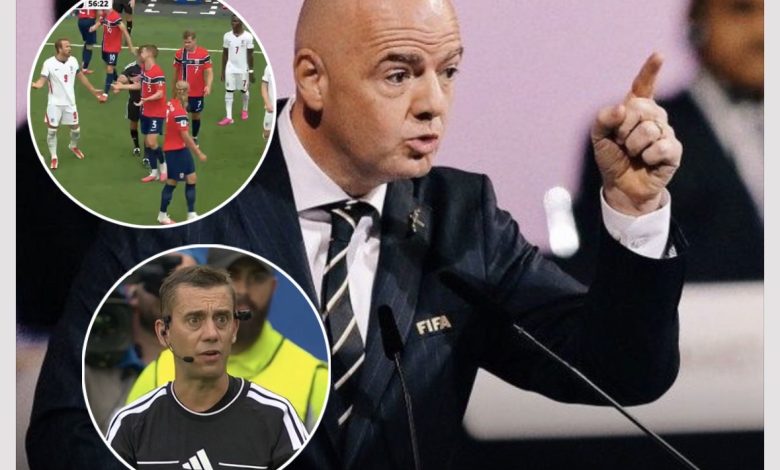
In the high-stakes environment of the 2026 FIFA World Cup quarter-final in Miami, England faced Norway in a match that delivered drama, controversy, and a dramatic extra-time finish. Jude Bellingham emerged as the hero with two goals, propelling England to a 2-1 victory after extra time and setting up a semi-final clash against Argentina. However, the game will be remembered as much for the polarizing incident surrounding Bellingham’s first-half equalizer as for the on-pitch heroics.
The build-up to England’s leveling goal in first-half stoppage time sparked immediate outrage from the Norwegian camp. Goalkeeper Ørjan Nyland launched a goal kick that, according to Norway’s protests and some television replays, appeared to clip an overhead camera cable (often referred to as a spidercam or skycam wire). The ball’s trajectory seemed altered, dropping short and allowing England to regain possession quickly. A swift sequence involving Elliot Anderson and Anthony Gordon led to Bellingham slotting home the equalizer, making it 1-1
Norway’s head coach Ståle Solbakken and his players were furious, immediately signaling to the referee that the ball had struck the cable. Under FIFA/IFAB protocols, contact with external objects like camera equipment typically warrants stopping play and restarting with a dropped ball, similar to a ball hitting the referee. VAR did not intervene, and the goal stood. Solbakken later commented that the incident was “pretty clear” from the bench, noting the ball fell directly in front of them, though he stopped short of prolonged complaints, focusing instead on his team’s performance.
FIFA’s Response and the “Connected Ball” Evidence
FIFA moved quickly to address the uproar. The organization released a statement emphasizing data from the “connected ball” technology, which includes a sensor tracking the ball’s “heartbeat.” According to FIFA, there was “no peak on the graph” indicating contact with the overhead wire that altered the ball’s movement. Without concrete evidence of interference, neither the referee nor VAR had grounds to disallow the goal.
This technological defense has been both praised for its objectivity and criticized for potentially overlooking visual evidence from certain camera angles. Replays broadcast by networks like FOX Sports appeared to show a slight deviation in the ball’s path mid-air, fueling debates about the reliability of sensor data versus human observation and multi-angle footage. Mark Clattenburg, commenting on air, noted that VAR should have reviewed the attacking phase leading to the goal.
The incident highlights ongoing challenges in modern football: the integration of advanced technology (goal-line tech, VAR, connected balls) with traditional refereeing, and the potential for disputes when they seem to conflict. Similar controversies, such as balls striking stadium infrastructure or advertising hoardings, have occurred before, but the visibility of this one—amplified by global broadcast and social media—intensified scrutiny.
Gianni Infantino’s Involvement: Statements, Not a Rematch Call
Headlines and social media buzz have sensationalized FIFA President Gianni Infantino’s role, with some claiming a “strongly-worded statement” or even calls for a rematch. However, available reports show Infantino has not issued any such demand for a rematch or reversal of the result. His public comments in recent weeks have focused on broader governance issues, the independence of FIFA’s judicial bodies, and defending the integrity of decisions amid external pressures (including high-profile calls from figures like U.S. President Donald Trump on unrelated disciplinary matters earlier in the tournament).
Infantino’s typical approach emphasizes football’s unifying power and respect for regulatory processes. In this case, FIFA’s official clarification on the ball sensor data serves as the governing body’s definitive stance: the goal was valid, play continued correctly, and the result stands. There is no indication of Infantino personally intervening to push for a rematch, which would be unprecedented and undermine the tournament’s structure. Claims suggesting otherwise appear to stem from clickbait or misinterpretations of his general statements on fairness and technology.
This aligns with Infantino’s history of navigating controversies by reinforcing institutional independence while engaging with stakeholders. His relationships with world leaders and football federations have drawn criticism at times, but in the Bellingham incident, the focus remains on technical evidence rather than presidential fiat.
The Match Context: England’s Path and Norway’s Heroic Run
To fully appreciate the stakes, consider the broader tournament narrative. Norway had enjoyed a remarkable run, including a stunning victory over Brazil, showcasing depth with talents like Erling Haaland. England, often criticized for underperforming relative to expectations despite a talented squad featuring Bellingham, Harry Kane, and others, needed a response after falling behind to Andreas Schjelderup’s opener.
Bellingham’s equalizer just before halftime shifted momentum. Norway pushed hard, but a potential second goal was disallowed for a foul involving Haaland. In extra time, Bellingham struck again in the 93rd minute, securing the win. His performance underscored his status as one of the world’s premier midfielders, carrying England through nervy moments.
Post-match reactions were mixed. Norwegian media and fans expressed frustration over the “scandal,” with some accusing officiating biases. English supporters celebrated Bellingham’s clutch moments, while neutral observers debated the VAR omission. Solbakken’s measured response—“I can sit here and cry, but I don’t want to do that”—earned respect, highlighting sportsmanship amid disappointment.
Technological and Regulatory Implications
The spidercam controversy reignites debates about pitch-side technology. Spidercams provide dynamic aerial views for broadcasts but introduce variables in play. FIFA regulations address external interference, yet enforcement relies on real-time detection. The connected ball sensor aims to provide objective data, but its limitations—potentially missing minor contacts or depending on calibration—warrant review.
VAR’s role also faces questions. Why wasn’t the build-up phase checked more thoroughly? Proponents argue over-reviewing slows the game; critics say consistency in major incidents is paramount for credibility. This case may prompt FIFA to refine protocols for overhead equipment and sensor integration ahead of future tournaments.
Broader context includes Infantino’s leadership in expanding the World Cup (to 48 teams in 2026) and embracing tech for fairness. Yet incidents like this test public trust. Past controversies—handballs, offside calls, referee errors—show football’s human element persists despite innovations.
Reactions from Stakeholders and Fans
Social media exploded with divided opinions. Clips of the alleged cable contact went viral, with hashtags questioning the result. Norwegian outlets highlighted perceived injustices, while English fans pointed to their team’s resilience and Bellingham’s quality. International observers called for calm, noting FIFA’s data-driven rebuttal.
Former players and pundits weighed in, with some like Clattenburg critiquing VAR’s inaction. Haaland’s family reportedly expressed views on social media, adding emotional layers. The Football Association and Norwegian federation have not formally appealed the result, accepting FIFA’s position while focusing on the semi-finals and future preparations.
England’s Semi-Final Outlook and Tournament Legacy
England now faces Argentina in what promises to be a blockbuster semi-final. Bellingham’s form makes them dangerous, but questions linger about squad depth and defensive vulnerabilities exposed against Norway. For Norway, elimination ends a dream run but cements their growing status in international football.
This controversy may not define the tournament but adds to its lore, akin to past disputed goals (e.g., Maradona’s “Hand of God” or Lampard’s ghost goal). It underscores football’s passion: moments of brilliance intertwined with perceived injustices fuel endless debate.
The Role of Leadership: Infantino’s Balancing Act
Gianni Infantino, as FIFA president since 2016, has steered the organization through reforms, corruption cleanups, and commercial growth. His statements often stress unity (“Football unites the world”) and procedural integrity. In response to various pressures, including political ones, he has reiterated the autonomy of disciplinary and match officials.
No credible reports support claims of Infantino “calling for a rematch.” Such an action would contradict FIFA’s commitment to finality in results post-confirmation. Instead, his approach here aligns with defending technical decisions transparently. Critics of FIFA governance may use the episode to question influence and consistency, especially given other recent interventions, but the Bellingham goal stands on evidentiary grounds provided by the organization.
Conclusion: Lessons for the Beautiful Game
The 2026 World Cup quarter-final between England and Norway exemplified football’s highs and lows. Bellingham’s double showcased individual excellence; the cable debate exposed systemic tensions in officiating and technology. FIFA’s swift clarification via sensor data aimed to quell doubts, though visual ambiguity ensures the discussion continues.
As the tournament progresses, stakeholders must prioritize fairness, transparency, and fan trust. Refinements to camera infrastructure, VAR protocols, and communication could prevent future disputes. Infantino and FIFA face the perpetual challenge of evolving the sport without alienating its traditional soul.
Ultimately, England advances on merit in a competitive match, but the controversy reminds us that in football, as in life, perception often rivals reality. Norway’s gracious exit and Bellingham’s stardom provide positive notes amid the noise. The semi-final awaits, promising more unforgettable moments—controversies included.