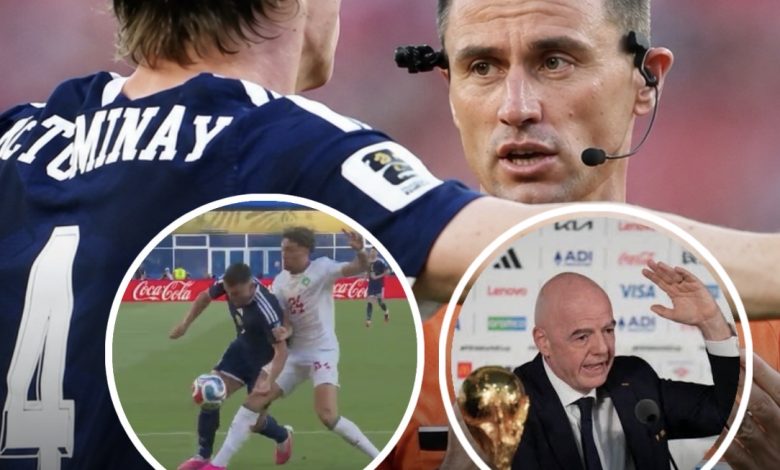
FIFA Closes Investigation Into Scotland vs Morocco Clash With Surprise Announcement After Weeks of Debate and Petitions
The long-running controversy surrounding Scotland’s dramatic FIFA World Cup defeat to Morocco has finally reached its conclusion, with FIFA announcing that its investigation into the match has officially been closed following weeks of intense scrutiny, public debate and thousands of petitions from supporters around the world.
The fixture, which ended in a narrow 1-0 victory for Morocco, sparked one of the biggest refereeing controversies of the tournament. Scottish supporters, former players and several football analysts questioned a number of key decisions made during the match, arguing that crucial calls had gone against Steve Clarke’s side at decisive moments.
Following the final whistle, social media exploded with demands for action. Hashtags calling for FIFA to review the officiating trended across the United Kingdom, while petitions urging football’s governing body to intervene quickly gathered significant momentum. The debate soon spread far beyond Scotland, with neutral fans weighing in on what many described as one of the tournament’s most controversial refereeing performances.
After days of speculation, FIFA confirmed it had launched a comprehensive investigation into the officiating team. The governing body reviewed match footage from every major incident, consulted VAR recordings, analysed referee reports and held discussions with members of its refereeing committee before reaching a final decision.
FIFA’s Final Verdict
In a surprising announcement that has divided opinion once again, FIFA confirmed that the investigation has now concluded and that there will be no change to the official result of the Scotland versus Morocco fixture.
While acknowledging that several decisions generated significant controversy and warranted internal review, FIFA stated that there was insufficient evidence to justify overturning the result or ordering an unprecedented replay of the match.
Instead, the organisation announced that lessons from the investigation would be incorporated into future referee assessments and training programmes, with additional emphasis placed on consistency in major tournament matches.
The announcement effectively closes one of the biggest talking points of this year’s World Cup group stage.
Scotland Left Frustrated
For Steve Clarke and his Scotland squad, the announcement represents the end of a difficult chapter.
The Scottish players had maintained throughout the controversy that their focus remained on preparing for the remainder of the tournament, but frustration was evident after several senior figures questioned the consistency of officiating standards.
Captain Andy Robertson had already spoken about the disappointment felt inside the dressing room following the defeat, insisting that the players believed several key moments could have been handled differently.
Despite the emotional fallout, Scotland now face an even greater challenge. Their qualification hopes rest on producing a strong performance against Brazil in their final Group C fixture, knowing only a positive result is likely to keep their World Cup dream alive.
The players will now be expected to put the controversy behind them and concentrate entirely on football.
Morocco Welcome the Decision
From Morocco’s perspective, FIFA’s announcement brings much-needed certainty.
The Atlas Lions have consistently defended the legitimacy of their victory, arguing that the players should not be blamed for decisions made by match officials.
Morocco’s disciplined defensive display and clinical finishing were enough to secure three valuable points, strengthening their position at the top end of Group C.
The confirmation that the result will stand allows the squad to prepare for their remaining fixtures without further uncertainty hanging over the tournament.
Their focus now shifts toward securing qualification for the knockout stages and building on what has already been an impressive campaign.
Tactical Breakdown
Although the refereeing dominated headlines, the football itself should not be overlooked.
Scotland enjoyed long periods of possession and attempted to dictate play through patient midfield combinations. Billy Gilmour and Scott McTominay worked tirelessly to control central areas, while Andy Robertson frequently pushed forward to create width down the left flank.
However, Scotland struggled to convert possession into clear-cut opportunities.
Morocco remained compact throughout, limiting space between the lines before launching quick counter-attacks whenever possession was regained.
The winning goal ultimately proved enough to separate the two sides, but the match will be remembered more for its contentious moments than its tactical battle.
Many analysts believe Scotland’s inability to capitalise on their chances also played a significant role in the defeat, regardless of the refereeing decisions.
Fans Continue the Debate
Even after FIFA’s final announcement, opinions remain sharply divided.
Scottish supporters continue to argue that the investigation failed to address what they believe were clear officiating errors.
Many feel that greater transparency should have been provided, including the publication of VAR communications similar to systems used in other sports.
Meanwhile, Moroccan fans welcomed FIFA’s decision, insisting their team’s victory was deserved and that calls for a replay lacked sporting justification.
Across social media, the debate remains one of the tournament’s biggest talking points, highlighting the growing scrutiny surrounding VAR and elite-level officiating.
Bigger Questions for FIFA
Beyond the Scotland-Morocco controversy, the investigation has once again highlighted wider concerns about refereeing consistency at major international tournaments.
Former referees and football experts have increasingly called for greater transparency regarding VAR protocols, referee evaluations and post-match explanations for controversial decisions.
Many believe football could benefit from adopting systems already used in sports such as rugby and cricket, where officials communicate decisions publicly and explain the reasoning behind key calls.
While FIFA insists its current review process remains robust, this latest controversy is unlikely to silence calls for reform.
Supporters increasingly expect greater openness from football’s governing bodies, particularly when matches carrying enormous sporting and financial consequences are involved.
What Happens Next?
With FIFA officially closing the investigation, attention now turns back to events on the pitch.
Scotland’s immediate objective is clear: produce a result against Brazil that keeps qualification hopes alive.
Morocco, meanwhile, know another positive performance could secure passage into the knockout rounds and continue what has already been an impressive World Cup campaign.
Although the official investigation has ended, the Scotland versus Morocco match is likely to remain one of the defining controversies of the 2026 FIFA World Cup.
Whether supporters agree with FIFA’s conclusions or not, the debate has reinforced one undeniable truth: every major refereeing decision is now analysed more intensely than ever before, and football’s governing bodies will continue facing pressure to ensure transparency, accountability and consistency at the highest level.