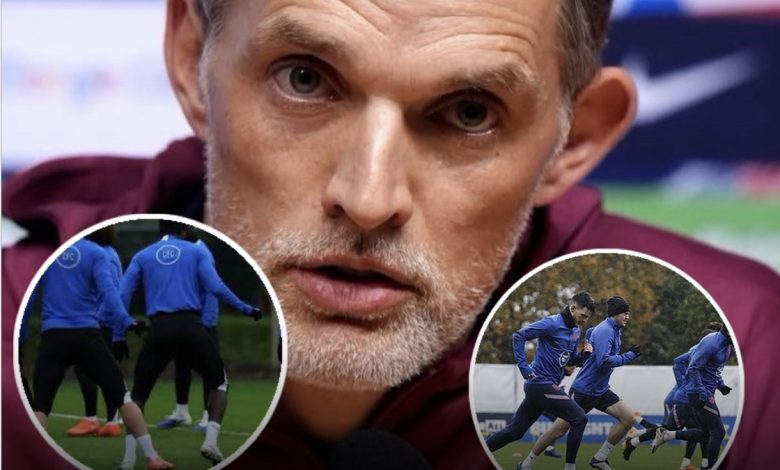
ENGLAND STAR LEAVES CAMP AFTER REPORTED TENSION WITH THOMAS TUCHEL
England’s international camp has been thrown into unexpected disruption after reports emerged that a senior England star has left the squad early and returned to his club training environment following growing tension with manager Thomas Tuchel.
The development comes at a delicate time for England, as Tuchel continues to impose his tactical identity and high-intensity standards on the national setup. While no official disciplinary statement has been released, the timing and nature of the departure has already sparked widespread discussion across the football landscape.
Sources close to the situation suggest the situation developed over several days, with frustrations gradually building behind the scenes before ultimately reaching a point where the player opted to leave camp early.
TUCHEL’S NEW ERA UNDER EARLY SCRUTINY
Thomas Tuchel’s appointment as England manager was expected to bring clarity, structure, and a more demanding tactical system to a squad often criticised for inconsistency in major tournaments.
Known for his intense coaching style and strict tactical expectations, Tuchel has wasted little time attempting to reshape the environment at St George’s Park. Training sessions have reportedly been highly detailed, physically demanding, and focused heavily on positional discipline.
However, early indications suggest that not every senior figure in the squad has fully adapted to the intensity of the new regime.
The reported departure of a key player, even on a temporary basis, raises early questions about how smoothly Tuchel’s methods are being received within the dressing room.
WHAT LED TO THE BREAKDOWN IN RELATIONSHIP?
Although exact details remain unconfirmed, reports indicate that disagreements stemmed from tactical instructions and training demands that the player was either uncomfortable with or unconvinced by.
It is understood that conversations between staff and the player took place before the decision to leave camp was finalised. While there is no suggestion of a public confrontation, the situation appears to have escalated behind closed doors.
Football camps are often high-pressure environments, especially under new management. Differences in opinion regarding role expectations, workload, or tactical positioning can quickly become points of friction when a new system is being introduced.
Tuchel’s reputation as a manager who demands full tactical compliance may also have played a role in how the situation unfolded.
CLUB VS COUNTRY DILEMMA RETURNS
The player’s return to his club setup has reignited the long-standing debate over club versus country priorities.
With club seasons becoming increasingly congested and physically demanding, some players are more protective of their fitness and preparation time, particularly during international breaks that do not involve competitive fixtures.
Returning to club training may suggest a desire to regain rhythm, maintain fitness standards, or avoid unnecessary strain during a transitional phase in international camp.
This decision, however, inevitably raises questions about commitment levels and the balance between individual needs and national duty.
IMPACT ON ENGLAND’S SQUAD DYNAMICS
Even if the departure is temporary or situational, the ripple effect within the England squad cannot be ignored.
Senior players often play a crucial role in stabilising the dressing room, especially during periods of managerial change. Any visible disagreement between a key figure and the manager can influence morale, unity, and overall squad harmony.
Younger players in particular may be observing how Tuchel manages such situations, making this an early test of leadership as much as tactics.
England’s coaching staff will now be focused on ensuring the issue does not escalate further or become a distraction ahead of upcoming fixtures.
TUCHEL’S AUTHORITY TESTED EARLY
For Thomas Tuchel, this represents one of the first real challenges of his England tenure.
Establishing authority in an international setup is often more complex than at club level, where daily contact allows managers to maintain tighter control over squad dynamics. At international level, limited time together means any disagreement can quickly become magnified.
How Tuchel handles this situation — whether through internal dialogue, clarification of roles, or squad rotation decisions — will be closely watched.
Maintaining authority while also keeping senior players engaged will be key to preventing similar situations in future camps.
FAN REACTION AND MEDIA SPECULATION
As news of the departure broke, reaction among supporters was swift and divided. Some fans expressed concern about early signs of unrest under Tuchel, while others suggested that strong management inevitably involves difficult decisions and occasional disagreements.
Pundits have also weighed in, with some arguing that early friction is normal during managerial transitions, especially when a new tactical system is being introduced.
Others, however, have warned that England cannot afford internal distractions with major tournaments on the horizon and expectations remaining high.
WHAT HAPPENS NEXT?
At this stage, it remains unclear whether the player will rejoin the squad for future international fixtures or whether this signals a longer-term issue between player and management.
England’s focus will now shift to ensuring stability within the camp and avoiding further disruption as preparations continue.
For Tuchel, the priority will be restoring full squad unity and ensuring that his tactical vision is understood and accepted across the group.
One thing is certain — this situation has added an early layer of pressure to his reign, and all eyes will be on how both manager and squad respond in the coming weeks.