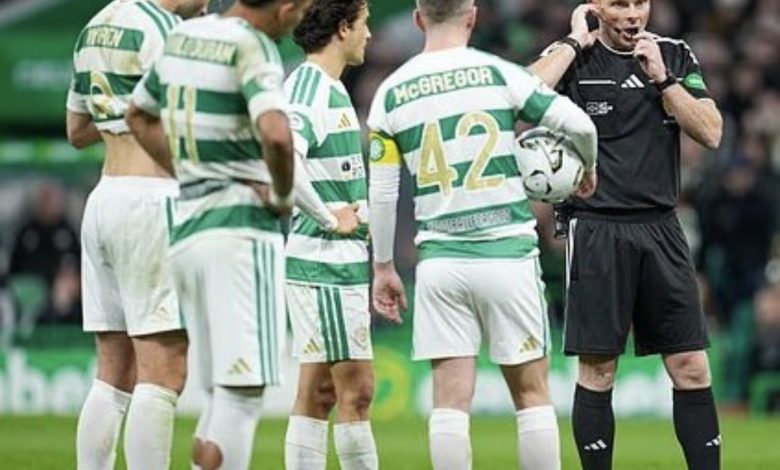
CELTIC FACE GROWING PRESSURE AFTER REMEMBRANCE SUNDAY SILENCE IS CUT SHORT AT PARKHEAD
Celtic have found themselves at the centre of another major controversy after a section of supporters booed during the Remembrance Sunday tribute before the Scottish Premiership clash with Kilmarnock, forcing referee John Beaton to bring the silence to an early end.
The planned period of silence at Celtic Park was supposed to last for one minute, but audible jeers and whistles from sections of the stadium meant the tribute lasted only around 12–13 seconds before Beaton signalled for the match preparations to continue. Multiple reports confirmed that the referee ended the tribute because of the noise coming from the stands. (Yahoo Sports)
The incident has immediately triggered another debate surrounding Celtic and their supporters, with questions now being raised about whether the club could face disciplinary consequences.
However, there is an important distinction to make.
There is currently no reliable confirmation that FIFA has announced a punishment against Celtic for the incident.
That means claims circulating online that FIFA has already imposed a major sanction should be treated with caution until an official disciplinary decision is published.
WHAT HAPPENED BEFORE KICK-OFF?
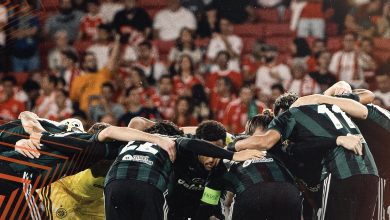
Players from Celtic and Kilmarnock gathered around the centre circle before kick-off for the Remembrance Sunday tribute.
The public-address announcement explained that the silence was intended to remember victims of conflicts, including men who had served Celtic and lost their lives during wartime. (BCE Soccer)
But within seconds, noise could be heard from sections of the Celtic support.
Some supporters booed and whistled rather than observing the silence.
The disturbance continued to such an extent that Beaton decided not to allow the full minute to continue.
The referee therefore ended the tribute after approximately 12–13 seconds.
The unusual scenes were immediately captured on television and social media, where clips quickly began circulating among football supporters.
WHY THE INCIDENT HAS CAUSED SUCH A STRONG REACTION
Remembrance Sunday is observed across football in the United Kingdom, with clubs traditionally holding a period of silence before their closest fixture to Remembrance Sunday.
The tribute is intended to honour people who lost their lives in conflicts, including those connected to football clubs.
Kilmarnock also observed the occasion, with their players wearing poppies on their shirts.
Celtic, meanwhile, did not wear poppies on their playing shirts. (Apex Football Lite)
The issue is particularly sensitive at Celtic because some sections of the support have historically opposed participation in Remembrance ceremonies.
The reasons are connected to Celtic’s Irish heritage and the complicated relationship between sections of the fanbase and the British Army, particularly because of historical events surrounding the Troubles.
That background has made Remembrance-related controversies at Celtic fixtures a recurring subject.
THIS IS NOT THE FIRST TIME
Sunday’s incident did not occur in isolation.
Last season, when Celtic also hosted Kilmarnock around Remembrance Sunday, the tribute was similarly disrupted.
On that occasion, the silence was reportedly ended after around 15 seconds, while some supporters were also seen turning their backs and making gestures.
This year’s incident therefore represents another occasion where a Celtic fixture has been overshadowed by controversy surrounding the Remembrance tribute. (Elrisala)
That history will inevitably increase pressure on Celtic to address what happened.
COULD CELTIC BE PUNISHED?
This is the question now dominating the debate.
It is important to understand that disciplinary responsibility does not automatically fall on a club simply because some supporters behave improperly.
Football authorities normally examine the circumstances, identify what regulations may have been breached and determine whether the club can be held responsible under the relevant rules.
At present, however, there is no credible confirmation that FIFA has issued a punishment specifically for this incident.
The claim that a “huge FIFA punishment” has already been announced appears to be circulating ahead of any verified official announcement.
That does not mean Celtic are necessarily in the clear.
A governing body could still investigate the incident, request information from the club or consider whether any existing disciplinary regulations apply.
But until such a decision is officially published, it would be misleading to state that a punishment has already been confirmed.
THE ROLE OF JOHN BEATON
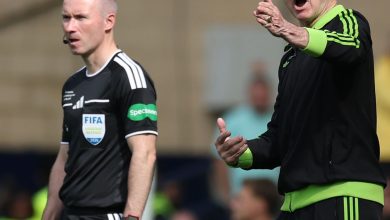
The referee also became part of the story because he was the person who eventually ended the silence.
Beaton did not appear to be ending the tribute because of a personal decision about Remembrance Sunday.
Instead, the noise from the stands had made the intended silence impossible to maintain.
Reports state that he blew his whistle after the boos and whistles continued. (LiveScore)
That decision has itself generated discussion.
Some supporters believe the referee was right to bring the tribute to an end rather than allow an increasingly disrupted ceremony to continue.
Others argue that ending it so quickly made the incident even more visible.
Either way, the decision ensured that what should have been a solemn pre-match moment became one of the biggest talking points surrounding the fixture.
CELTIC’S RESPONSE WILL NOW MATTER
The club’s response could become an important part of the story.
Celtic cannot control every individual action inside a stadium, particularly when thousands of supporters are present.
However, the club can decide how strongly it responds when incidents occur.
The challenge for Celtic is balancing respect for supporters’ individual beliefs with the expectation that major football occasions should be conducted respectfully.
The club also has to consider its relationship with governing bodies.
If a disciplinary authority decides to investigate, Celtic will likely be expected to explain the circumstances surrounding the incident and any measures taken to prevent similar disruptions.
THE CONTROVERSY ALSO OVERSHADOWED A CELTIC WIN
Ironically, the incident came before Celtic went on to secure an important victory.
Martin O’Neill’s side defeated Kilmarnock 1–0, with Liam Scales scoring the decisive goal in the first half.
The victory restored Celtic’s four-point lead at the top of the Scottish Premiership, giving the club an important result before the international break. (The Times)
But despite the three points, the Remembrance controversy dominated much of the discussion after the match.
Celtic had already been under pressure following inconsistent league results, making the victory particularly useful for O’Neill.
Instead of the focus being entirely on the football, however, the pre-match scenes became the headline.
WHAT HAPPENS NEXT?
The immediate priority for Celtic will be determining whether any governing body intends to take disciplinary action.
If an official investigation is opened, the club could be asked for its version of events.
But supporters should be careful with claims circulating on social media that a punishment has already been imposed.
At the time of writing, the confirmed facts are that a section of Celtic supporters booed and whistled during the Remembrance Sunday tribute, referee John Beaton ended the silence after roughly 12–13 seconds, and the incident has attracted widespread criticism.
A confirmed FIFA punishment has not been established by the reliable reports currently available.
That distinction is crucial.
Celtic may yet face disciplinary consequences, but reporting an unconfirmed punishment as an official decision would risk turning a genuine controversy into misinformation.
For now, the club faces another uncomfortable period of scrutiny.
The footballing authorities will have to decide whether the incident warrants action, while Celtic will have to consider how it handles an issue that has repeatedly resurfaced around Remembrance fixtures.
And with the images already spreading across social media, one thing is certain:
THE 13-SECOND REMEMBRANCE SILENCE HAS BECOME ANOTHER MAJOR CONTROVERSY SURROUNDING CELTIC — AND THE FINAL DISCIPLINARY VERDICT, IF THERE IS ONE, IS STILL TO COME.