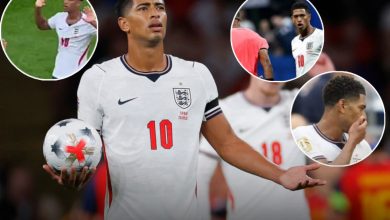
FRANCE FOOTBALL RELEASES TOP FIVE BALLON D’OR CONTENDERS AS ENGLAND FANS LEFT SPEECHLESS BY HARRY KANE’S SURPRISE POSITION IN RANKINGS

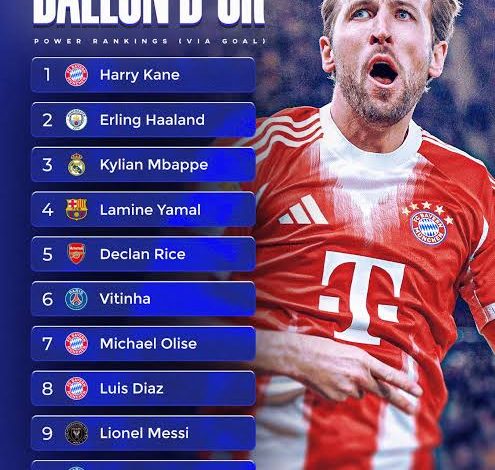
The latest Ballon d’Or conversation has left England supporters debating one major question: why is Harry Kane’s position attracting so much attention despite the extraordinary individual season he has produced?
Kane has built an extremely strong case for the 2026 award, but the Ballon d’Or is not decided simply by counting goals or choosing the player with the biggest trophy collection.
The official criteria place individual performances and decisive, impressive displays first, followed by collective performances and trophies, with class and fair play also forming part.
The actual award is decided by an international jury of specialised journalists, with each voter selecting ten players and awarding points from 15 for first place down to one point for tenth.
So, if Kane’s reported position has surprised England fans, the explanation may be found in the way the award is judged rather than in any suggestion that his season was disappointing.
In fact, Kane’s individual numbers provide one of the strongest arguments for his candidacy.
According to England Football, the Bayern Munich striker finished the campaign with 73 goals in 65 appearances for club and country, alongside eight assists.
He also scored 36 Bundesliga goals in 31 league appearances, won the European Golden Shoe and became the first player in Bundesliga history to finish as the competition’s leading scorer in each of his first three seasons.
Those figures are difficult to ignore.
Kane also reached 100 competitive goals for Bayern in only 104 appearances, demonstrating that his influence has not been restricted to one spectacular run of form.
For an award whose first criterion is individual performance, that statistical production gives him a very serious foundation.
His performances for England further strengthen the argument.
At the 2026 World Cup, Kane scored six goals in six matches, including an important brace against DR Congo that helped England recover from a difficult position.
He also scored against Mexico and moved beyond Gary Lineker to become England’s leading men’s World Cup goalscorer, while breaking another national record by becoming England’s most-capped captain.
That is why the debate surrounding Kane cannot simply be reduced to his position in a ranking.
The bigger question is whether voters believe his overall individual contribution was superior to those of the other leading candidates.
Lamine Yamal, Kylian Mbappé and the other leading names have their own arguments, particularly when individual brilliance is combined with major team achievements.
The Ballon d’Or rules deliberately place collective success behind individual performance rather than making trophies the only deciding factor.
That means a player does not automatically lose the award simply because another candidate has won more silverware.
At the same time, trophies still matter.
A player’s contribution to a successful team can strengthen his case, particularly when he has been decisive during important matches.
That is where Kane’s Bayern season becomes particularly relevant.
His goals were not merely accumulated against weaker opposition.
His overall campaign placed him among the most productive attackers in European football, while his continued importance to England gave voters another body of evidence when assessing his season as a whole.
There is also an important distinction between being nominated, being among the leading contenders and actually finishing in a particular position.
England Football confirmed that Kane, Jude Bellingham and Declan Rice were among England’s three nominees on the 30-player shortlist.
The voting process then allowed journalists to rank their ten preferred players, meaning the eventual order depends on the collective judgement of the international jury.
That should temper some of the reaction surrounding Kane.
If an unofficial or reported ranking places him lower than some England supporters expected, it does not necessarily mean voters have ignored his achievements.
It could simply reflect how closely matched the leading candidates are.
Indeed, reports following the conclusion of voting described the 2026 race as particularly open, with Kane, Yamal, Mbappé, Lionel Messi and Rodri among the names receiving significant attention.
There is another reason Kane’s position matters so much to English supporters.
The 2026 ceremony will be held in London on 26 October, marking the first time the Ballon d’Or ceremony has taken place in England.
That naturally adds another layer of interest around Kane, particularly because England have not had a men’s Ballon d’Or winner since Michael Owen in 2001.
For English fans, therefore, Kane’s candidacy represents more than another individual award campaign.
It represents the possibility of an English captain returning the biggest individual prize in football to the country after a quarter of a century.
But the final judgement must remain based on football rather than sentiment.
Kane’s supporters can legitimately point to his extraordinary goal record, consistency, importance to Bayern Munich and England, and his performances at the World Cup.
His critics can argue that other candidates produced equally impressive individual campaigns while achieving more collectively.
That is precisely why the Ballon d’Or remains such a fascinating debate.
The rules do not ask voters to choose the player with the loudest reputation or the biggest social-media following.
They ask them to consider individual performance, decisive influence, collective achievements, trophies, class and fair play.
For Kane, the strongest argument is therefore not simply that he scored 73 goals.
It is that those goals came alongside sustained influence for both club and country across an entire season.
Whether that is enough to put him first remains for the international jury to decide.
And that is why England fans should be careful about treating any reported ranking as the final verdict.
Kane’s position may have caused surprise, but the real story is that his extraordinary individual campaign has placed him firmly in one of the most competitive Ballon d’Or conversations in recent years.
For now, the debate continues.
The final answer will come when the votes are officially revealed in London on 26 October.