CELTIC AND RANGERS FANS REACT AS “TOP 25 BIGGEST CLUBS IN BRITAIN” LIST STIRS DEBATE

British football is a sport obsessed with hierarchy. Every fan base wants to know where their club sits — not just in the league table, but in the bigger conversation about size, history, support, and stature. So when a new list ranking the Top 25 Biggest Football Clubs in Britain began circulating, it didn’t take long before it found its way into Scottish football group chats, comment sections, and fan forums.
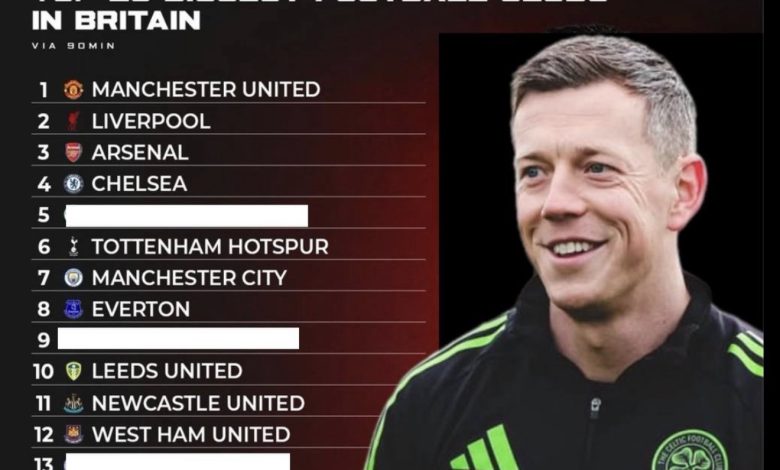
The list, compiled and shared via 90min, set out to rank clubs from across English and Scottish football using a blend of factors that typically define “big club” status — global fanbase, trophy history, matchday attendance, commercial pull, and overall cultural footprint. As expected, the usual English powerhouses occupy the top of the pile. Manchester United sits at number one, a position few would seriously contest given the club’s worldwide following and decades of dominance. Liverpool follows at two, with Arsenal and Chelsea rounding out the top four — a grouping that mirrors the established “big clubs” narrative English football has leaned on for years.
From there, the list works its way down through familiar names: Tottenham Hotspur, Manchester City, Everton, and a steady procession of Premier League and Championship clubs that most fans would expect to see somewhere on a list like this. Leeds United, Newcastle United, West Ham United, Nottingham Forest, Leicester City — all names with deep histories and passionate support bases, all slotted into the middle tier of British football’s supposed pecking order.
But this is Britain, not just England. And any list claiming to rank the biggest clubs “in Britain” — not just in the Premier League — has to account for Scottish football too. That’s where things get interesting, and where this particular ranking has managed to spark genuine debate north of the border.
Before getting into exactly where Scotland’s two most famous clubs landed, it’s worth pausing on why this question matters so much in the first place. Celtic and Rangers are not ordinary football clubs. Between them, they’ve won well over 100 Scottish league titles combined. Their rivalry — the Old Firm — is one of the fiercest and most historically loaded derbies anywhere in world football, carrying religious, political, and cultural weight far beyond the pitch. Both clubs regularly outdraw the vast majority of English top-flight teams in average attendance. Celtic Park and Ibrox are two of the most atmospheric grounds in Europe, routinely filled to capacity with support that borders on fanatical. In terms of European pedigree, Celtic remain the only Scottish club to have won the European Cup, doing so in 1967 with a squad built almost entirely of players born within a short distance of Glasgow — a feat still referenced as one of football’s great underdog stories.
So when a list like this drops, ranking clubs “in Britain” rather than simply “in England,” Celtic and Rangers fans don’t just glance at it out of curiosity. They study it. They compare it. And more often than not, they argue about it.
This particular list didn’t keep either club near the very top — no surprise, given the financial gulf between the Premier League and the Scottish Premiership in the modern game. But where the two Glasgow giants did land has become the real talking point.
Celtic came in at number 9, sandwiched between Everton at 8 and Leeds United at 10. Rangers, meanwhile, sit at number 13, positioned just after West Ham United and ahead of Nottingham Forest.
For a club with Celtic’s trophy cabinet, European pedigree, and one of the most fervent global diasporas in football, a top-10 finish ahead of clubs like Newcastle United and West Ham United will likely be seen by many Celtic supporters as fair — arguably even conservative given the scale of their support. Rangers fans, on the other hand, have been quick to point out their own claims: a support base that fills Ibrox week in, week out, a European final appearance in recent memory, and a fanbase spread just as widely across the world as their rivals.
Reaction across social media has been split along predictably tribal lines. Some Celtic supporters have pointed to the number 9 spot as validation of the club’s stature relative to several English sides ranked below them, arguing that history and European achievement should count for more than current Premier League television revenue. Rangers fans, meanwhile, have questioned the gap between the two clubs, insisting that any list ranking “biggest” purely on size and support — rather than recent domestic form — should have them closer to, if not level with, their rivals.
What’s clear is that lists like this one are never going to be received quietly in Scotland. The Old Firm rivalry doesn’t need much fuel to reignite comparison and debate, and a ranking that places both clubs inside the top 15 “biggest in Britain,” ahead of several established Premier League names, has done exactly what these lists are designed to do — get people talking, arguing, and defending their club’s honour.
Whether or not the exact positions hold up to scrutiny, one thing is certain: in Glasgow, size, history, and bragging rights will always be up for debate.