“Despicable & Shameful”: Scottish FA Hits Old Firm with Official Punishment Over Ugly Ibrox Fight

On a grey Sunday afternoon in March 2026, the latest chapter in the fiercest rivalry in British football unfolded at Ibrox Stadium. What should have been remembered primarily as a dramatic Scottish Cup quarter-final decided by penalties instead became synonymous with chaos, injury, and institutional failure. Celtic defeated Rangers 4-2 on penalties after a goalless 120 minutes, Tomas Cvancara converting the decisive kick. Within moments, hundreds of supporters from both sides poured onto the pitch. Flares flew, missiles were thrown, stewards and police were assaulted, and a 10-year-old boy was struck by a coin. Police Scotland immediately branded the scenes “despicable” and “shameful.” Months later, the Scottish Football Association formalised that condemnation by charging both clubs with breaches of Disciplinary Rule 37.
The charges, issued alongside a 37-page independent review published on 21 July 2026, represent the most significant official punishment yet arising from the disorder. Hearings were scheduled for mid-August. The episode has forced Scottish football to confront long-simmering questions about ultras culture, away-ticket allocations, policing capacity, club accountability, and the effectiveness of existing disciplinary frameworks.
The Match and the Flashpoint
Rangers hosted Celtic in the Scottish Gas Men’s Scottish Cup Round of 16 (sometimes referred to as the quarter-final stage in coverage) on 8 March 2026. Under Scottish Cup rules, the away club is entitled to claim up to 20 per cent of the ground’s capacity. After protracted discussions and intervention from the SFA, Celtic received the entire Broomloan Road Stand—approximately 8,042 tickets. It was the largest away allocation for an Old Firm fixture in years, following a period in which numbers had been restricted to roughly 2,000–2,500 or, at times, zero.
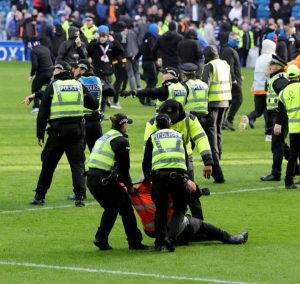
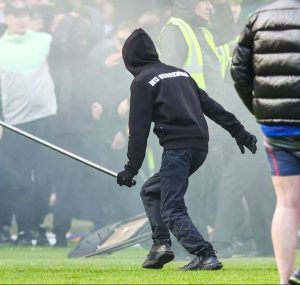
The match itself was tense and attritional. Neither side managed a goal in normal or extra time. The penalty shoot-out delivered the drama, and when Cvancara scored, celebration among the visiting support spilled onto the pitch. What began as jubilation quickly escalated. Rangers supporters, many from the Union Bears section and some wearing face coverings while carrying poles and reinforced gloves, responded with a hostile counter-incursion. Police and stewards formed a cordon to separate the groups. Flares were thrown repeatedly between the two sets of fans. The stand manager was assaulted and hospitalised with an inner-ear injury. A Celtic coach and player were also attacked. Order was eventually restored after four minutes and 28 seconds—a period the subsequent independent review described as one in which “life-threatening violence was possible.”
Pre-match problems compounded the post-match disorder. Ticketless supporters and those attempting to force entry created delays at turnstiles. Green Brigade ultras overwhelmed search lines on Broomloan Road, creating a crushing risk outside the stadium. Sectarian chanting, pyrotechnics, object-throwing, and graffiti—including material mocking the 1971 Ibrox disaster that killed 66 people—occurred throughout the day. Damage to the stadium, particularly in the Celtic end and involving LED boards, was later estimated by Rangers at around £1.3 million, though compensation arrangements remained disputed.
Immediate Condemnation
Police Scotland’s response was swift and unequivocal. Chief Superintendent Kate Stephen stated: “The behaviour of a number of supporters… was shameful. It must be condemned by everyone involved in football and wider society… Officers and stewards were faced with extreme hostility and violence over a sustained period, with many individuals having armed themselves with items clearly intended to cause harm. Officers and members of the public have been injured in this despicable display.”
First Minister John Swinney called the violence “completely and utterly unacceptable” with “no justification whatsoever,” emphasising the severe danger to fans, police, and stewards. Scotland’s Chief Constable Jo Farrell later criticised both clubs for their initial silence in the hours after the match. The Scottish FA itself issued a statement within 40 minutes of full-time condemning pitch invasions and announcing an immediate investigation.
Arrest numbers climbed steadily. Initial reports spoke of nine arrests; by June the total reached around 40, with charges including assault, possession of offensive weapons, culpable and reckless conduct, and breach of the peace. Thirty-seven people were reported injured. One man was charged with assaulting a coach and a player.
Both clubs eventually issued statements. Rangers described the scenes as “unacceptable,” stressed that safety must come first, and expressed particular horror at graffiti referencing the Ibrox disaster, calling it “vile,” “cowardly,” and “shameful.” Celtic acknowledged serious issues requiring appropriate responses and later welcomed aspects of the independent review while criticising aspects of policing.
The Independent Review
In the aftermath, the SFA commissioned Mark Blackbourne, a sports event consultant, UEFA match delegate, and stadium inspector, to lead an independent review. His 37-page report, published in July 2026, proved damning across the board. It characterised the events as two near-miss incidents of the most serious kind: the crushing risk outside the stadium caused by Celtic ultras overwhelming security, and the pitch confrontation that came “within a very small margin of becoming a violent mass confrontation.” It described it as a “minor miracle” that no one suffered serious injury.
Blackbourne catalogued systemic failures. Planning was compressed by a dispute over the 8,000-ticket allocation that was only finalised late. Only one multi-agency meeting took place. The risk assessment used by Rangers was nearly identical to that prepared for a league fixture the previous week despite the vastly larger away presence. There was no adequate contingency for ticketless fans or forced entry. Police deployment was judged insufficient in key areas. Safety Advisory Group processes were sidelined. Ultras groups on both sides were described as operating with forensic awareness and, in some respects, like organised crime groups, using intimidation and coordinated tactics.
The report reserved particular criticism for the disciplinary culture in Scottish football. Sanctions, it argued, had become too modest, too deferred, and too inconsistently applied to change behaviour. Fines alone were insufficient. Immediate measures such as section or ground closures should become the default first response rather than suspended penalties. Escalation tariffs based on a rolling three-year period were recommended, along with scaling financial penalties to club revenue. Legislative change was urged to strengthen offences around pitch incursions, pyrotechnics, face coverings, and tailgating, and to expand Football Banning Orders. A stronger multi-agency planning structure and clearer pathways for away allocations in high-risk fixtures were also proposed.
The review noted that the Celtic pitch entry began as celebration but that the Rangers response was “reactionary, confrontational, and overtly threatening.” Both clubs were found wanting in their ability to identify and discipline their own supporters effectively. Bans issued by clubs were often seen as ineffective.
Official Punishment: Rule 37 Charges
On the same day the report was published, the SFA’s Compliance Officer issued identical Notices of Complaint against Rangers and Celtic. Both clubs were charged with breaching Disciplinary Rule 37. That rule requires a club, so far as is reasonably practicable, to ensure good order and security at its ground; to adopt and implement policies and procedures to prevent unacceptable conduct; and to deal effectively with any instances of such conduct. It also requires clubs to identify supporters engaged in unacceptable conduct and take proportionate disciplinary measures.
Hearings were set for 13 August 2026 (some reports indicated 16 August). Possible outcomes under the Judicial Panel Protocol include substantial fines, points deductions, ticket restrictions, section or ground closures, or other measures. The report’s authors and many observers argued that the authorities must now demonstrate the will to use the full range of powers already available in the rulebook, including more severe options that have rarely been applied.
Club Responses and Broader Fallout
Rangers accepted responsibility for matters within its control and said it would implement lessons learned. The club had already introduced a formal Supporter Conduct and Sanctions Policy after the match, with tiered bans up to indefinite. However, it strongly contested aspects of the report, particularly what it called the limited examination of the SFA’s role in enforcing the large ticket allocation despite safety concerns raised by the home club. Rangers rejected any pathway back to full historic away allocations at Ibrox and argued that the governing body itself had escaped sufficiently robust scrutiny.
Celtic’s interim chairman Brian Wilson described the review as thorough and providing “food for thought and action.” The club maintained that the initial non-violent pitch entry by a relatively small number of its supporters was not in itself a major threat, but expressed deep concern about masked Rangers fans carrying weapons and subsequent attacks on Celtic staff and supporters. Celtic questioned why recommendations from Glasgow City Council’s Safety Advisory Group appeared to have been overturned at senior levels within Police Scotland and welcomed proposals to strengthen the formal status of Safety Advisory Groups.
The episode has reignited debate about the place of ultras groups—Green Brigade and Union Bears in particular—within Scottish football. Critics argue that clubs have for too long tolerated or failed to confront organised elements that engage in coordinated disruption, pyrotechnics, and intimidation. Supporters’ organisations have pointed to the need for clearer accountability without collectively punishing the vast majority of fans who attend matches responsibly.
Away allocations remain a flashpoint. The large Celtic contingent was both a return to traditional cup norms and, in the eyes of many safety professionals, a significant elevation of risk that was inadequately planned for. Future high-profile fixtures will almost certainly see tighter restrictions or more rigorous multi-agency preparation.
Policing resources and morale have also come under scrutiny. Reports that experienced officers were left “petrified” at the prospect of another such fixture at Ibrox underscored the human cost. The review recommended enhanced deployments around ultra sections at critical moments and better contingency planning.
Historical Echoes and the Path Ahead
Scottish football has seen dark days before—most notoriously the 1987 “Shame Game” at Ibrox that produced multiple red cards, player prosecutions, and fan violence, and the 2016 Scottish Cup final between Rangers and Hibernian that featured a mass pitch invasion. The Bowen Report after 2016 and earlier guidance from the Lord Advocate have been revisited in light of the 2026 events. Many of the same recommendations around planning, stewarding, and accountability resurfaced, raising uncomfortable questions about whether lessons were properly absorbed.
The Ibrox disorder of March 2026 occurred against a backdrop of heightened global visibility for the Scottish game, with a competitive title race and European interest. The reputational damage was therefore acute. The SFA, SPFL, clubs, police, and government now face the task of translating a detailed independent report and formal charges into concrete change.
Whether the forthcoming Judicial Panel hearings produce sanctions of sufficient severity to deter future misconduct, whether legislative reforms materialise, and whether clubs demonstrably improve their internal disciplinary cultures will determine if this episode becomes a genuine watershed or merely another cycle of condemnation followed by incremental adjustment. For now, the official record stands: the Scottish FA has formally punished both halves of the Old Firm for failing to ensure good order and security on one of the darkest afternoons in recent Scottish football history. The “despicable and shameful” label applied by police on the day has been given institutional weight. The game north of the border must now prove it is prepared to match that language with lasting action.