RANGERS’ CONTROVERSIAL HIBS PENALTY EXPLAINED BY NEW VAR ANGLE AS EX-REFEREE WEIGHS IN ON “PEDANTIC” CALL — FRESH EVIDENCE SPARKS FURY!

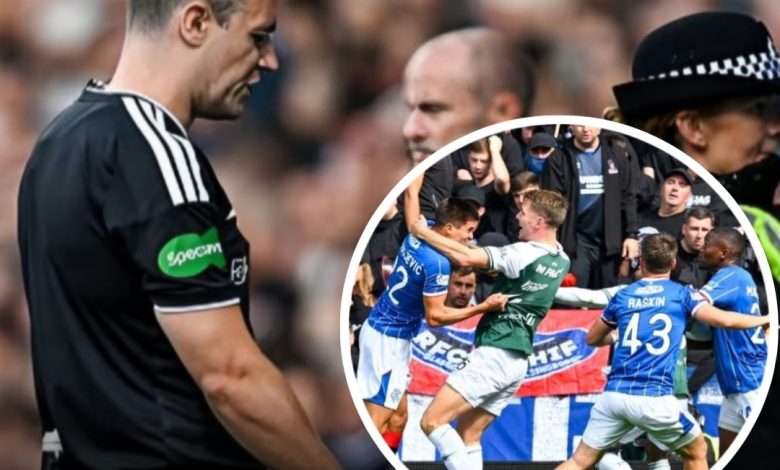
The controversy surrounding Rangers’ defeat to Hibernian has intensified after fresh discussion of the penalty that helped put the visitors ahead at Ibrox.
What initially appeared to be a relatively routine set-piece challenge became one of the biggest talking points of the match after VAR intervened and Rangers were punished for holding inside the penalty area.
The decision has divided opinion, with Rangers supporters questioning whether the contact was sufficient to justify a spot-kick, while others argue that once an opponent is illegally held inside the box, the referee has little choice but to award a penalty.

The issue became even more contentious because the match was ultimately decided by a single goal. Hibernian eventually won 2–1, meaning the penalty was not merely an isolated incident in a comfortable victory. It became part of a result that left Rangers frustrated and under increasing pressure.
Rangers manager Derek McInnes described his side as having been hard done by and questioned the softness of the penalty decision. Reports from the match indicate that Hibs scored from their first-half spot-kick before Rangers fought back, only for the visitors to claim victory with a late goal.
THE INCIDENT THAT CHANGED THE MATCH
The controversy came during a Hibernian attacking set piece.
As the ball was delivered into the Rangers penalty area, there was contact between a Rangers defender and a Hibs attacker. The initial action did not immediately result in a penalty, but VAR subsequently reviewed the incident.
After reviewing the footage, the officials decided that the holding was sufficient to warrant a penalty.
Josh Campbell stepped forward and converted the spot-kick, giving Hibernian the advantage.
For Rangers, the frustration was obvious. The feeling was that the incident represented exactly the sort of marginal contact that football supporters have become increasingly divided over in the VAR era.
The question was not simply whether contact occurred.
The bigger question was whether the contact was significant enough to constitute a foul worthy of a penalty.
That distinction is crucial.
Football contains physical contact throughout a match. Defenders and attackers wrestle for position at corners, players pull shirts, arms become tangled and opponents attempt to gain an advantage. Not every instance of contact automatically results in a free-kick.
But when officials determine that a player has illegally held an opponent and that the offence occurs inside the penalty area, the consequences are dramatically different.
A free-kick becomes a penalty.
And that can completely change a match.
WHY RANGERS WERE SO ANGRY
From the Rangers perspective, the timing and nature of the decision made it particularly difficult to accept.
The home side were already attempting to impose themselves on the match, and conceding a penalty gave Hibernian a major advantage.
McInnes later expressed his frustration with the decision, describing the penalty as very soft and suggesting Rangers had been unfortunate during the defeat.
That frustration was understandable from a competitive standpoint.
Rangers eventually found an equaliser through a Hibs own goal, creating the impression that they might still rescue something from the match.
Instead, Hibernian struck again late on through Callum Wright.
The final score was 2–1 to the visitors.
That made the penalty even more significant in the post-match debate because Rangers were left wondering what might have happened had Hibs not received the early opportunity from the spot.
THE NEW ANGLE CHANGES THE DISCUSSION
One of the biggest problems with controversial incidents is that supporters often see only one camera angle.
A television broadcast might show the incident from behind the goal, from the side or from a wide tactical camera. Each angle can create a completely different impression.
A challenge that appears harmless from one perspective can look considerably more obvious from another.
That is why VAR is supposed to be able to examine incidents from multiple perspectives.
The emergence or discussion of an additional angle therefore adds another layer to the debate.
Rather than relying entirely on the first replay shown during the live broadcast, viewers can examine the relationship between the players more closely.
The additional footage does not automatically prove that the penalty was correct or incorrect.
Instead, it allows the incident to be examined with greater context.
That distinction matters.
Football supporters sometimes treat a new camera angle as conclusive evidence when it may simply provide another interpretation of the same event.
The important issue is what the officials could reasonably determine from the available evidence and whether the contact met the threshold for a foul.
THE “PEDANTIC” ARGUMENT
One of the most interesting aspects of the controversy is the criticism that the decision was overly pedantic.
That argument essentially suggests that the officials focused too heavily on the technical details of the contact instead of considering whether the incident was genuinely significant enough to affect the attacking player.
Critics of the decision argue that football is a contact sport and that referees should avoid turning every minor tug or touch into a penalty.
Supporters of the decision, however, can make an equally strong argument from the opposite direction.
If defenders know that minor holding will be ignored inside the penalty area, attackers can be unfairly disadvantaged.
The Laws of the Game do not create a separate standard simply because a foul happens during a corner kick.
If an offence is considered a punishable holding offence and takes place inside the penalty area, the referee can award a penalty.
That is where the debate becomes difficult.
The disagreement is not necessarily about whether holding is prohibited.
It is about the threshold.
How much holding is enough?
How long does it have to continue?
How much does the attacker have to be affected?
And, perhaps most importantly, is the incident clear enough for VAR to intervene?
VAR’S ROLE UNDER THE SPOTLIGHT
The incident also raises a much wider question about the purpose of VAR.
The technology was introduced to reduce major refereeing errors, but it has also created a new category of controversy.
Instead of arguing only about whether a referee saw an incident correctly, supporters now debate whether VAR should have intervened in the first place.
That is particularly relevant for borderline penalties.
A referee may see an incident live and decide that there is not enough for a penalty. VAR can then examine the footage and potentially recommend an intervention if the original decision is considered a clear and obvious error.
The difficulty comes when reasonable people can watch the same footage and reach different conclusions.
If one experienced referee considers the contact a clear foul while another believes it is normal physical competition, is the original decision truly a clear and obvious error?
That is the heart of the modern VAR debate.
WHY THE INCIDENT HAS CAUSED SUCH A STRONG REACTION
The reaction has been amplified by the result.
Had Rangers won comfortably, the penalty controversy might have quickly disappeared from the headlines.
Instead, Rangers lost.
The penalty helped Hibs take the lead, Rangers fought back, and then Hibernian found a late winner.
According to reports, Hibs managed only two shots on target but scored twice, while Rangers created opportunities without being able to convert enough of them.
That statistic tells another important part of the story.
The penalty was controversial, but it was not the only reason Rangers lost.
Rangers had opportunities to change the outcome themselves.
They needed to be more clinical.
They also needed to defend the decisive late attack better.
Football rarely comes down to one incident, even when that incident dominates the conversation afterwards.
RANGERS’ BIGGER PROBLEM
The penalty controversy should therefore not completely obscure Rangers’ wider problems.
The defeat left McInnes still waiting for his first competitive victory as Rangers manager.
The result also increased the pressure surrounding the new manager and his squad, particularly after Rangers were booed at the final whistle.
That is a much bigger concern than one refereeing decision.
Managers can complain about officiating, but they cannot control it.
They can control preparation.
They can control attacking efficiency.
They can control defensive organisation.
And they can demand that their players respond when a controversial decision goes against them.
For Rangers, that response was not enough to prevent Hibernian from leaving Ibrox with all three points.
HIBS DESERVE CREDIT TOO
It would also be unfair to discuss the match entirely through the Rangers perspective.
Hibernian still had to take advantage of the opportunities presented to them.
Campbell had to convert the penalty.
The visitors then had to withstand Rangers’ attempts to equalise.
After Rangers levelled, Hibs could easily have lost control of the match.
Instead, they remained competitive and eventually found the winning goal.
Callum Wright’s late strike ultimately settled the contest and delivered one of Hibernian’s most significant results of the opening stages of the campaign.
Whatever supporters think about the penalty, Hibs cannot be blamed for accepting the decision and doing their job from twelve yards.
THE REAL QUESTION: WAS VAR RIGHT TO INTERVENE?
This is arguably the most important question of the entire controversy.
There are two separate decisions to consider.
The first is whether the contact was a foul.
The second is whether it was sufficiently clear and obvious to justify VAR intervention.
Those are not necessarily the same thing.
A referee can make a borderline decision that another referee might have made differently. That does not automatically mean VAR should overturn it.
The VAR system is designed to correct significant errors, not necessarily to eliminate every disagreement between referees.
That distinction is why controversial penalty incidents continue to generate so much debate.
If VAR intervenes too frequently, supporters complain that referees are becoming dependent on technology and that football is being slowed down by microscopic decisions.
If VAR does not intervene, supporters complain that technology has failed to correct an obvious mistake.
Officials are therefore caught in an extremely difficult position.
THE HUMAN ELEMENT CANNOT BE IGNORED
Refereeing will never become completely objective.
Even with multiple cameras, slow-motion replays and VAR, decisions involving physical contact can remain subjective.
Slow motion can make a brief movement appear far more dramatic than it did at full speed.
A small tug can look significant when replayed repeatedly.
Conversely, a physical challenge that appeared obvious live can look much less serious from another angle.
That is why experienced referees often emphasise context.
Where was the defender?
Where was the attacker?
Was the player attempting to gain an advantage?
Did the contact actually restrict movement?
Was the contact sustained?
And did the incident meet the established threshold for a foul?
Those questions are more important than simply asking whether two players touched each other.
WHY THE CONTROVERSY WILL NOT DISAPPEAR QUICKLY
The debate is unlikely to disappear because the match itself ended in such dramatic fashion.
Rangers lost by a single goal.
The first Hibs goal came from the disputed penalty.
Rangers then equalised.
Hibs subsequently scored a late winner.
That sequence creates the perfect conditions for supporters to revisit the penalty and ask whether the match would have unfolded differently without it.
There is no way to answer that question.
Football is too unpredictable.
If the penalty had not been awarded, Hibs might have scored later.
Rangers might have scored first.
The game might have finished 0–0.
Or Rangers might have won.
Nobody can know.
What can be analysed is the decision itself and whether it met the standards expected of officials.
A WARNING FOR RANGERS
Ultimately, Rangers have to take the controversy as one part of a much larger lesson.
They cannot afford to allow disputed refereeing decisions to define their season.
If the club believes the decision was wrong, the appropriate response is to demand clarity and consistency from the authorities.
On the pitch, however, the response must be different.
Rangers have to turn frustration into performance.
They have to become more clinical in front of goal.
They have to defend late situations better.
And they have to make sure that a single controversial decision does not become the difference between victory and defeat.
FINAL VERDICT
The Hibernian penalty will continue to divide opinion because it sits in one of football’s most frustrating grey areas.
There is a clear difference between saying that contact occurred and saying that the contact was enough to justify a penalty.
There is also a difference between believing that a penalty could reasonably be awarded and believing that VAR was required to intervene.
The fresh angle adds another piece of evidence to an already heated discussion, but it does not eliminate the subjective element.
For Rangers supporters, however, the frustration is understandable.
Their team suffered a 2–1 defeat at Ibrox, the controversial penalty gave Hibs an early advantage, and the match ultimately slipped away in dramatic fashion.
For Hibernian, the story is very different.
They accepted the decision, converted the penalty, survived Rangers’ response and then produced the late moment that secured victory.
The controversy will dominate the headlines, but the bigger story for Rangers is that they remain without the competitive win they desperately need.
The penalty may have been controversial.
The debate over the VAR intervention may continue for days.
The argument over whether the call was too “pedantic” will undoubtedly continue among supporters and pundits.
But Rangers cannot allow the controversy to hide the fundamental truth of the result: Hibernian came to Ibrox, competed, took their opportunities and left with three points.
That is ultimately what Rangers must respond to.
And if the club wants to turn the anger surrounding this decision into something positive, the answer will not come from another replay.