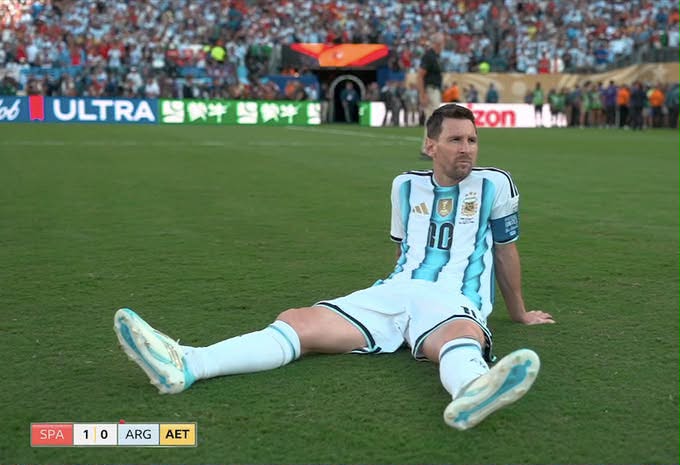
Lionel Messi Has Now Lost Two of His Three FIFA World Cup Finals: A Legacy That Transcends Victory and Defeat
Few players in the history of football have experienced the breathtaking highs and heartbreaking lows of the FIFA World Cup quite like Lionel Messi. Across nearly two decades of international football, the Argentine captain has carried the hopes of an entire nation on his shoulders, inspiring millions with moments of magic while enduring the crushing disappointments that come with competing at the highest level.
With Argentina’s defeat to Spain in the 2026 FIFA World Cup final, a remarkable statistic has emerged: Lionel Messi has now lost two of the three World Cup finals he has played. While some may choose to focus on the losses, the statistic tells only part of a much larger story—one that reflects extraordinary longevity, unmatched consistency, and an enduring commitment to representing his country on football’s biggest stage.
For many footballers, simply reaching one World Cup final is considered the pinnacle of an international career. Messi reached three. That achievement alone places him in an elite category occupied by only a handful of players in football history.
The Long Journey to the Biggest Stage
Lionel Messi’s World Cup story did not begin with glory. It began with dreams, expectations, and enormous pressure.
Since making his World Cup debut as a teenager, Messi has been viewed as Argentina’s next football icon. Comparisons with Diego Maradona followed him everywhere. Every tournament became another opportunity for fans and critics to judge whether he could deliver football’s greatest prize for his country.
Those expectations only intensified as his club career reached unimaginable heights. Having won countless league titles, domestic cups, UEFA Champions League trophies, and individual awards, one question continued to dominate discussions:
Could Lionel Messi win the FIFA World Cup?
For years, the answer remained elusive.
The Heartbreak of Brazil 2014
The first World Cup final of Messi’s career came in Brazil in 2014.
Argentina produced an impressive tournament, relying on disciplined defending, resilience, and moments of brilliance from their captain. Messi inspired his teammates throughout the competition, delivering crucial goals and assists while leading Argentina to their first World Cup final since 1990.
Standing in their way was Germany.
The final was tense, tactical, and fiercely contested. Argentina created several opportunities, with Gonzalo Higuaín famously missing one of the game’s biggest chances. Messi himself came agonizingly close with an effort that drifted narrowly wide.
For over 110 minutes, neither side could break the deadlock.
Then came Mario Götze’s unforgettable goal in extra time.
Germany claimed a 1–0 victory, leaving Argentina devastated. Messi walked past the World Cup trophy without touching it—a moment that became one of the defining images of modern football.
Although he received the tournament’s Golden Ball award as its best player, the individual recognition could not erase the pain of losing the biggest match of his career.
For many observers, it seemed that Messi’s opportunity to become a World Cup champion had slipped away forever.
Years of Criticism
The years following the 2014 final were incredibly difficult.
Argentina suffered further disappointments in consecutive Copa América finals, losing twice to Chile on penalties. Messi faced relentless criticism despite consistently being his nation’s best player.
Some questioned his leadership.
Others questioned his mentality.
There were even calls suggesting he would never emulate Diego Maradona’s achievements with Argentina.
At one point, overwhelmed by disappointment, Messi briefly announced his retirement from international football.
Fortunately for Argentina—and football itself—he changed his mind.
Redemption in Qatar
The 2022 FIFA World Cup transformed everything.
Entering the tournament, Messi openly admitted it would likely be his final World Cup. Argentina arrived in Qatar carrying enormous expectations after winning the Copa América the previous year.
The tournament began with a shocking defeat to Saudi Arabia.
Instead of collapsing, Argentina responded magnificently.
Messi inspired his teammates through every stage of the competition, producing memorable performances against Mexico, Australia, the Netherlands, Croatia, and finally France.
The final against France became one of the greatest football matches ever played.
Messi scored twice.
France repeatedly fought back through Kylian Mbappé’s brilliance.
After extra time ended 3–3, penalties decided the champion.
Argentina prevailed.
At last, Lionel Messi lifted the FIFA World Cup.
Images of him kissing the trophy instantly became iconic, ending years of debate over whether he could complete football’s greatest achievement.
For millions of supporters around the world, it represented the perfect ending to one of the sport’s greatest careers.
Yet football still had another chapter to write.
Defying Time
Most players retire from international football shortly after reaching the summit.
Messi chose a different path.
Despite already achieving every major honour available, he continued representing Argentina into his late thirties.
His decision surprised many observers.
Competing at the highest level becomes increasingly difficult with age, especially in international tournaments requiring immense physical and mental endurance.
Nevertheless, Messi adapted his game brilliantly.
Rather than relying exclusively on explosive pace, he focused on intelligence, positioning, passing, and vision.
His experience became one of Argentina’s greatest strengths.
One More World Cup
The 2026 FIFA World Cup presented another remarkable milestone.
At an age when most football legends had long retired, Messi remained Argentina’s inspirational leader.
Many questioned whether he could still compete against younger opponents.
He answered those doubts throughout the tournament.
Argentina once again reached the final.
Doing so meant Messi had achieved something incredibly rare—appearing in three FIFA World Cup finals.
Very few players in football history have managed such consistency across multiple generations of teammates and tactical eras.
His leadership once again proved invaluable.
Argentina defeated difficult opponents on the road to the championship match, showing resilience and determination throughout the tournament.
The Final Against Spain
Standing between Argentina and consecutive World Cup titles was Spain.
The final promised everything football fans could hope for.
Two technically gifted teams.
World-class players.
Global attention.
Massive expectations.
Both nations understood the historical significance of the occasion.
Spain sought to reclaim football’s greatest prize.
Argentina hoped to defend their title.
Messi once again captained his country on football’s biggest stage.
Despite Argentina’s determination, Spain ultimately emerged victorious with a narrow victory, ending Argentina’s dream of back-to-back World Cup triumphs.
For Messi, the defeat meant another painful World Cup final loss.
His overall World Cup final record now stands at:
2014: Lost to Germany.
2022: Defeated France to become world champion.
2026: Lost to Spain.
One victory.
Two defeats.
Does This Statistic Define His Legacy?
Absolutely not.
Statistics can be powerful, but context matters.
Reaching three World Cup finals across twelve years is itself one of football’s greatest achievements.
Many legendary players never reach even one.
Some of football’s biggest icons retired without ever lifting—or even playing in—a World Cup final.
Messi not only reached three but also inspired Argentina throughout each campaign.
His longevity is extraordinary.
His consistency is extraordinary.
His influence is extraordinary.
The losses should not overshadow the achievement.
Instead, they highlight how incredibly difficult it is to win football’s greatest tournament.
The Weight of Expectation
Perhaps no player has carried more international pressure during the modern era than Lionel Messi.
Every World Cup became a referendum on his legacy.
Every missed opportunity generated endless headlines.
Every victory prompted comparisons with football’s greatest names.
Despite this extraordinary pressure, Messi consistently performed with remarkable composure.
He continued creating chances.
He continued scoring goals.
He continued leading by example.
His resilience became one of the defining characteristics of his career.
A Career Beyond Numbers
Football is often obsessed with statistics.
Goals.
Assists.
Trophies.
Finals won.
Finals lost.
Yet Messi’s influence extends far beyond numerical records.
He transformed how millions view creativity in football.
He demonstrated that intelligence can be just as powerful as athleticism.
He inspired countless young players worldwide to believe that technical excellence could overcome physical limitations.
Every generation has its defining football icon.
For many supporters, Lionel Messi has been that figure.
The Respect of Rivals
One remarkable aspect of Messi’s career has been the admiration he receives from opponents.
Players who spent years trying to stop him often describe him as the greatest footballer they have ever faced.
Managers praise not only his ability but also his professionalism and humility.
Even after defeat, respect for Messi remains universal.
That level of admiration cannot be measured solely by medals.
The Legacy Lives On
As football continues to evolve, Messi’s place in history is already secure.
Whether discussions focus on goals, assists, trophies, longevity, or influence, his name will always be central to conversations about the greatest footballers ever to play the game.
Losing two World Cup finals may become a memorable statistic, but it should never overshadow what those appearances truly represent.
Each final required years of preparation, qualification, exceptional performances, and leadership.
Very few players in history have demonstrated such sustained excellence.
Final Thoughts
Lionel Messi’s World Cup journey has been filled with triumph, heartbreak, perseverance, redemption, and inspiration. The statistic that he has now lost two of his three World Cup finals is accurate, but it captures only one chapter of a much richer story.
He experienced the agony of defeat in Brazil in 2014, reached the pinnacle by lifting the trophy in Qatar in 2022, and endured another painful loss in the 2026 final against Spain. Through it all, he remained the face of Argentine football and one of the sport’s greatest ambassadors.
History will remember that Messi reached three World Cup finals, won one of them, and spent nearly two decades competing at the highest international level. More importantly, it will remember the joy he brought to fans, the unforgettable moments he created, and the lasting impact he had on football itself.
For Argentina, Messi will forever be the captain who fulfilled a lifelong dream by winning the World Cup. For football supporters everywhere, he will remain one of the greatest players ever to grace the game—a legend whose legacy is defined not only by trophies, but by resilience, brilliance, and an unwavering passion for representing his nation on the world’s biggest stage.