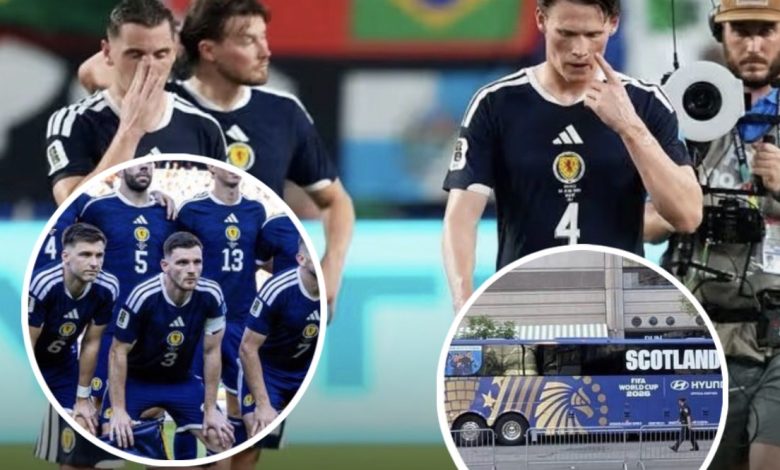
Scotland’s painful FIFA World Cup defeat to Brazil has sparked fresh debate over the future of one of the nation’s biggest stars after extraordinary scenes following the final whistle reportedly saw the team’s most valuable player left behind by the team bus.
The result itself was difficult enough for Steve Clarke’s side to accept. Brazil produced a clinical display to secure an emphatic victory, exposing Scotland’s defensive weaknesses while demonstrating why they remain among the favourites to lift the trophy. But as supporters attempted to process the defeat, attention quickly shifted away from the football and towards what happened after the match.
Reports and videos circulating on social media suggested that one of Scotland’s senior figures was not with the rest of the squad as the team bus departed the stadium, leading to widespread speculation among supporters. While the exact circumstances remain unclear, the incident has become the latest talking point surrounding a player who many believe has carried the expectations of an entire nation for several years.
For many fans, the images represented more than just an organisational mishap. They symbolised what has been a frustrating tournament for both the player and Scotland as a whole.
A Night to Forget Against Brazil
Scotland entered the match knowing they faced one of the toughest assignments in international football. Brazil arrived with an attacking lineup packed with pace, creativity and confidence, while Scotland hoped discipline and determination would help bridge the gap in quality.
Instead, Brazil dominated key moments throughout the contest.
Scotland worked tirelessly without possession, but every defensive mistake was punished by a ruthless Brazilian side that moved the ball with speed and precision. Despite occasional moments of promise, Scotland struggled to create sustained pressure in the attacking third.
The midfield found it difficult to control possession, while Brazil’s forwards consistently stretched the Scottish back line.
As the goals arrived, confidence visibly drained from Steve Clarke’s players.
By full-time, the disappointment was evident on every face wearing dark blue.
Supporters who had travelled thousands of miles to back the national team applauded their players, but there was little disguising the frustration surrounding another heavy defeat on the biggest stage.
The Team Bus Incident
The biggest talking point after the match was not one of Brazil’s goals.
Instead, supporters noticed that Scotland’s most valuable player appeared to have been left behind when the team bus departed from the stadium.
Videos shared online immediately generated debate.
Some supporters questioned whether the player had remained behind to complete media duties, anti-doping procedures or television interviews.
Others wondered if there had been confusion over transport arrangements.
A number of fans interpreted the situation emotionally, suggesting it reflected the difficult mood inside the Scotland camp following the defeat.
At this stage, there has been no official confirmation that the player was intentionally left behind, nor any indication that disciplinary action was involved.
Without confirmation from the Scottish Football Association or the coaching staff, much of the online discussion remains speculation.
“He Cost Us the Game”
Football supporters often search for individual players to blame after disappointing results, and this defeat was no different.
Across social media, opinions were divided.
Some fans argued that Scotland’s most valuable player failed to deliver when his country needed him most.
Others insisted he was unfairly criticised for a collective team performance that fell below expectations.
Critics pointed to misplaced passes, missed opportunities and moments where leadership was required but seemingly absent.
Supporters defended him by highlighting the lack of support around him, arguing that even the world’s best players struggle when isolated against elite opposition like Brazil.
The reality is that football matches are rarely lost because of one individual.
Scotland were second best across several areas of the pitch, and Brazil’s overall quality proved decisive.
Still, high-profile players inevitably receive the greatest scrutiny.
Expectations Have Never Been Higher
Being Scotland’s most valuable player comes with enormous responsibility.
Every international window brings expectations that he will inspire victories, create moments of magic and carry the nation through difficult matches.
That burden can become overwhelming.
Supporters naturally expect star players to influence games, but international football often presents unique challenges.
Unlike club football, national team players spend relatively little time training together.
Building chemistry, tactical understanding and attacking partnerships takes time.
Against a side as technically gifted as Brazil, even established international stars can struggle to impose themselves.
Has Time Finally Caught Up?
One question increasingly being asked is whether this tournament marks the beginning of the end for the player’s Scotland career.
International football moves quickly.
New generations emerge.
Young players demand opportunities.
Managers constantly balance loyalty to experienced professionals with the need to build for the future.
If Scotland are to compete consistently at future major tournaments, Steve Clarke—or whoever leads the national team in years ahead—may eventually need to refresh the squad.
That does not necessarily mean immediately moving on from experienced stars.
However, every disappointing campaign increases the pressure for change.
Supporters have already begun debating whether younger players deserve more prominent roles.
Steve Clarke Faces Difficult Decisions
Few managers have transformed Scotland’s fortunes like Steve Clarke.
He guided the national team back to major tournaments and restored belief after years of disappointment.
However, international management is judged almost entirely on tournament performances.
Heavy defeats inevitably raise difficult questions.
Should Scotland continue relying on experienced leaders?
Should tactical adjustments be made?
Should younger players be trusted sooner?
The Brazil defeat has intensified those debates.
Clarke now faces the challenge of lifting morale while ensuring criticism does not permanently damage squad unity.
Dressing Room Response
One of the biggest tests following any heavy defeat is the dressing room atmosphere.
Players naturally experience disappointment differently.
Some become angry.
Others remain quiet.
Many replay mistakes repeatedly in their minds.
Leadership becomes essential.
Senior players must ensure frustration does not become division.
Regardless of the circumstances surrounding the team bus incident, Scotland will hope the squad remains united heading into future matches.
Successful international teams recover quickly from setbacks.
Allowing disappointment to linger rarely produces positive results.
Fan Reactions
Supporters expressed a wide range of emotions after the match.
Some argued the team simply encountered a superior opponent.
Others believed Scotland lacked ambition and attacked too cautiously.
Several fans defended the player at the centre of attention, insisting one poor performance should not erase years of loyal service.
Others claimed change had become unavoidable.
The debate highlighted how passionate Scotland supporters remain about the national team.
Even after painful defeats, expectations continue to rise.
That reflects how far the programme has progressed under recent management.
Looking Beyond One Match
One defeat should never define an international career.
Many legendary footballers have endured disappointing tournaments before returning stronger.
Equally, football evolves rapidly, and every player eventually reaches the point where younger talent begins challenging for a starting place.
Whether this match proves to be the beginning of the end or simply another difficult chapter will depend on how both the player and Scotland respond in the months ahead.
Performances, rather than emotions, will ultimately determine future selection.
Lessons Scotland Must Learn
Brazil demonstrated the importance of technical quality, composure under pressure and clinical finishing.
Scotland can take valuable lessons from the experience.
Improving ball retention, creating more attacking opportunities and developing greater squad depth should become priorities moving forward.
International tournaments provide harsh education.
The challenge is ensuring those lessons translate into future progress.
The Bigger Picture
While headlines have focused on one player and one unusual post-match incident, Scotland’s performance reflected broader issues rather than individual shortcomings alone.
Brazil deserved their victory because they controlled the game’s decisive moments.
Scotland now face the far more important task of responding positively.
Whether the team bus incident proves to be nothing more than an unfortunate misunderstanding or becomes symbolic of a difficult evening, it should not overshadow the need for honest reflection throughout the squad.
Supporters will hope this painful defeat becomes a turning point rather than the beginning of decline.
As for Scotland’s most valuable player, only time will determine whether this tournament represents the closing chapter of an outstanding international career or simply another obstacle before one final resurgence in the famous dark blue shirt.
Football has a remarkable habit of offering redemption to those willing to fight for it.
The coming months may provide the answer.