HOW SCOTLAND CAN STILL QUALIFY FOR THE WORLD CUP KNOCKOUTS — AND WHO THEY COULD FACE DESPITE BRAZIL DEFEAT

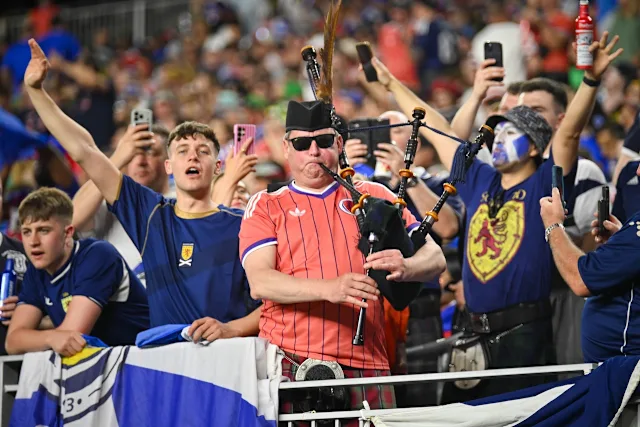
Scotland’s hopes of reaching the World Cup knockout stages suffered a major blow after a heavy 3-0 defeat to Brazil, but Steve Clarke’s side are not out of the tournament just yet.
The loss left the Scots facing an anxious wait as they look to secure one of the places available in the expanded 48-team FIFA World Cup format. While Brazil comfortably booked their place in the Round of 32 as Group C winners, Scotland must now rely on the tournament’s best third-placed qualification route to extend their stay in North America.
Although the defeat was disappointing, Scotland’s earlier victory over Haiti means they still have a realistic chance of progressing. The expanded World Cup format has created additional opportunities for teams finishing third in their groups, and Scotland remain firmly in that conversation.
How the New World Cup Format Works
For the first time in history, the World Cup features 48 nations split into 12 groups of four teams.
The top two teams from each group automatically qualify for the knockout stages, accounting for 24 places. They are joined by the eight best third-placed teams across the 12 groups, creating a 32-team knockout bracket.
This means finishing third no longer automatically results in elimination. Instead, teams are ranked against other third-placed nations based on points, goal difference, goals scored and other tiebreakers.
Scotland’s qualification hopes therefore depend not only on their own results but also on outcomes elsewhere in the tournament.
What Scotland’s Position Means
Scotland finished Group C behind Brazil and Morocco after defeats to both nations and a victory over Haiti.
The win over Haiti ensured Scotland collected three points from their three matches. While that total does not guarantee qualification, it keeps them in contention among the third-placed teams.
Historically, three points would often be insufficient to progress from a World Cup group. However, the new format changes the equation significantly.
With 12 groups in operation, several third-placed teams are expected to finish on three points or fewer. Scotland therefore remain very much alive as the final round of group-stage matches across the tournament are completed.
The crucial factors now become goal difference and goals scored.
Scotland’s heavy defeat to Brazil damaged their goal difference, meaning they are vulnerable if several other third-placed teams finish level on points. However, there remains a realistic pathway into the Round of 32 if results elsewhere prove favourable.
The Results Scotland Need
The simplest route for Scotland is for enough third-placed teams in other groups to finish with fewer than three points.
If several groups produce clear top-two finishers while the bottom two sides struggle to collect points, Scotland’s tally could prove sufficient.
The Scots will also be hoping that third-placed teams in other groups do not build superior goal differences.
Every draw and narrow defeat elsewhere could prove significant. Fans will find themselves closely monitoring multiple groups over the coming days as qualification permutations become clearer.
Scotland’s fate is effectively in the hands of teams they have never faced during the tournament.
Should enough results fall their way, they could sneak into the knockout stages despite finishing third in Group C.
Why the Haiti Victory Could Be Crucial
When Scotland defeated Haiti earlier in the tournament, it may not have appeared to be a defining result.
However, that victory could ultimately become one of the most important wins in recent Scottish football history.
Had Scotland drawn or lost that match, they would almost certainly have been eliminated following the defeat to Brazil.
Instead, the three points secured against Haiti have given them a fighting chance.
Tournament football is often about maximising opportunities, and Scotland did exactly that against the group outsiders.
Now they must hope that victory carries enough weight when the final third-place rankings are calculated.
What Steve Clarke Said
While disappointment understandably followed the Brazil defeat, Scotland’s manager insisted the team still had reason to remain optimistic.
Clarke praised his players’ effort against one of the tournament favourites and stressed that qualification remained possible.
The Scotland boss acknowledged Brazil’s quality but pointed to the fact that reaching the knockout stages was always likely to require patience and resilience.
Players and supporters alike now face a nervous wait as results from other groups determine whether their World Cup dream continues.
Potential Knockout Opponents
If Scotland do qualify as one of the best third-placed teams, they are likely to face one of the tournament’s strongest nations in the Round of 32.
That is the trade-off for advancing through the third-place route.
The exact opponent depends on Scotland’s final ranking among the qualified third-placed teams and how FIFA allocates those teams within the knockout bracket.
Possible opponents could include group winners from several sections of the tournament, including traditional powerhouses such as France, Argentina, Spain, Germany or Portugal, depending on how the final standings unfold.
Brazil would not be an immediate opponent because the tournament bracket is designed to separate teams emerging from the same group during the opening knockout round.
Scotland could therefore find themselves preparing for another major challenge against one of world football’s elite nations.
Could Scotland Cause an Upset?
Reaching the knockout stages would immediately transform the mood around Scotland’s campaign.
A team that appeared destined for elimination would suddenly have a chance to make history.
World Cup tournaments have repeatedly shown that momentum can shift quickly once the knockout rounds begin.
Several nations have recovered from difficult group stages before embarking on memorable runs.
Scotland’s strengths remain organisation, discipline and determination. While they would almost certainly enter any Round of 32 tie as underdogs, knockout football often rewards teams capable of remaining compact and taking their chances.
One strong performance could be enough to produce a famous upset.
The Significance for Scottish Football
Qualification for the knockout stages would represent one of Scotland’s greatest achievements on the global stage.
The nation has endured decades of frustration at major tournaments, often falling short despite moments of promise.
Advancing beyond the group phase would provide a significant boost for Scottish football and validate the progress made under Clarke’s management.
It would also inspire a new generation of supporters and players, demonstrating that Scotland can compete with some of the world’s best teams.
Even after the defeat to Brazil, that possibility remains alive.
Why Brazil Were Simply Too Strong
Brazil entered the match as overwhelming favourites and showed exactly why they are considered contenders to lift the trophy.
Their technical quality, attacking depth and ability to control possession proved too much for Scotland.
The South Americans dominated large periods of the contest and punished Scotland whenever opportunities arose.
Despite the result, Scotland can take encouragement from competing against a team expected to challenge for the World Cup title.
There is no shame in losing to a nation of Brazil’s calibre, particularly when qualification hopes remain intact.
The Waiting Game Begins
For now, Scotland can do nothing except watch and wait.
The players have completed their group-stage campaign and must rely on results elsewhere to determine whether they will feature in the knockout rounds.
Supporters across Scotland will be calculating points totals, goal differences and qualification scenarios as other groups conclude.
It is an uncomfortable position to be in, but it is far better than being mathematically eliminated.
The expanded World Cup has created opportunities that would not have existed under previous formats.
Scotland remain beneficiaries of that system.
Verdict
The 3-0 defeat to Brazil was a setback, but it was not necessarily the end of Scotland’s World Cup journey.
Thanks to their victory over Haiti, Steve Clarke’s men remain in contention for one of the coveted best third-placed qualification spots.
Their chances will depend heavily on results elsewhere, with points totals and goal difference likely to determine their fate.
Should enough outcomes go in their favour, Scotland could find themselves celebrating a place in the Round of 32 despite finishing behind Brazil and Morocco in Group C.
The wait may be nerve-racking, but hope remains alive.
And if Scotland do squeeze through, an enticing knockout clash against one of the tournament’s giants could be waiting just around the corner.