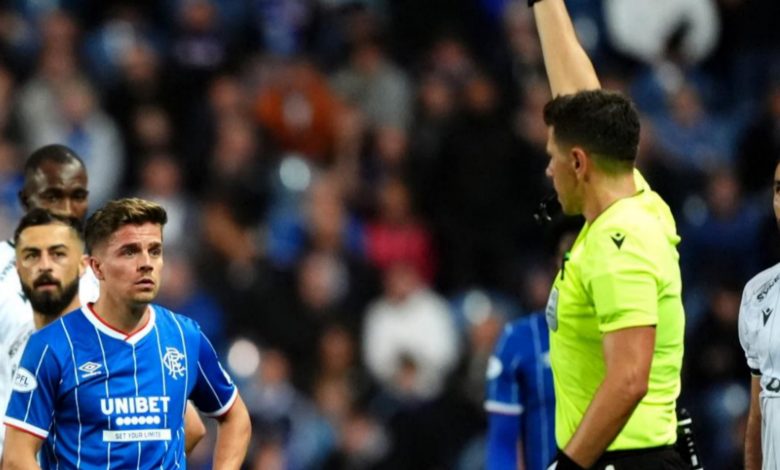
In the cold light of the morning after a tense European night at Ibrox, the confirmation arrived from Nyon that Rangers supporters had been dreading. UEFA’s disciplinary processes had reviewed the red card shown to Cammy Devlin in the first leg of the UEFA Conference League play-off against FK Jablonec, and the outcome was unambiguous: the sending-off stands, the automatic suspension applies, and the Australian midfielder will miss the return leg in the Czech Republic. For a support base already living on the edge of every European campaign, it was the precise verdict they did not want to hear.

The incident itself had unfolded with a mixture of confusion, shock and the peculiar theatre that only modern VAR can produce. Rangers led 1-0 through Ryan Naderi’s second-half strike in a match that had been more attritional than fluent. Derek McInnes’s side, still finding their rhythm under the new manager after a busy summer of recruitment, were protecting a slender advantage when Devlin was introduced from the bench around the 69th minute. Within five minutes the night had turned.
The ball was played into Devlin on the edge of the Jablonec box. What followed looked, in real time to many inside the stadium and to several experienced observers on television, like an attempt to shield possession or to initiate contact in the hope of winning a penalty. Devlin’s body contorted; his foot came through high. Contact was made with the shin of Jablonec defender Jiri (or Jriri) Slama. The Czech player went down. Rangers players and staff, including McInnes, appeared to anticipate a potential spot-kick review. Instead, the referee, Marian Barbu, was directed to the pitchside monitor by the VAR team. When he returned, the red card was produced.
Devlin’s reaction was one of genuin
bafflement. Television cameras captured him asking officials what had happened, the expression of a player who believed he had been the victim of a foul rather than the perpetrator of a sending-off offence. Former Rangers midfielder Kevin Thomson, commentating on Rangers TV, noted the same confusion and suggested the challenge looked more unfortunate than malicious—an attempt to get in front of the defender that resulted in high foot placement and a rash outcome. BBC Sportsound’s Andy Halliday and Steven Thompson initially missed the severity of the contact in real time, debating a possible penalty, before Halliday later apologised and described the studs plant into the leg in stark terms. The consensus that emerged once the replays circulated was that, while the force might have looked less catastrophic in full speed, the still images and the high contact made a red card the only realistic decision under the laws.
McInnes, speaking after the final whistle, did not attempt to defend the indefensible. “Having seen it again, it’s a red card, there’s no debate,” the Rangers manager said. “But I actually think it looks worse than it was. He’s caught the boy on the shin and it looks terrible. The stills of it, it looks like a red card day all day long. But I think it looks worse than it actually was. Not ideal.” Those measured words from a coach who knows Devlin well—having managed him previously at Hearts—carried the weight of reluctant acceptance. The manager’s focus quickly shifted to the broader performance and the need for greater strength in the second leg, but the practical consequence was already clear.
UEFA’s disciplinary framework for serious foul play in European competition leaves little room for ambiguity in the immediate aftermath of a straight red card. The referee’s decision on the field is final in most respects; only in cases of clear and obvious error (such as mistaken identity) do the control and disciplinary bodies reopen the on-field call itself. The automatic suspension that follows a red card for serious foul play is the standard one-match ban, applied to the next relevant fixture in the competition. In this instance, that fixture is the second leg in Jablonec. Appeals or requests for reduction are possible in theory, but the threshold is high and the timeline tight. The official statement that reached clubs and media confirmed what logic already dictated: Devlin is unavailable for the return match.
That confirmation landed like a blow for the Rangers support. The first-leg victory had been hard-earned and far from convincing in the opening period. A slender one-goal cushion away from home against a motivated Czech side is precarious at the best of times. Losing a combative, high-energy midfielder who had been signed precisely for his tenacity and ability to disrupt opponents only sharpened the sense of vulnerability. Devlin’s style—aggressive, relentless, occasionally over the top—has always been part of his value and part of his risk. Supporters who had already taken to the Australian’s wholehearted approach in pre-season and early domestic appearances now faced the prospect of navigating a crucial European night without him.
The context of Devlin’s arrival at Ibrox adds another layer. Having left Hearts under freedom of contract after five years and more than 150 appearances, the 28-year-old reunited with McInnes at Rangers in July 2026 on a two-year deal with the option of a further year. He had been part of the Hearts side that pushed Celtic all the way in the previous Premiership title race. At Ibrox he was expected to bring the same intensity that had made him a favourite in Edinburgh and a regular in the Socceroos setup, including selection for the 2026 World Cup squad. His early weeks had shown flashes of that same pestilential energy that Scottish opponents had come to know. European refereeing, however, has long been less forgiving of the physical edge that sometimes passes in the Premiership. Devlin himself had previously acknowledged that continental officials might not afford him the same latitude, while insisting he would not fundamentally change the way he plays.
The second leg now becomes a sterner test of the squad depth McInnes has been building. Eleven signings already completed, with the manager indicating more arrivals remain possible, have given Rangers options. Yet the absence of a player of Devlin’s particular profile in a high-stakes away fixture removes a certain disruptive presence that can unsettle opponents and protect a lead. The slender advantage must be defended with discipline and clinical finishing on the counter if opportunities arise. Jablonec will sense an opening; the home crowd in the Czech Republic will demand aggression. Rangers must answer without one of their more combative midfield options.
Beyond the immediate tactical headache lies a broader familiar tension for Rangers in Europe. European campaigns have repeatedly been defined by fine margins, controversial decisions, and the cost of individual errors. A red card that feels harsh in the moment but is upheld under the letter of the law is not unique. What stings supporters is the timing and the sense that a moment of misjudgement—whether an over-eager attempt to win a penalty or a simple loss of balance resulting in high contact—has removed a useful player from a decisive night. The official UEFA confirmation closes the door on hope of a last-minute reprieve and forces the club to plan without him.
Devlin’s personal reaction will matter. Players who receive unexpected red cards often speak of shock followed by determination to make amends. His history includes previous dismissals and the subsequent public accountability that follows. At Hearts he had faced the consequences of rash challenges and responded with renewed application. The same response will be required at Rangers, both in the dressing room and in future performances once the suspension is served. For the manager, the episode serves as an early reminder of the tighter margins that apply once the competition leaves the domestic calendar.
As the squad prepares for the journey to Jablonec, the focus shifts from the VAR monitor at Ibrox to the practicalities of protecting and, if possible, extending a one-goal lead with ten outfield players who must compensate for a missing midfielder. The official statement from UEFA has removed any remaining ambiguity. The red card stands. The ban applies. Rangers must now prove they can advance without Cammy Devlin on a night when every Rangers fan would have preferred him to be available. The slender advantage remains intact, but the margin for further error has narrowed. In European football, that is often the difference between progress and an early exit.