PREMIER LEAGUE RELEASES OFFICIAL STATEMENT ON WHY LIVERPOOL PENALTY WAS AWARDED — DESPITE THERE APPEARING TO BE NO CONTACT
The Premier League has provided an explanation for the controversial penalty awarded to Liverpool in their dramatic 2-2 draw with Newcastle United, with the decision becoming one of the biggest talking points of the match.
Liverpool appeared to have been heading towards defeat at St James’ Park before a late VAR-reviewed incident inside the Newcastle penalty area resulted in a spot-kick being awarded.
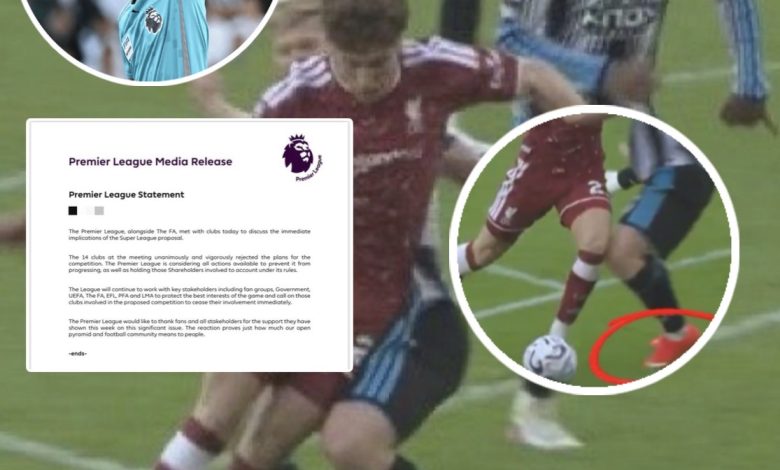
The decision immediately divided opinion, particularly among Newcastle supporters, with several replays appearing to show little obvious contact between the players.
With the game entering its final moments, the penalty carried enormous significance. Liverpool had the opportunity to rescue a point, while Newcastle were just moments away from securing what would have been a hugely valuable victory.
WHY DID THE REFEREE AWARD THE PENALTY?
The incident involved Liverpool substitute Victor Muñoz and Newcastle defender Lewis Hall inside the penalty area.
Muñoz went to ground following the challenge, prompting referee Stuart Attwell to point towards the penalty spot. Newcastle players immediately protested the decision, while Liverpool were presented with an opportunity to level the score.
The incident was subsequently checked by VAR, with the officials assessing whether there was enough contact to justify the on-field decision.
The explanation centres around the fact that Hall was deemed to have made contact with Muñoz while attempting to defend the situation, despite not making contact with the ball.
That distinction proved important.
From the officials’ perspective, the issue was not simply whether the contact looked significant enough to supporters watching the replay. The question was whether the defender’s action constituted an offence inside the penalty area.
THE CONTACT BECOMES THE BIG DEBATE
The controversy has largely come from the perception that the contact was minimal.
Football supporters are accustomed to seeing penalties overturned when replays show that an attacking player has initiated contact, exaggerated a challenge or gone to ground without being sufficiently impeded.
That is why the incident at St James’ Park has generated such debate.
Newcastle fans have argued that the available replays did not appear to show the type of obvious contact normally associated with a penalty. Others have questioned whether the incident should have been considered a clear and obvious error if the referee’s original decision was allowed to stand.
However, the Premier League’s position is that there was sufficient contact for the referee’s decision to be supported.
The fact that VAR did not overturn the decision is also significant.
WHY DID VAR NOT INTERVENE?
VAR is not designed to re-referee every decision made on the pitch.
For an on-field decision to be overturned, the VAR team must determine that the original decision was clearly and obviously wrong.
That means there can be situations where supporters disagree with a decision but VAR does not intervene because the incident falls within the referee’s reasonable interpretation of what happened.
That appears to be the key point in this case.
Once VAR determined that contact had occurred and that Hall had not played the ball, there was not considered to be sufficient grounds to overturn the penalty.
For Newcastle supporters, however, that explanation may not make the decision any easier to accept.
NEWCASTLE WERE SECONDS AWAY FROM A HUGE WIN
The timing of the decision made the controversy even more painful for the home side.
Newcastle had twice taken the lead during an entertaining contest and looked increasingly likely to hold on as the clock moved into stoppage time.
Anthony Elanga gave Newcastle the advantage before Liverpool responded through Cody Gakpo.
The home side then regained the lead through Joe Willock, putting Newcastle in a position to claim all three points.
Liverpool refused to give up, however, and continued searching for an opportunity.
That opportunity eventually arrived in the Newcastle penalty area.
The resulting spot-kick completely changed the mood inside St James’ Park.
SZOBOSZLAI ACCEPTS THE RESPONSIBILITY
With Liverpool needing a goal to avoid defeat, Dominik Szoboszlai stepped forward to take the penalty.
The pressure could hardly have been greater.
A successful penalty would rescue Liverpool from what had looked like a defeat. A miss would leave Newcastle celebrating a major victory.
Szoboszlai kept his composure and converted, sending the goalkeeper the wrong way and making it 2-2.
The Liverpool players celebrated wildly, while the reaction inside the stadium was understandably very different.
For Newcastle, it felt like victory had been taken away at the final possible moment.
THE ARGUMENT OVER CONSISTENCY
One of the biggest issues raised by the incident is consistency.
Supporters frequently accept that referees can make difficult decisions, but they want to see similar incidents treated in the same way across different matches.
That is where the debate surrounding this penalty is likely to continue.
If minimal contact is enough for a penalty in one situation, supporters will naturally ask whether similar contact will receive the same treatment elsewhere.
The Premier League’s explanation may clarify the officials’ reasoning, but it does not necessarily settle the wider argument about the threshold for awarding penalties.
LIVERPOOL’S POINT COULD PROVE IMPORTANT
From Liverpool’s perspective, the controversy will matter far less than the final result.
They leave St James’ Park with a point after recovering from behind twice, and the late penalty could prove significant as the season develops.
Dropping points in a match where they were behind twice could have been costly, so rescuing a draw will be viewed positively by the Liverpool camp.
Newcastle, meanwhile, will be left wondering how they failed to turn such a strong performance into three points.
NEWCASTLE FANS WILL FEEL HARD DONE BY
The reaction from Newcastle supporters is likely to centre less on whether contact technically occurred and more on whether that contact was enough to warrant such a consequential decision.
There is a major difference between saying a player was touched and saying a player was fouled.
That distinction is at the heart of the argument.
Newcastle fans will point towards the replays and argue that the contact appeared too minor to justify a penalty, particularly in the final seconds of a Premier League match.
Liverpool supporters will naturally see it differently, pointing to the fact that the defender made contact inside the penalty area and did not win the ball.
THE FINAL VERDICT?
The Premier League’s explanation essentially answers the technical question: the penalty was awarded because the officials determined that there was sufficient contact between the Newcastle defender and the Liverpool attacker, with Hall failing to make contact with the ball.
But the explanation does not end the debate.
If anything, the decision is likely to remain one of the most discussed moments from the match.
For Newcastle, it is a painful reminder of how fine the margins can be in Premier League football. For Liverpool, it is a valuable point rescued in dramatic circumstances.
And for supporters watching from outside both camps, the incident raises the familiar question surrounding VAR and penalty decisions:
Should minimal contact inside the box really be enough to decide the outcome of a Premier League match?
That is the question Newcastle supporters will continue to ask long after the final whistle.