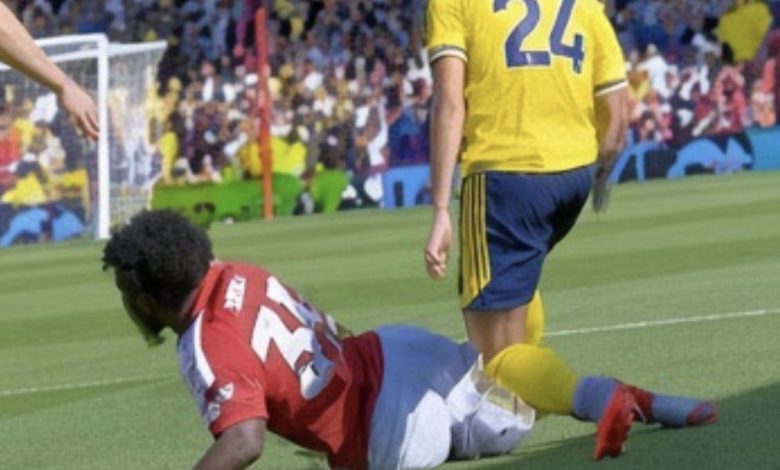
Leeds United began their Premier League campaign with a dramatic 1–0 victory over Nottingham Forest, but the result was overshadowed by a controversial first-half incident involving a challenge on James Justin.
The incident quickly became one of the biggest talking points of the match after Nottingham Forest defender Ola Aina was shown a yellow card for a challenge on the Leeds player. VAR subsequently reviewed the incident for a possible red card for serious foul play, but the decision to keep the punishment at yellow was allowed to stand.
For many Leeds supporters, the decision was difficult to understand. The challenge appeared dangerous, and the fact that VAR spent a significant amount of time reviewing the incident only added to the frustration. The images from the incident have since circulated widely among supporters, with many questioning why the tackle did not result in a dismissal.
The controversy came during a match that was already full of talking points. Leeds eventually secured all three points thanks to a late free-kick from Anton Stach, who found the net in the 88th minute to give Daniel Farke’s side a hugely important opening-day victory.
However, the result did not completely remove the frustration surrounding the earlier incident.
Why was the challenge reviewed?
The tackle was serious enough for VAR to examine whether it crossed the threshold for serious foul play. That distinction is important because not every dangerous-looking tackle automatically results in a red card.
VAR is only expected to intervene when there is a potential clear and obvious error involving a sending-off offence. In this case, the review concluded that the original yellow-card decision should stand. ESPN reported that the challenge was reviewed specifically for serious foul play before Aina remained on the pitch.
That decision has created a major debate among Leeds fans because the incident looked extremely uncomfortable from several angles.
The question is not simply whether contact was made. The key issue is whether the challenge involved excessive force or endangered the safety of the opponent to the extent required for a straight red card.
That is where the disagreement begins.
Leeds fans expected a red card
From a Leeds perspective, there is an obvious argument that the challenge deserved greater punishment.
Supporters saw their player on the receiving end of a heavy challenge and then watched the VAR process unfold. Naturally, many expected the referee to return to the pitch and upgrade the yellow card.
Instead, the original decision remained unchanged.
That has led to frustration among supporters who believe the threshold for red cards is becoming increasingly difficult to understand.
One of the biggest problems with VAR is that supporters can see the same incident repeatedly from slow-motion angles. What initially looks like a normal tackle can appear considerably worse when replayed frame by frame.
At the same time, refereeing decisions cannot be based purely on how dramatic an incident looks on television.
The officials have to apply the laws and determine the level of force, the manner of the challenge and the potential danger to the opponent.
The timing made the controversy even bigger
The incident occurred early enough in the match that a red card would have completely changed the contest.
Nottingham Forest were hoping to make a strong start under Oliver Glasner, while Leeds were looking to begin their campaign positively.
A dismissal would have left Forest playing with ten men for a large portion of the game.
Instead, Aina stayed on the pitch and Forest continued to create opportunities.
The home side ultimately failed to score, but they had several chances. Nikola Milenkovic hit the post, while Igor Jesus also had opportunities that could have changed the result.
This is why the decision remains so significant for Leeds supporters.
Had Forest won or drawn the match, the discussion around the tackle would probably have been even louder.
Leeds eventually had the last laugh
Despite the controversy, Leeds found a way to leave the City Ground with three points.
For much of the match, Forest looked dangerous and created the better opportunities, while Leeds struggled to consistently threaten the home defence.
But football is ultimately decided by moments.
With just minutes remaining, Stach stepped up to take a free-kick and produced the decisive moment of the afternoon. His effort found the net in the 88th minute, sending the travelling Leeds supporters into celebration.
It meant that all the earlier frustration surrounding the Aina incident suddenly became part of a much bigger story: Leeds had survived the pressure, kept a clean sheet and somehow found a winner late in the match.
Was the decision actually wrong?
This is where the debate becomes more complicated.
It would be too strong to claim as a confirmed fact that the referee or VAR definitely made an incorrect decision.
The available match reports confirm that the challenge was reviewed for serious foul play and that the yellow-card decision remained.
There has also been no verified evidence found showing that the FA has officially issued a separate statement giving a new explanation for the decision.
So while Leeds fans may understandably feel that the challenge deserved a red card, it is important to distinguish between fan opinion and an officially confirmed FA ruling.
That distinction matters if the story is being published as news.
The strongest argument for the Leeds side is that the challenge looked dangerous enough to warrant a much more serious punishment. The strongest argument for the officials is that VAR determined the incident did not meet the required threshold for a straight red.
Both sides can therefore be debated without pretending that an official explanation exists when it has not been verified.
A major talking point for Farke’s team
For Daniel Farke, the most important thing will be that his team left Nottingham with three points.
There were certainly areas for improvement. Forest had opportunities and Leeds were not always comfortable defending their attacks.
But keeping a clean sheet away from home and scoring a late winner is an excellent way to begin a Premier League campaign.
The challenge controversy, meanwhile, is likely to remain a talking point among Leeds supporters for some time.
It also raises a wider question about how VAR should deal with challenges that look dangerous but do not clearly meet the threshold for serious foul play.
If officials are going to maintain a yellow-card decision after such a lengthy review, supporters will naturally want to understand exactly what separates a yellow card from a red card.
The debate is not going away
The biggest frustration for Leeds fans is not simply that the player avoided a red card.
It is the feeling that supporters are often given very little clarity when major VAR decisions are made.
Fans want to understand why one challenge is considered a yellow while another similar-looking challenge becomes a red.
That consistency is crucial.
For now, the official outcome of the incident is clear: Aina was booked, VAR reviewed the challenge for possible serious foul play and the yellow card remained.
Leeds, however, got the result they wanted.
The Whites left the City Ground with a 1–0 victory, a clean sheet and three points, while the controversial tackle became one of the defining talking points of the afternoon.
And that is precisely why the debate will continue among Leeds supporters: was the yellow card enough, or should VAR have sent him off?
For many Leeds fans, the answer appears obvious. For the officials, it was not.
What do you think — was it a clear red card, or was the yellow decision correct?