Leeds United began their 2026/27 Premier League campaign with a dramatic 1-0 victory over Nottingham Forest at the City Ground, but the result could easily have looked very different had Harry Wilson’s first-half effort been allowed to stand.
The summer signing appeared to have given Leeds the lead during a promising spell for Daniel Farke’s side, only for the goal to be ruled out for offside after a VAR check. While the decision immediately sparked debate among supporters, a closer look at the incident explains why the goal was not awarded — and why the controversy has been exaggerated in some Leeds United circles.
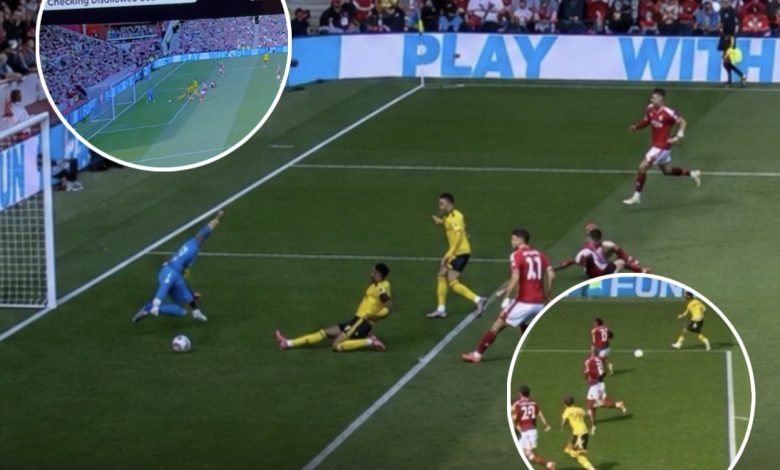
The incident occurred in the 25th minute, rather than the 22nd minute. Leeds worked the ball into the Forest penalty area before Jayden Bogle delivered the ball across goal. Dominic Calvert-Lewin was in an onside position and appeared ready to attack the opportunity, but Wilson moved into the final position and finished from close range. Sky Sports reported that Wilson was in an offside position and took the ball away from Calvert-Lewin to complete the tap-in. (Sky Sports)
That detail is important because the decision was not based on a subjective foul or an interpretation of whether Wilson interfered with a defender. The available match reporting identifies the reason simply as offside. The VAR review therefore had a straightforward question to answer: was Wilson ahead of the relevant defensive line when the ball was played into his path?
The answer given by the officials was yes.
Why did the goal look onside to some Leeds fans?
This is where the confusion surrounding the incident comes from.
The still image circulating online can make it appear as though Wilson is level with the last Forest defender. Offside decisions, however, are judged at the precise moment the ball is played, not when the receiving player eventually touches or shoots the ball.
That distinction is particularly important in a fast-moving attacking sequence. A player can appear level from one camera angle while still being marginally beyond the second-last opponent when the pass is made.
The image supplied with the controversy also illustrates the difficulty. The defensive line is not perfectly straight, while several players are moving in different directions. A conventional television camera can therefore create a misleading perspective.
The VAR system is designed to examine the exact frame at which the ball is played. That is why an apparent goal can remain under review even when the attacking player looks level to the naked eye.
In this case, the evidence from the match reports does not support the claim that Wilson was incorrectly ruled offside. Sky Sports specifically described him as being “clearly in an offside position”, while ESPN’s live commentary also recorded that Wilson’s goal was disallowed for offside. (Sky Sports)
The crucial role of Dominic Calvert-Lewin
There is another interesting element that has been overlooked in the debate.
Wilson did not simply finish a loose ball after being played onside by a defender. The attack involved Calvert-Lewin, and Wilson ultimately took the ball off the Leeds striker to complete the move.
That matters because Calvert-Lewin himself was onside.
Had Wilson remained behind the ball or in an onside position when the pass was made, Leeds would have had a legitimate goal. Instead, Wilson’s movement beyond the defensive line meant that the eventual finish could not stand.
The incident therefore highlights one of the most frustrating aspects of the modern offside law: being onside at the end of an attacking move is irrelevant if the player was already beyond the permitted line when the ball was played.
For supporters watching live, that can feel extremely harsh.
Was VAR actually wrong?
Based on the available evidence from the match, there is no credible confirmation that VAR made an error.
In fact, the major match reports agree on the basic explanation. Leeds’ official match report confirms that the game ended 1-0 after Anton Stach’s 88th-minute free-kick, while Sky Sports and ESPN both record Wilson’s earlier effort as a disallowed offside goal. (Leeds United)
There is also an important distinction between saying “fans are furious” and saying “the officials made a shocking mistake”.
Those are not the same thing.
Football supporters are naturally going to question an important VAR decision, particularly when it removes what would have been a debut Premier League goal for a new signing. But there is currently no reliable evidence that the Football Association has released a “shocking statement” admitting that the goal should have counted.
That claim should therefore be treated carefully.
The FA does not normally need to issue a statement every time VAR correctly applies the offside law. If an official error were subsequently acknowledged, that would be a separate development requiring confirmation from the relevant authorities.
Leeds were still able to overcome the setback
Perhaps the most encouraging aspect for Farke is that Leeds did not allow the disallowed goal to derail their afternoon.
The Whites continued to compete in a tight contest and eventually found the breakthrough in the 88th minute. Stach produced another outstanding direct free-kick, curling the ball beyond Matz Sels to give Leeds a 1-0 victory. (Leeds United)
The victory was particularly significant because Leeds were playing away from home on the opening weekend of the Premier League season.
It also meant that Wilson’s disallowed effort became a footnote rather than a defining moment of the afternoon.
Had Leeds lost or drawn the match, supporters would probably still be discussing the incident today. Instead, Stach’s late winner ensured that Farke’s side left Nottingham with maximum points.
Wilson’s debut still offered encouragement
Despite having his goal ruled out, Wilson made an important first appearance for his new club.
Farke handed league debuts to Wilson, James Trafford and Tarik Muharemović, with the summer recruits immediately thrown into the intensity of Premier League football. The official Leeds report confirmed that the trio were among the new arrivals involved from the start. (Leeds United)
For Wilson personally, there will obviously be disappointment that his first Leeds goal did not count.
However, the fact that he was in the right area to finish the move is encouraging. Attackers are judged heavily on their ability to arrive in dangerous positions, and Wilson’s involvement demonstrated the attacking threat Leeds can create when their wide players combine with Calvert-Lewin.
His challenge now is to turn those promising positions into goals that cannot be taken away by the offside flag.
The bigger VAR debate
The controversy also opens a wider discussion about VAR and the way offside decisions are communicated to supporters.
Even when the final decision is technically correct, fans can become frustrated when they are shown an image that does not immediately make the decision obvious.
This is one of the reasons why transparency remains such an important part of VAR. Supporters want to understand exactly why a goal has been disallowed rather than simply being told that the system has checked it.
The Premier League has experienced numerous controversial VAR incidents in recent seasons, including decisions where officials later acknowledged errors. That history naturally makes supporters suspicious whenever a major goal is ruled out. (Squawka | EN)
But Wilson’s case should not automatically be placed into that category.
At present, the strongest available evidence points towards a genuine offside decision rather than an incorrect VAR intervention.
Leeds fans have every right to question it — but the evidence matters
There is nothing wrong with Leeds United supporters debating the decision.
Football is built around those arguments. One fan can look at the replay and believe Wilson is level, while another can freeze the footage and reach the opposite conclusion.
What is important is separating frustration from fact.
The goal was disallowed in the 25th minute because Wilson was judged to be offside when the attacking move developed. The available reporting does not show an official admission that the decision was wrong, and there is no confirmed FA statement overturning the decision. (Sky Sports)
That makes the headline that the goal was “cancelled despite not being offside” difficult to substantiate as a factual claim.
For Leeds, however, the most important thing is the result.
Farke’s side eventually secured all three points through Stach’s brilliant 88th-minute free-kick, while Wilson will have another opportunity to open his Leeds account in the matches ahead. (Leeds United)
The offside controversy may continue to dominate social media for a few days, but Leeds supporters will ultimately remember the afternoon for something far more positive: a hard-fought opening-day victory at the City Ground.
And perhaps that is the biggest lesson from the incident. VAR can remove a goal, but it cannot remove the three points.