ATTENTION EVERYONE FANS can’t believe the club position after the release of TOP 25 BIGGEST FOOTBALL CLUBS IN BRITIAN

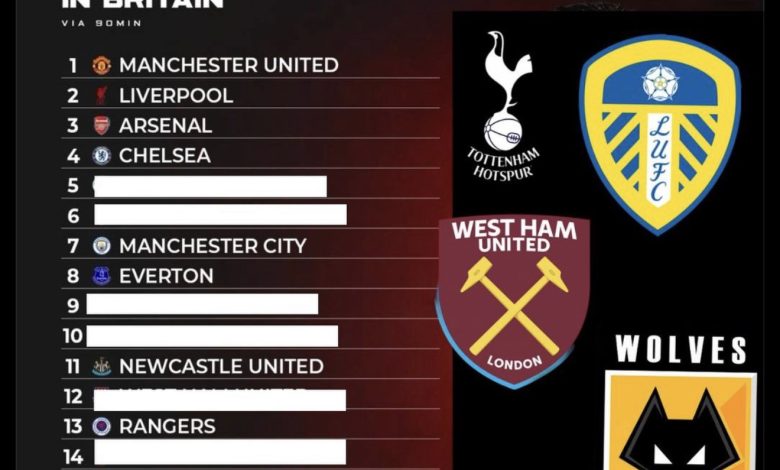
A new ranking of the 25 biggest football clubs in Britain has sparked plenty of debate among supporters, particularly because the list does not simply follow current league position, recent form or transfer spending.The ranking, published by 90min, attempts to measure something much broader: the overall size and historical importance of clubs based on factors such as trophies, fanbases, stadiums, European history, tradition, longevity and the perception of a club within British football. Importantly, 90min itself acknowledged that this was not a purely statistical exercise and described the process as partly based on the collective judgement of its writers. That is what makes the list so interesting.
A club can be struggling in the present day and still be regarded as historically enormous, while another club enjoying an excellent modern period may not yet have the same historical weight.And there is one particular section of the ranking that is likely to leave supporters arguing for days.
CURRENT FORM IS NOT THE ONLY MEASURE
One of the biggest points to understand about the list is that “biggest” does not necessarily mean “best.”
A club does not automatically move up because it is currently competing in the Premier League, playing European football or spending huge sums in the transfer market.
Historical success matters.
So does the size of the supporter base, the club’s identity, major trophies, famous players, European achievements and the amount of time the club has spent competing at the highest level.
That explains why some clubs with relatively limited recent success appear surprisingly high.
It also explains why certain clubs that have enjoyed huge financial investment in recent years are not necessarily placed above clubs with decades of history behind them.
90min’s original ranking made that distinction very clear, explaining that being a big club cannot simply be reduced to raw statistics such as trophies, money or stadium size.
THE TOP FOUR ARE HARDLY A SURPRISE
The first four positions are occupied by four of the most recognisable names in English football.
At No.1 is Manchester United, followed by Liverpool, with Arsenal and Chelsea completing the top four.
There is a considerable historical argument behind all four positions.
Manchester United have won 20 English league titles and have a huge international following. Liverpool have an extraordinary European record, including six European Cups/Champions League titles. Arsenal have one of English football’s most decorated histories, while Chelsea have enjoyed enormous domestic and European success, particularly during the modern era.
But after those four, the debate becomes considerably more interesting.
THEN COMES THE FIRST BIG SURPRISE
The fifth position is particularly important because it demonstrates that the ranking is not exclusively about English football.
A Scottish club appears immediately after the traditional English giants.
That club has a remarkable domestic record, a huge supporter base and an important place in British football history. It has also achieved something that very few British clubs can claim: winning the European Cup.
Its position will inevitably lead to comparisons with several Premier League clubs.
Some supporters will argue that modern commercial power and Premier League exposure should carry more weight. Others will point towards domestic dominance, European history and generations of supporters.
The ranking clearly chose the latter factors to a significant degree.
And then comes another North London club.
THE NEXT POSITION WILL CERTAINLY ATTRACT ATTENTION
The club occupying No.6 has been a consistent presence in the English top flight for much of its modern history.
Its supporters can point towards domestic trophies, European success, a huge modern stadium and a remarkably consistent Premier League record.
90min noted that the club had spent only one of the previous 70 seasons outside the top flight at the time of its ranking, while also highlighting its modern consistency and stadium.
Yet some fans may still question why it sits where it does.
That is exactly why “biggest club” debates are so difficult.
One supporter may place greater importance on trophies. Another may prioritise attendances. Someone else may look at European success, global support or historical influence.
There is no universally accepted formula.
MANCHESTER CITY’S POSITION ALSO TELLS A STORY
Manchester City are seventh.
Considering the club’s enormous success in the modern era, some supporters might immediately ask why they are not higher.
City have dominated English football for significant periods of the Premier League era and have developed into a major force in European football.
However, a historical ranking covering the entire history of British football inevitably gives older achievements and decades of tradition considerable weight.
That means a club’s position cannot simply be calculated by counting trophies from the last 10 or 15 years.
Everton follow City at No.8, with their extraordinary historical record providing much of the argument.
90min highlighted Everton’s nine English league titles, five FA Cups and long-standing presence in the top flight.
THE MIDDLE OF THE LIST IS WHERE THE ARGUMENT REALLY STARTS
Further down, several famous clubs appear in positions that could easily provoke disagreement.
Newcastle United are at No.11.
The Magpies have a huge fanbase, a famous stadium and a long history in English football. They also possess four English league titles and six FA Cups according to the 90min ranking.
Immediately around them are several clubs with extraordinary historical stories.
There is also a Scottish giant sitting at No.13, a club with one of the most decorated domestic records in British football.
And then there is another club whose history includes one of the most remarkable European achievements ever produced by a British side.
That club’s placement is likely to be one of the biggest talking points among supporters.
WHY THE RANKING HAS CAUSED SO MUCH DEBATE
The biggest problem with these lists is that club size is subjective.
Should a club’s modern global following matter more than trophies won decades ago?
Should Premier League success outweigh European Cups won by previous generations?
Should stadium capacity be considered?
What about average attendance?
What about the number of league titles?
And should a club’s historical importance be considered even when its current team is playing outside the Premier League?
There is no simple answer.
90min itself effectively acknowledged this problem by explaining that its ranking was not intended to be a mathematical calculation and that perception and intangible factors were part of the process.
That is why supporters of Leeds United, Nottingham Forest, Wolves, West Ham United and Aston Villa, among others, can make very strong arguments about where their clubs should sit.
SO, WHAT ABOUT THE CLUBS THAT HAVE BEEN HIDDEN?
This is where the graphic becomes particularly interesting.
Several positions were deliberately covered, leaving supporters to guess which clubs were being discussed.
The names hidden in the supplied graphic correspond to Celtic, Tottenham Hotspur, West Ham United, Leeds United, Nottingham Forest, Wolverhampton Wanderers and Aston Villa.
And their positions reveal just how differently 90min viewed historical size compared with simply looking at current Premier League status.
For example, Nottingham Forest’s European history is extraordinary. The club won the European Cup twice under Brian Clough and also won the English league title and multiple domestic trophies.
Leeds United, meanwhile, have three English league titles and a significant European history, while Wolves have won three English league titles and multiple FA Cups and League Cups.
West Ham have never won the English top-flight title, but their FA Cup record, European success, fanbase and historical importance have contributed to their position.
Aston Villa have seven English league titles, seven FA Cups and, perhaps most significantly, a European Cup.
THE FULL REVEAL
After all the suspense, here are the positions represented by the hidden names:
5. Celtic
6. Tottenham Hotspur
9. West Ham United
10. Leeds United
12. Nottingham Forest
14. Wolverhampton Wanderers
17. Aston Villa
The remaining positions shown in the graphic are Manchester United at No.1, Liverpool at No.2, Arsenal at No.3, Chelsea at No.4, Manchester City at No.7, Everton at No.8, Newcastle United at No.11, Rangers at No.13, Leicester City at No.15, Sunderland at No.16, Sheffield Wednesday at No.18, Blackburn Rovers at No.19, Derby County at No.20, Crystal Palace at No.21, West Bromwich Albion at No.22, Sheffield United at No.23, Southampton at No.24 and Fulham at No.25.
That leaves supporters with plenty to argue about.
Is Celtic’s position justified by its domestic dominance and European history? Should Tottenham be higher? Does Leeds belong inside the top 10? Should Nottingham Forest’s two European Cups push them above some of the clubs listed ahead of them? And what about Aston Villa, another European Cup winner, appearing at No.17?
Those questions are precisely why rankings such as this generate so much discussion.
Ultimately, this is 90min’s assessment rather than an official football authority’s definitive measurement of club size. The publication itself says the ranking involved subjective judgement rather than a strict statistical formula.
But that may actually be what makes the debate so entertaining.
If you could change only ONE position on this list, which club would you move — and where would you put them?