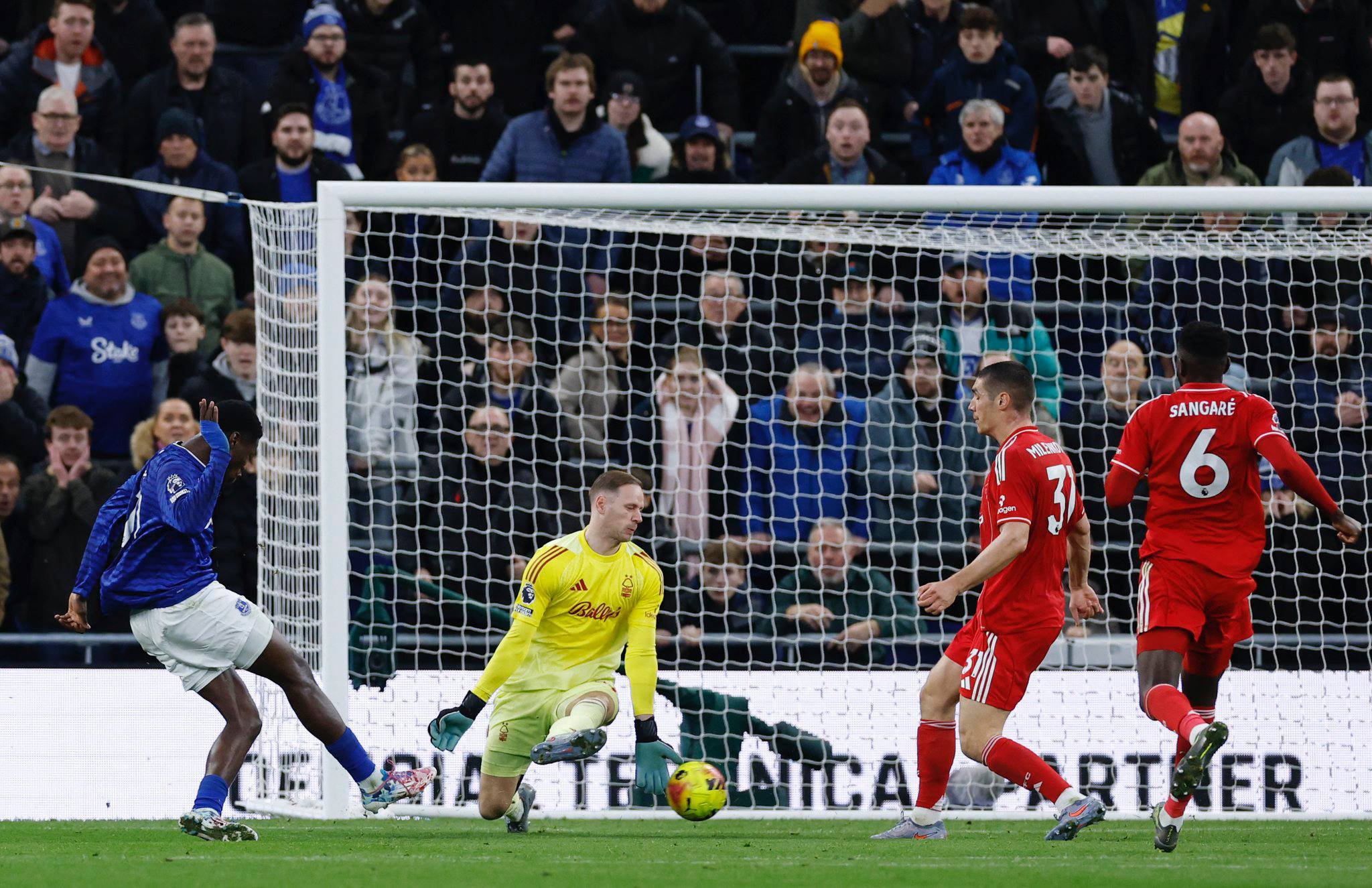
NOTTINGHAM FOREST FANS HAVE SEEN ENOUGH,HE IS THE WORSE PLAYER IN THE WHOLE SQUAD AND THEY WANT HIM OFF THE CLUB ASAP AFTER HIS TERRIBLE PERFORMANCE
Nottingham Forest’s 3–0 humiliation at the hands of Everton has detonated a full-scale crisis among the club’s supporters, and this time, the outrage is no longer vague or collective. It is focused, personal, and ruthless. One player has been singled out as the embodiment of everything that went wrong at Goodison Park — and Forest fans are now demanding, loudly and without hesitation, that he be removed from the club immediately.
This was not just another defeat. This was a psychological collapse, a tactical failure, and, in the eyes of many supporters, proof that certain players are simply not good enough to wear the shirt.
Everton 3–0 Nottingham Forest. The scoreline alone is brutal. The details make it even worse.
A Night That Fell Apart From the First Touch
The match barely had time to breathe before Forest’s nightmare began. An early own goal from Nikola Milenković shattered whatever pre-match structure Nottingham Forest hoped to establish. Defensive disorganisation turned into full-blown panic almost instantly. Everton sensed it. The crowd sensed it. Forest’s back line never recovered.
By halftime, Everton had doubled their advantage through Thierno Barry in stoppage time, exposing Forest’s fragile mentality at the worst possible moment. When Kiernan Dewsbury-Hall added the third in the 80th minute, it was no longer about the scoreline. It became about damage control — and even that proved impossible.
Forest were not simply beaten. They were systematically dismantled.
Fan Ratings Tell a Brutal Story
As the post-match ratings emerged, the fury intensified. While several Forest players were poor, one individual stood out in a deeply embarrassing way. Morato, partnered in central defence with Milenković, recorded the joint-worst rating on the pitch at 2.8, the lowest of all players. In modern Premier League terms, a rating that low is not merely bad — it is catastrophic.
For fans, the numbers only confirmed what their eyes had already seen: positional chaos, weak duels, delayed reactions, mistimed clearances, and a complete lack of authority. Every Everton attack seemed to find space exactly where Forest needed stability the most.
Social media erupted within minutes of the final whistle. Supporters were merciless.
“Worst defender I’ve ever seen at this club.”
“He doesn’t belong in the Premier League.”
“Terminate the contract tonight.”
The language was unforgiving, but it reflected a deeper truth: Forest fans believe this was not an isolated bad game. They see it as the final chapter in a pattern of repeated failure.
When One Player Becomes the Symbol of a Systemic Failure
It is never fair, in purely sporting terms, to reduce a team collapse to one individual. Football is a collective enterprise. Yet fandom is not governed by academic balance. It is driven by emotion, memory, and tolerance thresholds. And for Nottingham Forest supporters, that threshold has now been crossed.
Morato’s display crystallised everything that has frustrated fans throughout the season:
poor defensive anticipation,
lack of composure under pressure,
inability to organise the back line,
and repeated errors that place the entire team in danger.
The own goal may officially sit next to Milenković’s name, but in the court of public opinion, the wider defensive breakdown has been laid at Morato’s door.
Once a player becomes a symbol rather than merely a participant, the relationship between club and supporter is fundamentally broken.
Tactical Exposure and Mental Collapse
From a tactical standpoint, Forest’s 4-2-3-1 was thoroughly dismantled by Everton’s direct transitions and midfield control. Idrissa Sangaré and Elliot Anderson struggled to shield the defence, while the full-backs were repeatedly dragged out of shape. But none of these structural problems excuse the individual errors that sabotaged Forest from within.
Time after time, Everton players were allowed to receive the ball between the lines with no pressure. The central defenders failed to step out decisively. The distances were wrong. The communication was worse. When panic replaced structure, Everton simply accelerated.
By the final 15 minutes, Forest were no longer competing. They were surviving.
The Fans Have Turned — And That Changes Everything
In football, once the supporters turn on a player en masse, redemption becomes almost impossible. Confidence evaporates. Every misplaced pass is booed. Every mistimed tackle is magnified. Even solid performances are dismissed as temporary illusions.
This is exactly the phase Forest’s targeted defender has now entered.
The chants calling for his removal did not wait for another match. They began immediately after full-time. The language was not about improvement. It was not about patience. It was about expulsion.
“Off the club ASAP.”
Those words now dominate Forest fan spaces online.
At this stage, the emotional logic is simple: supporters believe keeping him is actively sabotaging their survival hopes. Whether or not that belief is strictly fair becomes irrelevant once it takes hold at scale.
What This Means for the Dressing Room
Public scapegoating does not remain confined to social media. It seeps into training. It shapes dressing-room psychology. Teammates become cautious in passing to the targeted player. Errors multiply under pressure. Self-doubt becomes visible in body language.
Managers often speak about “protecting players.” But protection becomes impossible when the criticism becomes this unanimous and this violent in tone.
If Forest continue to select a player that the fanbase has fully rejected, every home match risks turning toxic. The entire team pays the price for one broken relationship.
Everton, Meanwhile, Smelled Blood
While Forest imploded, Everton thrived. James Tarkowski and Michael Keane dominated the defensive duels. Dewsbury-Hall controlled midfield tempo. Barry and Jesus exploited every defensive hesitation. Everton did not need brilliance — only discipline — because Forest supplied the chaos.
This is perhaps the most damning indictment of all. Forest were not beaten by a superteam. They collapsed against a well-organised, ruthless side that simply capitalised on their fear.
The Transfer Question No One Can Avoid
Now comes the moment the club hierarchy cannot escape: What happens next?
Forest are battling not just for points, but for credibility. If supporters believe one player is actively dragging the club toward disaster, inaction becomes a political decision as much as a sporting one.
Three paths now confront the management:
1. Drop him immediately and remove him from the firing line.
2. Persist with him and attempt psychological rehabilitation.
3. Quietly prepare an exit strategy in the next transfer window.
Judging by the fury currently engulfing the fanbase, only one of these options will satisfy public sentiment.
A Breaking Point, Not Just a Bad Night
Every season has a match that breaks something irreversibly. For Nottingham Forest, this Everton defeat feels like that moment. Not because of the scoreline alone, but because of what it triggered.
Supporters have not merely lost patience. They have lost belief — and belief is far harder to restore than points.
One player now carries the weight of that collective disillusionment. Fair or not, accurate or exaggerated, deserved or emotional, the verdict from the stands is already written.
Forest fans have “seen enough.”
They want him gone. Immediately.
And in modern football, once that sentence is passed, very few players ever escape it.




Post Comment