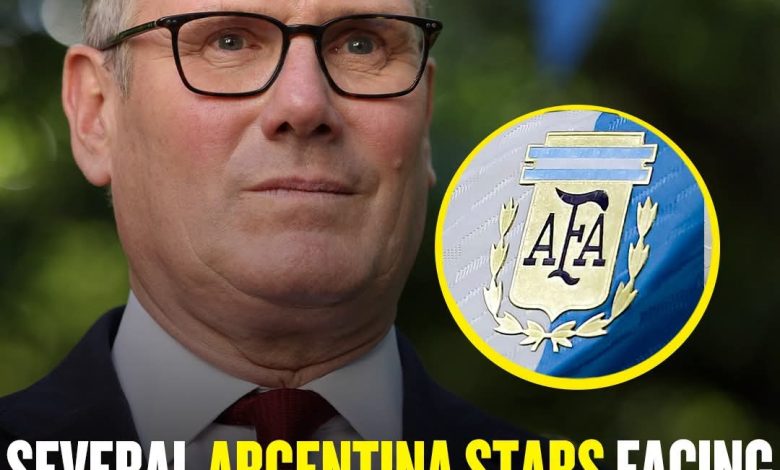
SEVERAL ARGENTINA STARS FACING POSSIBLE FIFA SANCTIONS AS UK GOVERNMENT CALLS FOR INVESTIGATION
The 2026 FIFA World Cup has produced unforgettable moments on the pitch, but one of the tournament’s biggest talking points has emerged away from the game itself. Argentina’s dramatic semi-final victory over England has been overshadowed by controversy after several Argentine players displayed a banner carrying the message “Las Malvinas son Argentinas” (“The Falklands are Argentine”) during their post-match celebrations. The incident has sparked political debate, prompted criticism from British officials, and led to calls for FIFA to investigate whether the players breached the organization’s rules on political messages in football. �
The Guardian +1
Despite dramatic headlines circulating online, it is important to distinguish between calls for sanctions and actual bans. At the time of writing, no Argentina player has been banned from football. Instead, FIFA has confirmed that its disciplinary committee is reviewing reports from the incident before deciding whether any disciplinary action is necessary. �
Talksport +1
The controversy began immediately after Argentina defeated England in a thrilling World Cup semi-final. As the players celebrated qualification for another World Cup final, several members of the squad were photographed holding a banner referring to the Falkland Islands, known in Argentina as Las Malvinas.
For many Argentinians, the message represents a long-standing national claim over the islands. However, in the United Kingdom, the banner was viewed as a political statement connected to one of the most sensitive territorial disputes in modern British history.
The Falkland Islands remain a British Overseas Territory, although Argentina continues to claim sovereignty over them. The dispute resulted in the Falklands War in 1982, a conflict that claimed hundreds of lives and remains an emotional subject in both countries. �
The Guardian +1
Because of this historical background, what may have been intended by some as a patriotic expression was interpreted by many others as bringing politics into one of the world’s biggest sporting events.
Following the celebrations, criticism came quickly from politicians, veterans’ organizations and representatives of the Falkland Islands. The UK government publicly backed calls for FIFA to investigate whether the display violated football’s rules against political messaging.
Prime Minister Keir Starmer’s office reiterated the UK’s longstanding position supporting the right of the Falkland Islanders to determine their own future and emphasized that politics should not be brought onto the football field. �
The Guardian +1
This political reaction immediately intensified public debate. Football supporters who had spent weeks focusing solely on sporting competition suddenly found themselves discussing diplomacy, international law and one of the world’s longest-running territorial disputes.
The controversy also reignited memories of previous occasions when political symbols have appeared during football tournaments.
Over the years, FIFA has repeatedly insisted that football should remain politically neutral. The organization’s disciplinary code generally prohibits political, ideological or religious messages during official competitions.
Those regulations exist because FIFA believes football should unite supporters from every nation regardless of political disagreements.
Whenever players display banners, flags or slogans connected to political causes, FIFA normally examines whether those actions violate its disciplinary regulations before deciding whether punishment is appropriate. �
Talksport +1
That explains why FIFA has not rushed to announce immediate punishments.
Instead, officials have begun reviewing the match reports, available evidence and all relevant circumstances before determining whether disciplinary proceedings are warranted.
This is standard procedure in international football.
Contrary to sensational social media posts claiming that multiple Argentina stars have already been suspended or banned, FIFA has announced only that the matter is under review. �
Talksport +1
If FIFA concludes that its regulations were broken, there are several disciplinary options available.
Possible sanctions could include:
Official warnings.
Financial fines.
Suspended sanctions.
Match suspensions in more serious circumstances.
However, whether any of these measures will be imposed remains entirely unknown until FIFA completes its investigation.
That distinction is important because headlines suggesting that Argentina’s stars are already “banned from football” are inaccurate based on the information currently available. �
Talksport +1
The debate has also raised questions about the role of governments in football.
Many supporters have wondered whether the UK government can directly demand bans against players from another country.
In reality, governments cannot instruct FIFA to suspend footballers.
FIFA is an independent governing body responsible for enforcing its own disciplinary regulations.
Governments may express opinions, condemn incidents or request investigations, but disciplinary decisions remain FIFA’s responsibility under its established rules and procedures. �
The Guardian +1
That independence is actually one of FIFA’s core principles.
Historically, FIFA has even sanctioned national football associations when governments interfered excessively in football administration.
The organization consistently emphasizes that sporting decisions should remain free from political control. �
Wikipedia
For Argentina, the timing could hardly be worse.
The reigning world champions are preparing for another World Cup final while simultaneously dealing with growing international attention surrounding the post-match celebrations.
Rather than discussing Lionel Messi’s leadership, Argentina’s tactical brilliance or their remarkable resilience throughout the tournament, much of the football world is now debating banners and politics.
That is undoubtedly a distraction the coaching staff would rather avoid.
Players themselves now face increased media scrutiny before the biggest match of the tournament.
Every press conference is likely to include questions about the investigation rather than purely football-related matters.
Managers generally dislike such situations because they shift attention away from preparation on the training ground.
For England supporters, emotions remain understandably mixed.
Many were devastated after seeing their team’s hopes of reaching the World Cup final disappear despite taking the lead.
The controversial banner only added another layer to an already emotional evening.
Some fans believe football should remain completely separate from politics.
Others argue that players, like everyone else, have personal views they cannot always separate from major national events.
These differing opinions have fuelled intense discussions across television, radio and social media.
Meanwhile, reactions inside Argentina have been very different.
Some political figures defended the players, describing the banner as an expression of national identity rather than a political campaign.
Others have suggested that international football inevitably reflects national pride because players represent their countries on the global stage. �
The Times
Regardless of those differing viewpoints, FIFA must now determine whether the display crossed the line established by its own disciplinary regulations.
That decision could become one of the most closely watched disciplinary rulings in recent World Cup history.
The case also highlights the increasingly difficult challenge facing international sporting organizations.
Major tournaments bring together nations with complex histories, unresolved disputes and passionate supporters.
Even celebrations intended for domestic audiences can carry entirely different meanings internationally.
As football continues to grow as a truly global sport, governing bodies frequently find themselves balancing freedom of expression with their commitment to political neutrality.
This is far from the first time football has intersected with politics.
History contains numerous examples where international matches have reflected wider diplomatic tensions.
However, FIFA has consistently maintained that its competitions should not become platforms for political messaging, regardless of which country is involved. �
Wikipedia +1
As the investigation continues, players, coaches and supporters alike will await FIFA’s verdict.
Whatever the outcome, the decision is likely to establish another important reference point for future tournaments.
If sanctions are imposed, they could reinforce FIFA’s commitment to preventing political demonstrations during matches and official celebrations.
If no disciplinary action is taken, the organization will almost certainly need to explain why it concluded that the incident did not breach its regulations.
Until then, one fact remains clear: Argentina’s players have not been banned from football. FIFA is conducting a review, while the UK government has publicly supported calls for an investigation into whether the banner violated football’s rules on political messaging. Any reports claiming that suspensions have already been confirmed go beyond the facts currently available. �
Talksport +1
The coming days will determine whether this controversy ends with a warning, disciplinary sanctions, or no punishment at all. Until FIFA announces its final decision, the story remains one of investigation rather than confirmed guilt—a reminder that in international football, events away from the pitch can sometimes capture as much attention as the action on it. �
The Wider Impact on the World Cup
As the debate continues, the controversy threatens to overshadow what has otherwise been a remarkable World Cup campaign for Argentina. Throughout the tournament, the South American giants have demonstrated why they remain among the world’s elite football nations. Their blend of experienced leaders and exciting young talents has produced some of the competition’s most memorable performances, earning widespread praise from football experts and supporters alike.
However, football history has repeatedly shown that off-field controversies can quickly dominate headlines, no matter how impressive a team’s performances may be. Instead of discussing tactical masterclasses, outstanding goals, and memorable victories, the conversation has shifted toward politics, FIFA regulations, and the responsibilities of professional athletes representing their nations on the biggest stage.
For the players involved, this creates an additional burden at the worst possible time. Preparing for a World Cup final demands complete focus, both mentally and physically. Any distraction—particularly one involving a FIFA investigation and international political attention—can affect the atmosphere around a squad. Coaches often work tirelessly to shield players from outside noise, but in today’s world of social media and 24-hour news coverage, avoiding such stories is almost impossible.
Argentina’s coaching staff will undoubtedly be urging their players to remain focused on football rather than responding publicly to every allegation or criticism. Maintaining concentration ahead of the biggest match in world football is already difficult without an international controversy unfolding simultaneously.
What Happens Next?
The next stage of the process rests entirely with FIFA’s Disciplinary Committee. Officials are expected to examine photographs, videos, referee reports, and any official submissions before determining whether disciplinary proceedings should continue.
If FIFA believes that no rules were broken, the investigation could simply be closed without further action.
If, however, officials conclude that the display violated regulations concerning political messages during official competitions, disciplinary measures could follow. These might include official warnings, financial penalties, or suspensions depending on the seriousness of the breach and the circumstances surrounding the incident.
Importantly, any player or national association subject to disciplinary action would normally have the opportunity to respond through FIFA’s established legal procedures before final sanctions are imposed.
This ensures that disciplinary decisions are based on evidence and due process rather than public pressure or media speculation.
Lessons for International Football
Regardless of FIFA’s eventual decision, the incident serves as another reminder of how closely football and politics can intersect despite repeated attempts to keep them separate.
International football is unique because players do not simply represent clubs—they represent entire nations. National identity, patriotism, and historical events inevitably become part of the emotional backdrop of major tournaments.
That reality creates difficult challenges for governing bodies such as FIFA.
On one hand, footballers enjoy freedom of expression as individuals.
On the other hand, FIFA seeks to maintain political neutrality during its competitions to prevent international tournaments from becoming platforms for geopolitical disputes.
Finding the right balance between those principles is never straightforward.
Every disciplinary decision establishes a precedent that may influence how similar incidents are handled in future tournaments.
For that reason, FIFA’s ruling in this case could have implications extending well beyond the current World Cup.