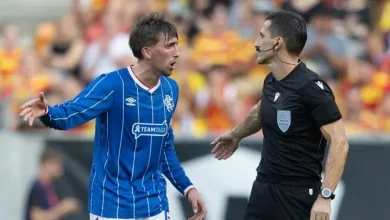
LAWRENCE SHANKLAND FINALLY BREAKS SILENCE ON RANGERS’ CONTROVERSIAL PENALTY APPEAL AS HE REVEALS HIS CONVERSATION WITH THE REFEREE

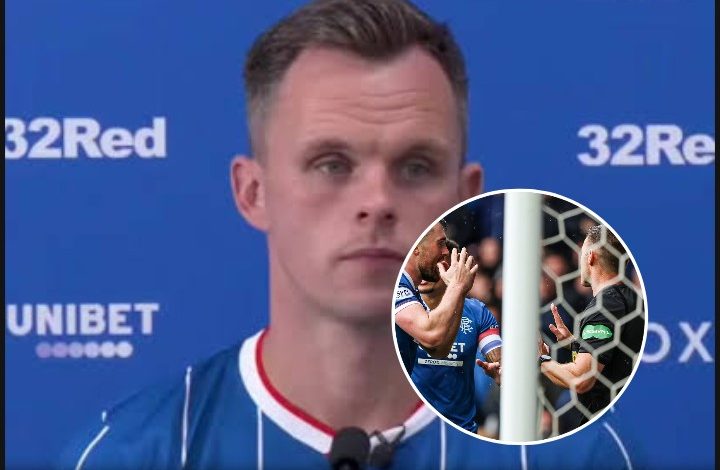
In the pressure-cooker atmosphere of Ibrox, few moments generate as much fury, debate and lasting resentment as a disputed goal that swings a high-stakes Scottish Premiership fixture. On a September afternoon in 2025, Lawrence Shankland provided exactly that. The then-Hearts captain scored twice in a 2-0 victory that left Rangers reeling, their home support in open revolt and the match officials under intense scrutiny. The first of those goals, in particular, became the flashpoint. Rangers players and staff appealed vigorously for handball in the build-up. The goal stood. Months of analysis, SFA admissions of error and lingering bitterness followed. Now, with the benefit of time and a dramatic change in his own career, Shankland has spoken more openly about the incident, the appeals, what he felt in the moment and his limited exchange with the match officials.
The sequence itself was typical of the chaos that often defines these fixtures. A move involving Claudio Braga saw the ball break in the Rangers penalty area. Shankland was involved in the initial phase. Contact with his arm or hand occurred. Play continued. Braga found him again, and the Scotland international finished from a tight angle. Rangers players immediately surrounded the referee. Arms were raised. Voices were raised. The home crowd bayed for the intervention that never came. VAR checked. The goal was allowed. Hearts led. Shankland later converted the rebound after Jack Butland saved his penalty to seal the points. For Rangers, it felt like three decisions had gone against them that afternoon: the handball goal, a disallowed equaliser of their own, and the award of the late penalty. Manager Russell Martin was scathing afterwards. The result accelerated the pressure that would eventually cost him his job.
Shankland did not hide from the controversy in the immediate aftermath. Speaking after the match, he was characteristically straightforward. “I’m not going to lie, it hit my hand and my arm in the build-up so I kind of knew that,” he admitted. He described running forward with a sinking feeling, thinking the goal might be chalked off, especially after a previous effort against Aberdeen had been disallowed. “I was running forward thinking, ‘we better not score here,’ because I wasn’t quite sure on the rule whether it counted or not. I couldn’t remember the touches that happened in between, then Braga slipped me down the side and it was a good finish. I was just thinking, ‘not again’.” When the referee pointed to the centre circle to restart, relief and delight flooded through him. “When the ref pointed to the [centre] spot I was delighted.”
On the specific question of the Rangers appeals and any dialogue with the officials, Shankland was clear that he largely stayed out of it. “Rangers were appealing for it. I never really asked, to be honest. As soon as they gave the goal I just celebrated and kept quiet but I’d heard from people that I think the Rangers defender touched it to start with? Maybe it starts a new phase of play or something. It’s quite a blurry rule and it’s not quite clear but I’m just delighted that it was given.” That short account has formed the basis of his public position ever since. He did not claim to have engaged the referee in a lengthy discussion on the pitch. He did not pretend the contact never happened. He simply took the decision that was given, celebrated with restraint initially, and moved on with the knowledge that the rules around handball in the attacking phase remain among the most contested and inconsistently applied in the modern game.
The subsequent official reviews only intensified the sense of injustice among Rangers supporters. Willie Collum, the Scottish FA’s head of refereeing, later stated publicly that the goal should have been disallowed. The contact, while not deemed deliberate, was punishable. The arm was judged to be in an unnatural position. Because the handball occurred in the attacking phase of play with subsequent passes, it was not a simple factual overturn that VAR could apply automatically. An on-field review should have been recommended. The audio of the conversation between referee Steven McLean and VAR official Greg Aitken was eventually released. Former referees described elements of that discussion as “shambolic,” particularly the focus on whether the handling was accidental rather than whether it met the threshold for a punishable offence under the laws. The Key Match Incident panel unanimously agreed the on-field decision was wrong and that VAR should have intervened. Separate majority findings also suggested Rangers’ disallowed goal should have stood. The late penalty awarded to Hearts was, by contrast, largely upheld.
These findings did little to soothe the raw feeling at Ibrox on the day. The home support’s frustration spilled into protests aimed at the manager and the club’s direction. Shankland, for his part, noted how Hearts were able to feed off that atmosphere. Having experienced the intensity of Tynecastle week in and week out, he understood the psychological impact of a restless home crowd and the way a lead can amplify the pressure on the opposition. The win was significant for Hearts in their title challenge that season. For Rangers it marked another difficult chapter in a campaign that never stabilised under Martin.
Handball laws have long been a source of frustration across European football. The distinction between deliberate and punishable, the position of the arm relative to the body, the concept of making oneself bigger, the treatment of deflections, and the question of whether a new phase of play has begun after intervening touches all create grey areas. Players themselves often struggle to keep the precise wording of the IFAB guidelines in their heads while operating at full speed. Shankland’s own comments reflected that uncertainty. He knew contact had occurred. He was unsure whether the subsequent play reset the decision. He kept quiet once the goal was given rather than seeking clarification in the moment. That pragmatic approach is common among experienced strikers. Protest too loudly when a decision goes your way and you risk inviting further scrutiny. Stay silent and accept the outcome, then deal with the fallout later.
The second goal that afternoon carried its own slice of fortune. Shankland’s penalty was saved by Butland. The rebound fell kindly and he finished. He later explained that he knew immediately the initial strike was not struck cleanly and simply reacted to the second opportunity. “Get after it – because I knew I hadn’t caught it right.” The combination of the earlier handball controversy and the rebound goal left Rangers feeling the footballing gods had conspired against them. Independent analysis from former referees and the official panels largely supported the view that the first goal should not have stood, while the penalty award was more defensible.
Time has added layers of irony to the episode. Shankland left Hearts in the summer of 2026 and signed for Rangers, the club he supported as a boy. He was subsequently named club captain by Derek McInnes, the manager with whom he had previously worked at Tynecastle. The player who scored a contested double that contributed to one of the more painful afternoons of the previous regime is now expected to lead the side out at Ibrox. That transition has required supporters on both sides to recalibrate. For some Rangers fans the handball goal remains a sore point; for others the arrival of a proven goalscorer and leader who knows Scottish football inside out represents a pragmatic upgrade. Shankland has spoken of the honour of captaining his boyhood club and the responsibility that comes with the armband at a club where scrutiny is constant and expectations are relentless.
His willingness to discuss the 2025 incident again, even briefly, fits a broader pattern. Shankland has never been one to hide from difficult moments. He has previously spoken candidly about a yellow card for simulation in a different match, explaining what the referee told him at the time and maintaining that he had not sought a penalty. He has admitted handball offences against Celtic and even joked about the strength of his wrist. That openness makes the limited nature of his comments on the Rangers appeals consistent rather than evasive. He acknowledged the contact. He noted the appeals. He stated he did not engage the referee in prolonged discussion. He accepted the decision that was given and moved on.
The wider context is the perpetual debate over VAR in Scottish football. Audio releases, review shows and panel findings have become regular features of the calendar. Supporters of every club can point to decisions they believe cost them points. Consistency remains the elusive goal. The Shankland handball at Ibrox sits in a long list of incidents that fuelled arguments about whether the technology and the application of the laws are delivering clearer, fairer outcomes or simply creating new layers of controversy. Former referees have been particularly critical of the specific dialogue that allowed the goal to stand, arguing that the accidental nature of the contact should not have been the decisive factor when the arm position met the criteria for a punishable offence.
For Shankland personally the episode formed part of a strong period of form that underlined his value as a centre-forward capable of deciding tight matches. His movement, finishing and leadership made him a constant threat. The subsequent transfer to Rangers closed one chapter and opened another. As captain he will now experience the other side of the Ibrox intensity: the demand for results, the examination of every decision that goes against the team, and the expectation that the skipper sets the tone both on and off the pitch. His previous honesty about the handball incident may even serve him well. Players and supporters who remember the controversy know he did not invent a version of events that denied contact occurred. That credibility can matter when future marginal calls go against his new team.
Football rarely grants clean resolutions to disputed moments. The goal stood. The points were awarded. The reviews confirmed an error. The player who benefited has since crossed the divide and assumed a leadership role at the club that felt most aggrieved. In breaking his silence more fully on the appeals and his interaction, or lack of extended interaction, with the referee, Shankland has not rewritten history. He has simply restated the facts as he experienced them in real time: contact happened, uncertainty followed, Rangers appealed, he stayed largely silent once the decision was made, and the game moved on. In the unforgiving environment of Scottish football’s biggest fixtures, that combination of honesty and pragmatism is often the only realistic response available to a player in the middle of the storm.
The conversation, such as it was, appears to have been minimal. The controversy was not. Years later it still resonates because it encapsulates so many of the tensions that define the modern game in Scotland: the imperfect application of complex laws, the emotional investment of supporters, the pressure on officials, and the way individual moments can linger long after the final whistle. Lawrence Shankland’s latest comments will not end the debate. They do, however, provide a clearer window into the thoughts of the man at the centre of it, delivered with the same directness that has characterised much of his public commentary throughout his career.