Brutal:Shankland Goes Nuclear: Captain’s Savage 9-Word Blast After Teammate’s Costly Mistakes Sink Rangers

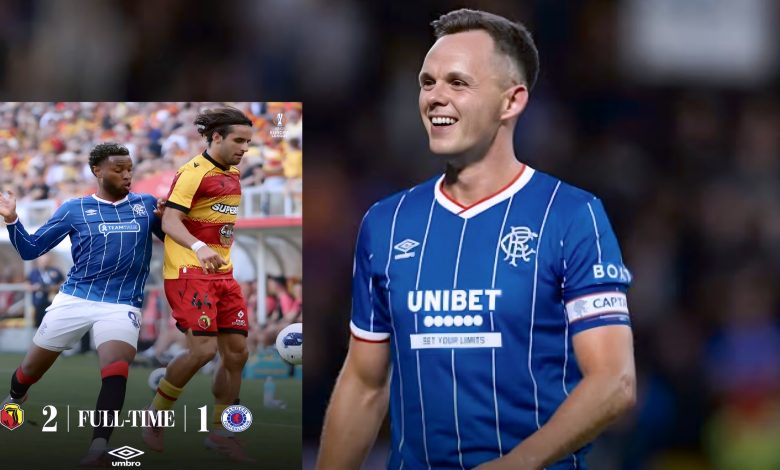
In the unforgiving glare of European competition and the intense scrutiny that comes with captaining Rangers, Lawrence Shankland has never been one to soft-pedal disappointment. The Scotland striker, appointed club captain only days into the 2026-27 season after his dream move from Hearts, delivered a characteristically blunt assessment in the wake of Rangers’ 2-1 first-leg defeat to Jagiellonia Białystok in the UEFA Europa League third qualifying round. The result, shaped by two avoidable defensive lapses after an early lead, left the Light Blues facing an uphill battle in the return leg at Ibrox and prompted the kind of direct leadership that defined Shankland’s time as Hearts skipper.
The match itself followed a painfully familiar script for Rangers supporters. Derek McInnes’s side started brightly at the Chorten Arena. An early own goal by Jagiellonia defender Guilherme Montoia, turned in from a Tuur Rommens cross, put the visitors ahead after just four minutes. Control appeared to be theirs. Then the errors arrived. Kajetan Szmyt equalised in the 13th minute and added a second eight minutes later, both goals stemming from defensive slackness and a failure to clear danger effectively. Rangers improved after the break—Cammy Devlin, Nico Raskin and Findlay Curtis were introduced—and came close to an equaliser, with Curtis striking the post in stoppage time and Shankland (introduced late) seeing an effort smothered. It was not enough.

McInnes was frank afterwards. “I just felt we beat ourselves,” the manager said. “We made two mistakes for the two goals… For me we beat ourselves tonight, it’s not good enough.” He spoke of lost concentration, a failure to stay aggressive and organised, and habits carried over from the previous campaign. The manager’s frustration was clear: an early advantage had been squandered through self-inflicted wounds rather than overwhelming opposition quality.
Shankland, who had been left on the bench initially with Dan Neil wearing the armband in a tactical setup featuring Youssef Chermiti up top, entered the fray late. As captain, the expectation—self-imposed as much as external—is that he fronts up. Throughout his career, and especially during Hearts’ near-miss title challenge the previous season, Shankland has specialised in unvarnished honesty. One of his most memorable lines after a 3-2 Edinburgh derby defeat to Hibs in December 2025 captured the same spirit: “We can’t turn up at 3-0 down, it’s nae use.” That roughly nine-word verdict, delivered with visible anger in the dressing room and then publicly, underscored his refusal to accept half-measures or late rallies that papered over earlier failings. The phrasing and tone have become emblematic of his leadership style—direct, demanding, and unwilling to let teammates off the hook when standards slip.
In the context of the Jagiellonia reverse, the parallel is obvious. Costly individual and collective mistakes turned a promising European away performance into a deficit. Shankland’s public and private reactions have consistently emphasised accountability. He does not trade in vague positivity or deflection. Whether addressing defensive organisation, concentration, or the need to impose oneself for the full 90 minutes rather than reacting only when behind, the message remains consistent: Rangers (and previously Hearts) are not good enough to gift opponents soft goals and still expect to succeed at the highest level they aspire to.
This moment arrives at a pivotal early stage for both player and club. Shankland joined Rangers in late May 2026 from Hearts on undisclosed terms, activating a clause in the three-year deal he had signed only a year earlier. A boyhood Rangers supporter released by the club as a youngster, he described the move as fulfilling a long-held dream. He scored 88 goals in 171 appearances for Hearts, captained them to second place in 2025-26 (missing the title on the final day), and brought proven leadership and finishing to Ibrox. Derek McInnes, who had managed him at Tynecastle, named him captain on 29 July 2026, just before the Premiership opener. McInnes cited Shankland’s proven ability to run a dressing room, his understanding of the club as a Glasgow boy, and the need for multiple leaders rather than one man carrying the entire burden that had often fallen on James Tavernier.
The appointment was not without questions. Some observers noted the speed of the elevation for a new arrival and the tactical decision to start him on the bench in Poland while Neil captained. Early league results had already shown the familiar pattern of dropped points; the Europa League reverse amplified concerns about defensive fragility and concentration. Shankland’s response—rooted in the same uncompromising standards he applied at Hearts—serves as both critique and rallying call. He has never pretended that leadership is only about lifting trophies or delivering polished soundbites. It includes calling out shortcomings when teammates’ mistakes prove decisive.
The broader context at Rangers makes the blast more significant. The club has endured years of inconsistency relative to its ambitions and resources. Last season’s third-place finish and early European exits left supporters demanding higher standards. McInnes’s arrival and the recruitment of familiar faces such as Shankland and Cammy Devlin were intended to inject know-how, mentality, and a clearer identity. Yet the opening weeks have exposed lingering issues: vulnerability to transitions, lapses in defensive organisation, and an inability to protect leads. McInnes himself acknowledged seeing “a lot of what I thought Rangers were last season” in the Polish performance—too many chances gifted, insufficient aggression and communication when the ball was lost in dangerous areas.
Shankland’s career trajectory lends weight to his words. Released by Rangers as a teenager, he rebuilt at Queen’s Park, had spells at Aberdeen, Ayr United, Dundee United and a difficult year in Belgium with Beerschot, then exploded at Hearts. His finishing, work rate, and increasingly vocal leadership turned him into one of the most effective Scottish strikers of his generation. International recognition followed, including involvement in Scotland’s 2026 World Cup campaign. Through setbacks—missed penalties that left him sleepless, injury absences, and the heartbreak of falling short of a Hearts title—he has responded by raising personal and collective expectations rather than lowering them. That history of resilience and directness is precisely why McInnes entrusted him with the armband so quickly.
For the players on the receiving end of any dressing-room or public critique, the message is unambiguous. Individual errors that cost goals cannot be dismissed as isolated moments when they repeatedly decide results. Concentration, communication, and the willingness to do the unglamorous defensive work for the full match are non-negotiable. Shankland has repeatedly stressed that teams of Rangers’ (and previously Hearts’) quality cannot afford to “just rock up and play for 30 minutes” or gift soft goals and then rely on late heroics. The Jagiellonia defeat illustrated the point in stark terms: an early lead evaporated because basic standards were not maintained.
Looking ahead, the return leg at Ibrox offers an immediate chance for redemption. A strong response would validate the leadership approach—honest assessment followed by collective improvement. A failure to cut out the mistakes would only intensify the scrutiny on both the squad and the new captain. McInnes has already signalled that leadership must be shared; Shankland cannot carry the burden alone. Yet as the public face and on-pitch standard-setter, his willingness to “go nuclear” when standards slip sets the tone.
Supporters recognise the value in such honesty. Polished corporate answers after costly defeats rarely satisfy a fanbase that has watched promising positions unravel through familiar failings. Shankland’s style—rooted in the Scottish football tradition of straight talking—resonates because it matches the stakes. Rangers exist to compete for major honours and progress in Europe. When teammates’ mistakes prevent that, the captain’s role includes saying so, clearly and without euphemism.
The nine-word (or near-nine-word) verdicts that have punctuated Shankland’s captaincy career are not manufactured drama. They are the product of a player who understands the difference between acceptable and unacceptable levels of performance. After Jagiellonia, the message lands with particular force: self-inflicted wounds cannot continue if the new era under McInnes and Shankland is to deliver the success the club demands. The captain has spoken. Now the squad must answer on the pitch.