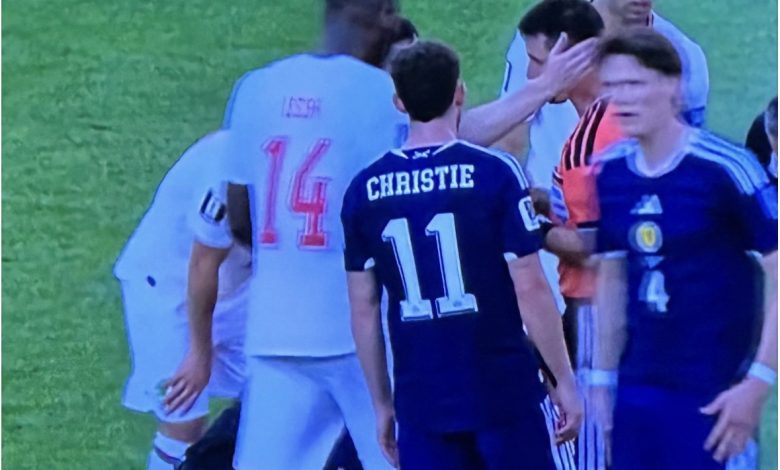
Football fans around the world have been discussing a heated moment involving Morocco defender Achraf Hakimi and Scotland captain Andy Robertson during Scotland’s narrow 1-0 defeat to Morocco. A viral image circulating across social media claims that FIFA has revealed the exact words Hakimi allegedly said to Robertson during a tense confrontation in the 60th minute of the match and suggests those comments sparked a heated argument between players.
However, as of now, there has been no official FIFA statement publicly releasing the exact conversation between the two players. Despite that, the incident itself has become one of the most talked-about moments from the match, with supporters, pundits, and former players all offering their opinions on what happened and why emotions boiled over.
The Incident That Captured Global Attention
The match between Scotland and Morocco was already highly competitive before the confrontation occurred. Morocco had taken a narrow lead and were defending resolutely against a Scotland side desperate to find an equaliser.
Around the hour mark, tensions rose dramatically following a challenge that led to players from both teams gathering around the referee. Television cameras quickly focused on Robertson and Hakimi, who appeared to exchange words during the stoppage.
The situation escalated as several players from both sides became involved. While there was pushing, pointing, and visible frustration, officials managed to restore order before the game resumed.
Within minutes, screenshots and clips of the incident were spreading rapidly across social media platforms. Fans immediately began trying to lip-read the conversation between the two players, leading to countless theories about what was allegedly said.
Why the Exchange Became Such a Big Story
Football has always been an emotional sport. In major international tournaments, every challenge, every decision, and every missed opportunity can significantly affect a nation’s hopes.
Scotland entered the contest knowing that a positive result could strengthen their position, while Morocco understood the importance of protecting their lead.
Under those circumstances, even relatively minor disagreements can quickly escalate into larger confrontations.
What made this particular incident stand out was the profile of the players involved.
Andy Robertson is widely regarded as one of Scotland’s most influential figures. As captain, he is known for his leadership, competitiveness, and willingness to stand up for teammates.
Hakimi, meanwhile, is one of Morocco’s biggest stars and has established himself as one of the finest full-backs in world football. His passion and intensity have become trademarks of his playing style.
When two elite competitors clash in a high-pressure environment, attention naturally follows.
The Social Media Explosion
Almost immediately after the match, social media users began analysing every available angle.
Some claimed Hakimi had directed provocative comments toward Robertson.
Others argued that Robertson had initiated the verbal exchange.
Several accounts even posted supposed transcripts of the conversation, claiming they had uncovered exactly what was said.
The problem is that none of these claims have been independently verified.
Without clear audio or an official statement, determining the precise words exchanged between the players remains impossible.
Nevertheless, speculation continued to grow, with many posts attracting hundreds of thousands of views.
This reflects a wider trend in modern football, where moments lasting only a few seconds can dominate headlines for days.
FIFA’s Position
One of the most important aspects of this story is distinguishing between verified information and online speculation.
Images circulating online frequently carry captions suggesting FIFA has officially released details of the conversation.
At present, there is no publicly available evidence showing FIFA has published a transcript or confirmed the exact words spoken by either player during the incident.
Football’s governing body generally does not release private conversations between players unless disciplinary proceedings require specific evidence to be made public.
In most cases, on-field verbal exchanges remain confidential.
As a result, many of the claims circulating online should be treated cautiously until confirmed by credible sources.
Scotland’s Frustration During the Match
To understand why emotions were running high, it is important to examine the wider context of the game.
Scotland believed they had opportunities to get back into the contest but struggled to break down Morocco’s organised defensive structure.
Several decisions throughout the match generated debate among supporters.
Every stoppage seemed to increase the tension.
Players became increasingly animated when speaking with officials, while the crowd reacted passionately to every challenge.
By the time the confrontation between Robertson and Hakimi occurred, frustration had already been building for much of the match.
Many observers felt the argument was simply a symptom of the pressure both teams were experiencing.
Robertson’s Leadership Role
Throughout his career, Robertson has earned a reputation as a fierce competitor.
Whether playing for club or country, he rarely avoids confrontation when he feels his team has been wronged.
Scotland supporters often praise this aspect of his personality, arguing that his determination inspires teammates.
During difficult moments, captains are expected to represent their players and communicate with referees.
That responsibility can occasionally place them at the centre of controversial incidents.
In this case, Robertson appeared determined to defend Scotland’s interests and challenge decisions he believed were unfair.
His visible frustration reflected the significance of the occasion.
Hakimi’s Competitive Nature
Hakimi possesses a similarly intense mentality.
The Moroccan defender has built a career on playing with energy, confidence, and aggression in the positive sporting sense.
His performances for both club and country have frequently demonstrated his refusal to back down from difficult situations.
Morocco’s players knew they were protecting an important lead.
As Scotland increased the pressure, maintaining concentration became critical.
Hakimi’s involvement in the argument may simply have reflected his commitment to helping Morocco secure victory.
Elite athletes often walk a fine line between passion and confrontation.
Former Players React
Several former footballers weighed in on the incident after the match.
Many argued that such disagreements are common in high-level football and often appear more dramatic than they actually are.
According to numerous ex-professionals, heated exchanges occur regularly during matches but rarely continue once the final whistle is blown.
Others suggested the growing influence of social media has amplified moments that previously would have been forgotten within hours.
What once might have been viewed as routine competitive behaviour now becomes a major talking point due to endless replays and online analysis.
The Role of Television Cameras
Modern football broadcasts capture almost every movement on the pitch.
High-definition cameras, slow-motion replays, and close-up shots allow viewers to see details that would previously have gone unnoticed.
This increased visibility creates both opportunities and challenges.
Fans gain a deeper understanding of the game, but isolated moments can also be taken out of context.
The Hakimi-Robertson confrontation is a perfect example.
Without hearing the conversation, viewers are left interpreting facial expressions, gestures, and reactions.
That uncertainty often fuels speculation rather than clarity.
Morocco’s Perspective
From Morocco’s point of view, the primary objective was securing an important victory.
The North African side demonstrated discipline, tactical organisation, and resilience throughout the contest.
Defending a narrow lead against a determined opponent requires mental strength.
Morocco’s players understood that Scotland would continue pressing until the final whistle.
As a result, every duel carried significant importance.
Supporters of the Moroccan team have argued that their players were simply standing up for themselves during a tense moment and that the incident has been exaggerated by some observers.
Scotland’s Perspective
Scottish supporters naturally viewed events differently.
Many fans believed their team deserved greater protection from officials and felt frustrations were understandable given the circumstances.
The emotional reaction following the match highlighted how much the result meant to Scotland.
Defeat left supporters disappointed, particularly because the game appeared closely contested for long periods.
For many fans, the argument involving Robertson symbolised the passion and determination Scotland showed throughout the contest.
The Impact on the Match
Interestingly, the confrontation itself did not significantly alter the final outcome.
Both teams eventually refocused on football after officials restored calm.
However, the incident contributed to the narrative surrounding the match.
Instead of discussing only tactical decisions or key goals, much of the post-match conversation centred on the exchange between Hakimi and Robertson.
This demonstrates how quickly a single moment can dominate headlines in modern football.
Why Fans Are So Interested
Part of football’s appeal lies in its emotional intensity.
Supporters connect deeply with players and often view confrontations as evidence of commitment and passion.
When star players become involved in disputes, curiosity naturally increases.
Fans want to know:
- What was said?
- Who started the argument?
- Was anyone at fault?
- Did the exchange influence the result?
Unfortunately, definitive answers are not always available.
In this case, the absence of verified information has only increased public interest.
The Dangers of Unverified Claims
One lesson from this controversy is the importance of verifying information before accepting it as fact.
Social media allows rumours to spread rapidly.
A dramatic caption can reach millions of people within hours, regardless of whether the underlying claim is accurate.
Claims that FIFA released the exact conversation between Hakimi and Robertson should therefore be approached with caution unless supported by official documentation or credible reporting.
Responsible football coverage requires distinguishing between confirmed facts and speculation.
That distinction is particularly important during major tournaments when emotions are already running high.
Looking Ahead
The incident will likely remain a talking point for some time, especially among supporters of both nations.
However, players and coaches will be more focused on future matches than on a brief confrontation.
Football history is filled with moments of tension between elite competitors.
Most are eventually forgotten as attention shifts toward upcoming fixtures and bigger challenges.
Hakimi and Robertson are both experienced professionals who understand the pressures associated with representing their countries on the biggest stage.
Whatever was said during their exchange, it is unlikely to define either player’s legacy.
Conclusion
The heated confrontation between Achraf Hakimi and Andy Robertson during Scotland’s clash with Morocco has become one of the most discussed moments of the match. Viral images and social media posts have fuelled widespread speculation, with some claiming FIFA released the exact words exchanged between the two players.
At present, however, there is no confirmed public evidence that FIFA has officially revealed the conversation. What remains clear is that the incident reflected the intensity, pressure, and emotion that accompany major international football.
Scotland were fighting desperately for a result, Morocco were determined to protect their lead, and two highly competitive players found themselves at the centre of a tense moment that quickly captured worldwide attention.
Until verified information emerges, the exact words exchanged between Hakimi and Robertson remain unknown. What is certain is that the incident has added another dramatic chapter to an already memorable encounter between Scotland and Morocco, reminding football fans once again why the sport continues to generate such passion and debate across the globe.