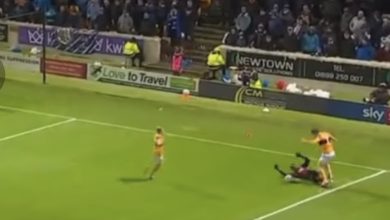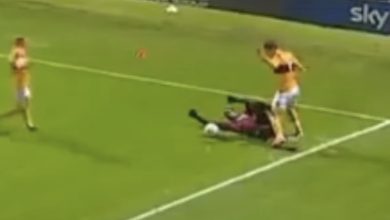
Rangers secured a dramatic 3-2 Scottish Premiership victory over Aberdeen at Ibrox, but the result has been overshadowed by a major debate surrounding Djeidi Gassama’s goal, with supporters questioning whether the Rangers forward was in an offside position when he put his side ahead.
The incident came immediately after Rangers had levelled the match through Ryan Naderi, creating one of the most chaotic periods of the game. Gassama then struck just a minute later to complete a rapid turnaround and put Rangers 2-1 ahead.
However, television replays have left some supporters convinced that the Rangers attacker may have been beyond the last defender when the ball was played.
And the biggest question being asked afterwards is not simply whether Gassama was offside.
It is:
WHERE WERE THE VAR LINES?
THE MOMENT THAT HAS EVERYONE TALKING
Aberdeen had taken the lead through Brad Lyons in the first half before Rangers responded spectacularly after the interval.
Ryan Naderi equalised shortly after the restart, and then Gassama followed almost immediately with Rangers’ second goal.
The official match records confirm Gassama’s goal was awarded and that Rangers eventually won 3-2, with Nicolas Raskin adding a third before Findlay Marshall pulled another goal back for Aberdeen.
But the Gassama goal has become the talking point.
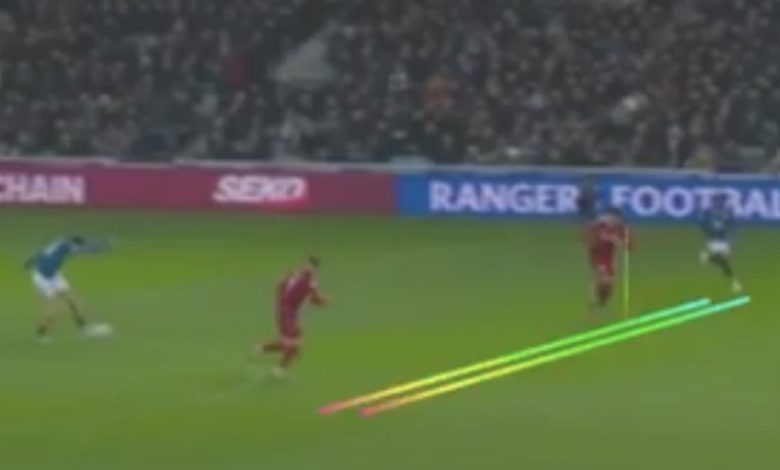
Images circulating after the match show supporters drawing their own lines across the pitch. From those manually drawn lines, Gassama appears to be significantly advanced compared with the relevant Aberdeen defender.
That has led to questions over whether the decision was actually checked by VAR and, if it was, why supporters were not shown the evidence.
“LOOKS A YARD OFFSIDE”
The reaction from supporters has been particularly strong because this is not being presented as a marginal decision.
Some fans looking at the available broadcast image believe Gassama looks clearly beyond the defensive line.
The debate is complicated by the fact that a single television camera angle cannot necessarily establish the exact offside position with the same precision as the official VAR system.
The crucial issue is the precise frame at which the ball was played, the positions of the relevant body parts and the calibration of the virtual offside technology.
But that has not stopped supporters from asking why they were seemingly left without a clear explanation.
On the live match discussion, supporters repeatedly questioned VAR decisions during the game, including comments about an apparent offside and frustration over how long certain checks appeared to take.
That atmosphere has only intensified the scrutiny surrounding Gassama’s goal.
SO, DID VAR ACTUALLY DRAW THE LINES?
This is where the situation needs to be separated from what supporters can see on television.
The fact that the broadcast did not show virtual offside lines does not, by itself, prove that VAR failed to draw or use them.
Scottish Premiership VAR procedures specifically provide for virtual offside lines in tight offside situations. The SPFL’s VAR protocol states that when a goal is scored and the assistant referee has not flagged for offside, the virtual offside lines are applied. If the lines do not overlap or touch, an offside decision can overturn the on-field decision; if they overlap or touch, the goal stands.
That is an important distinction.
The public television feed may not necessarily show every piece of VAR evidence used by the officials.
Therefore, based solely on the screenshots available after the match, it would be too strong to state as an established fact that VAR did not draw lines.
What can be said is that supporters were not given the clear visual evidence they expected, and that has created considerable suspicion around the decision.
WHY THE ABSENCE OF LINES MATTERS
Offside decisions are among the most technically precise decisions VAR is expected to deal with.
Unlike subjective decisions such as whether a challenge was sufficiently serious to constitute a foul, offside is fundamentally a positional question.
The SPFL VAR protocol categorises player position and offside as factual matters for VAR review, with a VAR-only review normally appropriate.
That means there does not necessarily need to be an on-field review by referee John Beaton.
If VAR determined that Gassama was onside, Beaton could simply accept the information and allow the goal to stand.
But from a supporter perspective, that creates a transparency problem.
If the decision is close, fans naturally want to see why it was made.
A correctly calibrated VAR image with the relevant defensive line and attacking player’s legal scoring position would immediately answer much of the debate.
Instead, supporters are looking at a broadcast replay and manually drawing lines themselves.
RANGERS’ COMEBACK MAKES THE INCIDENT EVEN MORE IMPORTANT
The controversy cannot be separated from the context of the match.
Rangers went into half-time behind and then produced an extraordinary second-half turnaround.
Naderi made it 1-1, Gassama put Rangers ahead and Raskin added a third only minutes later.
Aberdeen responded through Marshall, setting up a tense final period at Ibrox, but Rangers held on for all three points.
That means Gassama’s goal was not an irrelevant second or third goal.
It changed the score from 1-1 to 2-1.
Had it been ruled out, the entire remainder of the match could have unfolded differently.
That is precisely why Aberdeen supporters and neutral Scottish football fans are questioning the decision so strongly.
“IF IT’S CLEAR, SHOW US THE EVIDENCE”
The controversy also comes at a time when Scottish football continues to experience intense scrutiny over VAR.
There have already been highly controversial VAR incidents involving Rangers and Aberdeen this season.
In the previous meeting between the clubs, Aberdeen had a late equaliser from Kevin Nisbet overturned following a VAR review, with the decision involving both a foul on Dujon Sterling and an offside position.
That history makes the latest incident particularly sensitive.
Supporters are therefore not simply debating one isolated frame.
They are questioning the consistency and transparency of VAR decision-making in Scottish football.
THE BIG QUESTION REMAINS
There is currently a difference between saying “Gassama was definitely offside” and saying “the decision deserves a clearer explanation.”
The first requires the official VAR evidence and the correct frame of contact to establish conclusively.
The second is much easier to understand from the reaction to the match.
The available broadcast image has certainly encouraged supporters to believe that Gassama was beyond the defensive line, while the lack of an immediately visible VAR graphic has fuelled the frustration.
And with Rangers ultimately winning 3-2, the decision becomes even more significant.
For Aberdeen fans, the argument is simple: if VAR checked the goal and concluded that Gassama was onside, show the lines and explain the decision.
For everyone else, the question is whether the image being circulated actually captures the correct frame and the correct offside reference point.
Until the relevant VAR footage or official explanation is made available, the controversy is unlikely to disappear.
Rangers have the three points. Gassama has the goal. But Scottish football is now left debating whether VAR got the crucial decision right — and why supporters were never shown the lines that could settle the argument.