SFA UNDER PRESSURE AS JAMES PENRICE ESCAPES RED CARD FOR SHOCKING HIGH BOOT ON AFEEZ AREMU

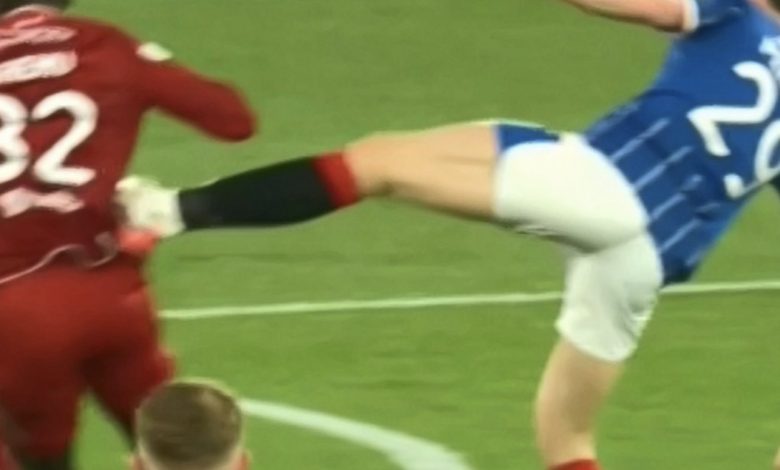
The controversial decision not to send off Rangers defender James Penrice following a dangerous challenge on Aberdeen midfielder Afeez Aremu has continued to generate debate across Scottish football.
The incident occurred during Rangers’ Premier Sports Cup semi-final victory over Aberdeen at Hampden Park on Saturday, October 31, 2026.
With the game still goalless, Penrice raised his boot dangerously high while challenging for the ball, catching Aremu around the ribs and chest area with his studs.
Despite the nature of the contact, referee Ryan Lee did not show Penrice a yellow or red card. VAR official John Beaton also decided against recommending an on-field review or intervening to upgrade the decision.
The decision has since attracted criticism from former referees, supporters and football commentators, with many questioning how such a challenge could go unpunished.
WHAT EXACTLY HAPPENED BETWEEN PENRICE AND AREMU?
The incident happened during the first half of the contest at Hampden.
As both players contested possession, Penrice raised his foot and made contact with Aremu’s upper body.
Replays showed the Rangers defender catching the Aberdeen midfielder with his studs around the ribs, raising immediate questions about whether the challenge constituted serious foul play.
What made the incident even more controversial was the fact that the referee was well positioned to assess the challenge.
However, Ryan Lee allowed play to continue without issuing any disciplinary punishment.
The VAR team, led by John Beaton, also did not recommend a red-card review.
Aberdeen eventually lost the match 1-0 after Ryan Naderi scored in the 83rd minute, sending Rangers through to the Premier Sports Cup final.
WHY WAS JAMES PENRICE NOT SENT OFF?
The central issue is whether Penrice’s challenge met the threshold for serious foul play under Law 12 of the IFAB Laws of the Game.
A player can receive a straight red card for a tackle or challenge that endangers an opponent’s safety or uses excessive force or brutality.
Importantly, the opponent does not have to suffer an injury for a red card to be justified.
Former FIFA referee and PGMOL chief Keith Hackett was particularly critical of the decision after reviewing the footage.
Speaking to Ibrox News, Hackett described the incident as a nailed-on red card.
He argued that Penrice’s challenge clearly endangered the safety of Aremu and met the criteria for serious foul play.
Hackett also questioned why VAR did not intervene, particularly given the position of Penrice’s studs and the area of Aremu’s body that was struck.
His assessment directly challenged the decision made by the officials at Hampden.
Former Premier League referee Bobby Madden and former top-level referee Mark Clattenburg also criticised the decision during their discussion of the incident, believing Penrice should have been dismissed.
This is where the controversy becomes particularly significant: experienced former officials believe the challenge crossed the red-card threshold, yet the referee and VAR team reached no such conclusion during the match.
WHY DID VAR NOT INTERVENE?
Under VAR protocol, officials can recommend an on-field review for a possible straight red card when they identify a clear and obvious error or a serious missed incident.
However, VAR is not designed to review every questionable tackle.
The VAR official must determine whether the original decision falls within the intervention threshold.
In this case, John Beaton did not recommend an intervention.
That means Penrice was allowed to continue playing, despite the subsequent criticism of the challenge.
The lack of intervention has become one of the biggest talking points surrounding the incident.
Supporters are asking whether VAR properly assessed the point of contact, the force of the challenge and the danger posed to Aremu.
WHY THE INCIDENT HAS BECOME A MAJOR SCOTTISH FOOTBALL TALKING POINT
The controversy has reignited wider concerns about consistency in Scottish refereeing.
Supporters regularly complain about different interpretations of dangerous challenges, particularly when similar incidents appear to receive different punishments.
For Aberdeen, there is an obvious frustration that a Rangers player was allowed to remain on the pitch following a challenge that former referees have described as worthy of a straight red.
There is also the additional sporting consequence.
Penrice remained on the pitch and later played a part in Rangers’ winning goal, with his miscued effort finding its way to Naderi, who finished from close range in the 83rd minute.
That does not establish that Aberdeen would have won had Penrice been dismissed, but it highlights how significant the decision could have been.
THE BIG QUESTION: WILL THE SFA EXPLAIN THE DECISION?
The biggest unanswered question is why the officials considered the challenge insufficient for a red card.
While former referees have offered their assessments, that should not be confused with a formal explanation from the SFA.
The governing body and its refereeing department face renewed pressure to provide clarity over controversial decisions, particularly when VAR is involved.
For now, Penrice escaped punishment during the match, and Rangers secured their place in the final.
But the debate surrounding the challenge is unlikely to disappear quickly.
Should James Penrice have been sent off for his challenge on Afeez Aremu, or did referee Ryan Lee and VAR official John Beaton make the correct decision?
Written by the HakimiSport Football Desk.