KEITH HACKETT CONDEMS EFL AND REFEREE RUEBYN RICARDO POOR OFFICIATING IN MATCH BETWEEN WEST HAM AND QUEENS PARK, HE’S CALLING THEM OUT


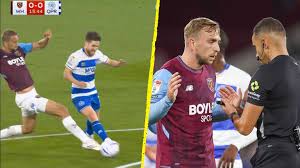 The controversy surrounding West Ham United’s Championship clash with Queens Park Rangers has reignited the debate over the importance of Video Assistant Referee (VAR) technology, with the disputed penalty decision involving referee Ruebyn Ricardo becoming the central talking point.
The incident has raised serious questions about whether the English Football League should reconsider its position on VAR, particularly when a single refereeing decision can significantly influence the outcome of a competitive match.
Nevertheless, the incident provides another opportunity to examine how refereeing mistakes can affect clubs, players, supporters and the credibility of football competitions.
THE CONTROVERSIAL DECISION THAT CHANGED THE GAME
West Ham and QPR met at the London Stadium on Friday, 9 October 2026, in a Championship fixture that attracted considerable attention because of a contentious penalty decision.
According to match reports, Ricardo awarded QPR a penalty after judging that West Ham midfielder Tomas Soucek had fouled Paul Smyth.
Nicolas Madsen subsequently converted the spot-kick, giving the visitors an important advantage.
However, replays reportedly suggested that Soucek had made contact with the ball outside the penalty area, raising questions about whether the decision was correct.
The incident immediately intensified discussions about the limitations of officiating without video assistance in the Championship.
For West Ham supporters, the frustration was understandable because decisions involving penalties can have a significant influence on the momentum and direction of a match.
For QPR, however, the responsibility was to take advantage of the opportunity presented to them, regardless of the circumstances surrounding the referee’s decision.
The controversy should therefore be examined through the evidence available rather than assumptions about the referee’s intentions.
Refereeing errors can happen in football, but the central question is whether the existing system provides sufficient safeguards to identify and correct mistakes when they occur.
WHY VAR HAS BECOME SUCH AN IMPORTANT ISSUE
VAR was introduced into elite football to help match officials review specific incidents that could have a significant impact on the outcome of a game.
Its principal purpose is not to eliminate every disagreement or turn football into a sport without controversy.
Instead, it provides an additional opportunity to correct clear and obvious errors involving goals, penalties, direct red cards and cases of mistaken identity.
The West Ham incident illustrates why supporters continue to question the absence of that assistance in the Championship.
When a referee awards a penalty after judging that a foul occurred inside the box, video footage can sometimes establish whether the contact happened inside or outside the penalty area.
Such information could help officials reach a more accurate decision.
Without VAR, the referee must generally make the judgement in real time, relying on positioning, the available viewing angle and the information provided by the assistant referees.
Even experienced officials can struggle to identify the precise location of contact during a fast-moving challenge.
That reality does not automatically make Ricardo’s decision indefensible, but it demonstrates the practical limitations of relying entirely on decisions made during live play.
A video review might have provided additional evidence in this particular incident, although it would be inappropriate to claim with certainty what the final decision would have been without examining the complete footage.
THE EFL MUST ADDRESS THE QUESTIONS SURROUNDING OFFICIATING
The controversy places renewed pressure on the EFL to explain how it intends to maintain consistent officiating standards across its competitions.
Championship clubs invest heavily in players, coaching staff, recruitment and infrastructure because promotion and league position can have enormous sporting and financial consequences.
For a club pursuing promotion, a disputed penalty can become particularly frustrating when the decision appears to have been made incorrectly.
However, the issue extends beyond West Ham.
Every Championship club deserves consistent application of the Laws of the Game, whether competing for promotion, fighting relegation or attempting to establish itself in the division.
The challenge for the EFL is to determine whether introducing VAR would provide enough benefits to justify its financial and operational costs.
Video technology requires equipment, trained personnel, suitable facilities and procedures designed to minimise unnecessary interruptions.
These requirements can make implementation more complicated across a league with numerous stadiums and fixtures.
Nevertheless, the financial and logistical challenges should not prevent a serious discussion about whether the current system provides the best possible protection against significant officiating errors.
The EFL must also consider alternative improvements, including referee development, clearer explanations of controversial decisions and more transparent reviews of incidents after matches.
ACCOUNTABILITY WITHOUT UNFAIRLY TARGETING REFEREES
The criticism surrounding Ricardo’s penalty decision also highlights the difficult balance between holding officials accountable and recognising the challenges associated with refereeing professional football.
Referees operate under enormous pressure, with players moving at considerable speed and thousands of supporters reacting to every important decision.
They must make immediate judgements while maintaining control of the match and applying the same laws to both teams.
However, acknowledging those difficulties does not mean every decision should escape scrutiny.
When credible footage raises questions about an important call, the relevant authorities should examine the incident and explain whether the decision met the expected standard.
Such reviews can help identify mistakes, improve training and strengthen confidence in the officiating system.
If Keith Hackett or another respected refereeing expert publicly comments on this incident, any specific criticism should be reported accurately and supported by a verifiable statement.
It would be misleading to attribute particular words or demands to Hackett without reliable evidence.
The wider debate, however, remains legitimate because football authorities must continually assess whether their systems are delivering fairness and consistency.
WEST HAM AND QPR MUST ALSO BE JUDGED ON THEIR PERFORMANCES
While refereeing decisions deserve attention, the discussion should not overshadow the contributions made by the players themselves.
West Ham still had opportunities to influence the result through their attacking play, defensive organisation and ability to respond to adversity.
Likewise, QPR deserved recognition for taking advantage of the penalty opportunity presented to them.
Match outcomes rarely depend on one incident alone, even when a particular decision becomes the dominant talking point.
West Ham’s supporters can reasonably demand greater accuracy from match officials without suggesting that every difficulty experienced by their team was caused by refereeing.
Equally, QPR should not be blamed for accepting a penalty awarded by the referee.
The responsibility for determining whether the decision was correct rests with the match officials and, more broadly, the procedures established by the governing authorities.
Keeping that distinction clear is essential to maintaining a balanced discussion.
CONCLUSION: THE VAR DEBATE IS FAR FROM OVER
The West Ham versus QPR controversy has once again demonstrated why VAR remains an important subject in English football.
When a disputed penalty becomes the defining moment of a match, supporters naturally question whether technology could have helped the referee reach a more accurate conclusion.
For the EFL, the priority should be to examine the available evidence, assess the quality of the decision and consider whether improvements to the officiating system are necessary.
VAR is not a perfect solution, and its introduction would not eliminate every controversial decision.
However, when used correctly, it can provide officials with additional information in incidents where a clear and obvious error may have occurred.
The ultimate objective should be to protect the integrity of the competition, improve consistency and ensure that clubs receive fair treatment under the Laws of the Game.
Whether the EFL eventually expands the use of video technology or pursues other reforms, the concerns raised by this incident deserve serious consideration.
Football supporters can accept that referees sometimes make mistakes, but they also expect governing authorities to learn from those mistakes and take meaningful steps towards preventing avoidable errors in the future.