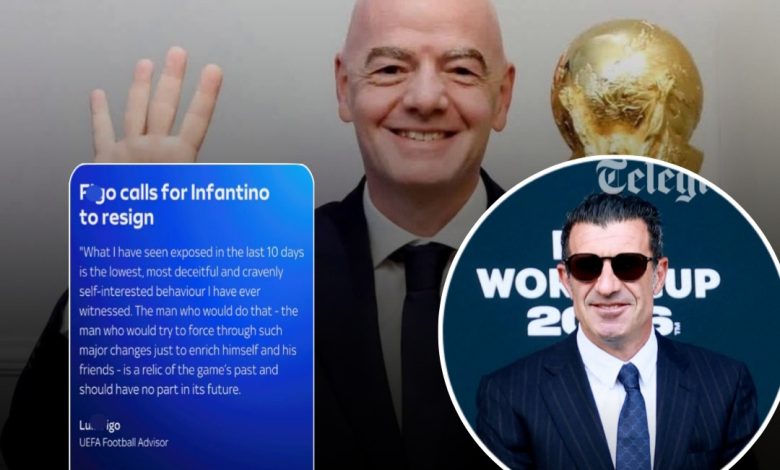
The pressure on FIFA President Gianni Infantino has reached an unprecedented level after Portuguese football legend Luís Figo became the first globally renowned former player to publicly demand his resignation. Figo’s explosive statement marks a significant escalation in the growing crisis surrounding FIFA’s leadership and has intensified calls for sweeping changes at the top of world football.
Figo, a former Ballon d’Or winner who represented Barcelona, Real Madrid, Inter Milan and Portugal with distinction, did not hold back in his criticism. In a blistering public statement, he accused Infantino of betraying the values he promised to uphold when he became FIFA president in 2016. The former Portugal captain alleged that the FIFA chief had undermined the credibility of football’s governing body through a pattern of questionable leadership and poor governance.
His strongest words quickly became the defining quote of the controversy:
> “It’s too late to save his dignity, but it’s not too late to save football. He should go. Now.”
The statement sent shockwaves throughout the football world because it came from someone who once sought to reform FIFA himself. Figo had previously run for the FIFA presidency in 2015 on a platform centred on transparency and accountability, giving his criticism added weight.
Figo’s intervention comes after the collapse of FIFA’s controversial proposal to create a commercial entity that would have allowed outside investors to purchase a stake in World Cup-related commercial rights. The proposal triggered fierce opposition from UEFA and several national football associations before FIFA ultimately withdrew the plan following widespread backlash.
By becoming the first internationally recognised former football superstar to openly demand Infantino’s resignation, Figo has raised questions about whether more football icons, federation leaders and influential stakeholders will now follow his lead. Many observers believe his comments could encourage others who have previously remained silent to speak out as pressure continues to mount on FIFA’s leadership.
The significance of Figo’s intervention extends far beyond the words themselves. Throughout his playing career, he earned a reputation as one of football’s most respected figures, winning every major club honour and leading Portugal during one of the country’s greatest footballing eras. Because of that standing, his decision to publicly call for Gianni Infantino’s resignation is likely to resonate with players, administrators and supporters across the globe.
According to Figo, the issue is no longer about a single failed proposal or one controversial decision. He argued that confidence in FIFA’s leadership has been steadily eroded by a series of governance failures that have damaged the credibility of the organisation. The former Ballon d’Or winner accused Infantino of putting personal ambitions ahead of the interests of football, claiming that the FIFA presidency had lost the trust of many within the game.
His comments also arrive at a delicate moment for FIFA. The governing body has been forced into damage-control mode after abandoning its controversial commercial rights proposal following widespread opposition led by UEFA and several member associations. FIFA has since apologised to its members for mistakes in the handling of the proposal, while senior officials met in Morocco in an effort to restore unity around Infantino’s leadership.
Despite FIFA insisting that Infantino still retains the backing of many national federations, the growing list of critics has created fresh uncertainty over his political future. With former players, football administrators and influential political figures now questioning his leadership, speculation is increasing over whether further pressure could emerge before the next FIFA presidential election. At present, however, no major challenger has formally declared a campaign against Infantino.
Whether Figo’s outspoken criticism proves to be an isolated intervention or the beginning of a wider movement remains to be seen. What is clear is that one of football’s most respected former stars has broken ranks in dramatic fashion, delivering one of the strongest public condemnations of a sitting FIFA president in recent memory. His message was unmistakable: in his view, the only way for world football to rebuild trust is through a change in leadership at the very top.
The reaction to Figo’s comments has been swift across the football community. While some administrators have stopped short of endorsing his call for resignation, many have acknowledged that his remarks reflect a broader frustration with FIFA’s direction. Analysts argue that criticism coming from a player of Figo’s stature carries a different level of influence than political disagreements between football governing bodies. It places the debate firmly in the public spotlight and increases pressure on FIFA to demonstrate that it can restore confidence among fans, players and national associations.
For years, Infantino has defended his presidency by pointing to FIFA’s financial growth, the expansion of international competitions and increased funding for football development programmes around the world. His supporters argue that these achievements have strengthened the global game and created new opportunities for emerging football nations. They maintain that many of the recent controversies have been exaggerated and insist that FIFA remains committed to transparency and reform.
Critics, however, believe the latest controversy has exposed deeper concerns about governance and decision-making within world football’s governing body. They argue that major strategic decisions affecting the future of the sport should involve broader consultation with confederations, clubs, players and supporters. The fierce backlash against FIFA’s proposed commercial venture has reinforced those concerns, with opponents claiming the organisation underestimated the strength of resistance from across the football landscape.
As attention now turns to FIFA’s next Executive Council meetings, many observers will be watching closely for signs of further dissent. Questions remain over whether additional football legends, current administrators or influential member associations will publicly join Figo in demanding leadership change. Even if no immediate challenge materialises, the controversy has undoubtedly become one of the biggest political tests of Infantino’s presidency.
For FIFA, the coming months could prove decisive. Rebuilding trust will require more than public statements—it will depend on convincing the football world that future decisions will be made with greater openness, accountability and consultation. Until then, Figo’s uncompromising message is likely to continue echoing throughout the sport.
“It’s too late to save his dignity, but it’s not too late to save football. He should go. Now.”
Whether those words become a turning point in the history of FIFA or simply another chapter in the debate surrounding Gianni Infantino’s leadership will ultimately depend on how football’s global community responds in the weeks and months ahead.