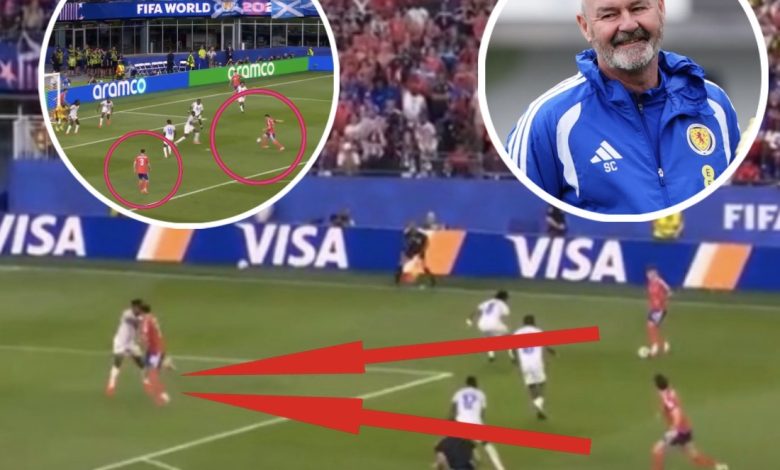
Scotland’s narrow 1-0 victory over Haiti has sparked an unexpected debate among football fans, pundits, and tactical analysts after a controversial attacking approach played a key role in deciding the contest. While the result itself may appear straightforward on paper, much of the discussion following the match has centered on Scotland’s intelligent use of blocking movements, decoy runs, and off-the-ball positioning during attacking situations.
The tactic, which was highlighted extensively on social media after the game, helped Scotland create the decisive moment that ultimately separated the two sides. While supporters of the Scottish national team have praised the move as clever, modern football, critics have argued that it pushes the boundaries of what should be considered acceptable within the spirit of the game.
As replays circulated online, some observers even went as far as urging FIFA to review the practice and consider introducing stricter regulations to prevent teams from using similar methods in future international tournaments.
Whether the controversy is justified or merely a reaction to Scotland’s tactical excellence remains open for debate, but there is no question that the incident has become one of the most talked-about moments of the tournament so far.
Scotland Find a Way Through a Stubborn Haiti Defence
Before the controversy emerged, Scotland’s focus was simply on securing three valuable points against a disciplined Haitian side.
Haiti entered the match determined to frustrate their opponents. Their defensive shape remained compact for long periods, limiting Scotland’s opportunities in open play and forcing the European side to search for alternative solutions.
For much of the encounter, Scotland enjoyed the majority of possession and territorial advantage. However, converting that dominance into clear-cut chances proved difficult.
Haiti’s defensive organisation impressed many neutral observers. Their back line remained compact, while midfield players worked tirelessly to close passing lanes and deny Scotland space between the lines.
As the match progressed, frustration appeared to grow among Scottish players. Several promising attacks broke down before reaching dangerous areas, and Haiti looked increasingly confident that they could earn a valuable result.
Then came the moment that changed everything.
The Set-Piece Routine That Changed the Match
The winning goal emerged from a carefully rehearsed attacking sequence that Scotland had clearly worked on extensively in training.
As Scotland prepared to deliver the ball into the danger area, several players positioned themselves strategically around the edge of the penalty box.
Instead of making direct runs towards goal, some attackers appeared to focus primarily on occupying defenders and disrupting Haiti’s defensive structure.
These movements created confusion inside the box.
Haitian defenders were forced to make split-second decisions regarding who to track and where to position themselves. In the chaos, crucial space opened in a dangerous area.
The eventual scorer was able to exploit that opening, finding enough room to receive the ball and finish clinically.
The goal itself was legal under the current Laws of the Game, and match officials did not identify any infringement during the sequence.
VAR also had no reason to intervene.
Nevertheless, the manner in which the goal was created quickly became the main talking point after the final whistle.
Why the Tactic Has Become So Controversial
Football has always evolved tactically.
What was considered revolutionary a decade ago often becomes commonplace in the modern game. High pressing, inverted full-backs, false nines, and complex positional systems all faced criticism when first introduced.
The debate surrounding Scotland’s approach stems from concerns about deliberate blocking movements.
Critics argue that some attacking players were not genuinely attempting to play the ball but were instead acting as obstacles designed to impede defenders.
Supporters counter that intelligent movement is an essential part of football and that attackers have every right to occupy space legally.
The distinction between legal positioning and illegal obstruction has always been difficult to define.
Current football laws prohibit players from unfairly impeding opponents when the ball is not within playing distance. However, proving intent can be extremely challenging.
This grey area is precisely why the incident has generated such strong reactions.
Some believe Scotland exploited a loophole.
Others believe they simply executed a brilliantly designed set-piece routine.
Calls for FIFA to Review the Situation
Following the match, discussions quickly spread across football forums and social media platforms.
Former players, analysts, and supporters began debating whether governing bodies should take a closer look at these types of attacking routines.
Several commentators suggested that football could eventually face the same challenges experienced in sports such as basketball and American football, where screening and blocking form a major tactical component.
Opponents of the tactic argue that football has traditionally rewarded technical skill, creativity, and movement rather than physical obstruction.
Allowing attackers to deliberately interfere with defenders, they say, could fundamentally alter the nature of set-piece situations.
Those in favour of Scotland’s approach reject that argument entirely.
They point out that modern defending has become increasingly sophisticated, with teams using zonal marking systems and coordinated structures designed specifically to neutralise attacking threats.
If defenders can organise collectively, they argue, attackers should also be permitted to use collective movement to gain an advantage.
The debate is unlikely to disappear anytime soon.
Scotland’s Coaching Staff Deserve Credit
Regardless of where individuals stand on the controversy, there is widespread agreement on one point.
Scotland’s coaching team deserves credit for identifying a weakness and developing a solution.
International football provides limited preparation time compared to club football.
Managers often have only a few training sessions to implement tactical ideas before major matches.
Successfully executing a complex set-piece routine under tournament pressure requires significant preparation, communication, and attention to detail.
The winning goal reflected those qualities.
Every movement appeared coordinated.
Every run seemed purposeful.
Every player understood their role.
Whether critics like the tactic or not, it represented a high level of tactical organisation.
Haiti’s Perspective
From Haiti’s perspective, the defeat will be particularly frustrating.
For long periods they defended courageously and limited Scotland’s opportunities.
The defensive unit remained disciplined and resilient against a team with superior resources and greater tournament experience.
Conceding from a single moment of confusion will feel harsh.
However, Haiti’s coaching staff may also use the incident as a learning opportunity.
Modern football increasingly revolves around marginal gains.
Set pieces account for a significant percentage of goals at elite level, and defending them effectively has become one of the most important aspects of tournament football.
Future opponents may now study Scotland’s routine closely in an attempt to prevent similar situations.
The Growing Importance of Set Pieces
Scotland’s winning goal also highlights a broader trend within the game.
Set pieces are becoming more influential than ever before.
Across international and club football, specialist coaches are being employed specifically to maximise attacking and defensive dead-ball situations.
Data analysis has transformed the way teams prepare.
Coaches now examine countless hours of footage to identify recurring defensive weaknesses and design routines capable of exploiting them.
As a result, goals scored from corners, free-kicks, and indirect situations have increased significantly over recent years.
The margins between teams at major tournaments are often extremely small.
One successful set-piece routine can determine qualification, elimination, or even a championship.
Scotland demonstrated exactly why these situations receive so much attention.
Could FIFA Actually Change the Rules?
While calls for FIFA intervention have generated headlines, any immediate rule change appears unlikely.
Football’s lawmakers traditionally prefer gradual adjustments rather than dramatic overhauls.
Before introducing new regulations, officials would need to determine whether a genuine problem exists.
They would also need to establish clear definitions distinguishing legal movement from illegal obstruction.
That process would be extremely complicated.
Any new rule would require consistent enforcement across every level of the game, from grassroots football to the World Cup.
Ambiguous interpretations could create even greater controversy.
For that reason, many experts believe referees will continue applying existing laws rather than relying on new regulations.
Unless future incidents become widespread and significantly affect matches, football authorities may see little reason to intervene.
Fans Divided Over Scotland’s Success
As expected, fan opinion remains sharply divided.
Scottish supporters have largely celebrated the tactical ingenuity shown by their team.
Many argue that successful teams should be praised for innovation rather than criticised for finding new ways to gain an advantage.
Others see the controversy as evidence that Scotland simply outsmarted their opponents.
Meanwhile, neutral observers remain split.
Some feel uncomfortable with attackers focusing on defenders rather than the ball.
Others believe football’s evolution should not be restricted merely because a tactic appears unusual.
The disagreement reflects a broader philosophical question about the sport.
Should football encourage constant tactical innovation?
Or should authorities act whenever new strategies begin pushing the limits of existing rules?
There is no easy answer.
What This Means for Scotland Going Forward
For Scotland, the most important fact is that the tactic worked.
The team secured a crucial victory and collected three valuable points.
Confidence within the squad is likely to increase following such a disciplined and professional performance.
At the same time, future opponents will now be aware of the threat Scotland pose from set pieces.
Defensive coaches will spend time analysing the winning goal and preparing countermeasures.
That may make it harder for Scotland to repeat the same routine successfully.
However, the very best teams rarely rely on a single strategy.
If Scotland have developed one effective set-piece weapon, there is every chance they have several others waiting to be unveiled.
That uncertainty can become a weapon in itself.
Conclusion
Scotland’s 1-0 victory over Haiti will be remembered not only for the result but also for the tactical debate it created.
A carefully orchestrated attacking routine succeeded in breaking down a stubborn Haitian defence and ultimately decided the match. While critics have called on FIFA to examine whether such tactics should remain permissible, supporters insist Scotland merely demonstrated intelligence, preparation, and tactical excellence.
The controversy highlights the constant evolution of football. As teams search for new ways to gain an advantage, the boundaries between innovation and exploitation will inevitably be tested.
For now, Scotland can celebrate a hard-earned victory, while the wider football community continues debating whether the tactic represents the future of set-piece strategy or a trend that governing bodies should eventually address.
One thing is certain: the discussion surrounding Scotland’s winning goal is unlikely to disappear anytime soon, and every future set-piece involving similar movements will now receive far greater scrutiny from fans, analysts, and officials alike.