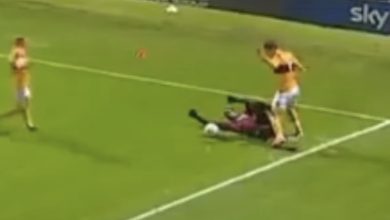
Rangers have responded to the Scottish FA’s position following the controversial penalty appeal involving Djeidi Gassama during their meeting with Motherwell, with the club making its stance on the refereeing decision clear.
The incident quickly became one of the major talking points surrounding the fixture, particularly because Rangers believed there was a strong case for a penalty after the ball appeared to strike the Motherwell player’s hand inside the penalty area.
However, despite the claims from the Rangers camp, the referee and VAR team ultimately allowed play to continue.
The controversy has now taken another turn following the SFA’s explanation of the decision, with Rangers making it clear that they remain unhappy with the way the incident was handled.
THE INCIDENT THAT SPARKED THE DEBATE
The flashpoint occurred during a period when Rangers were pushing forward and looking for another opening.
Gassama was involved in the attacking move, with the ball eventually ending up in a dangerous position inside the Motherwell penalty area. As the defending player went to ground, the ball appeared to make contact with his arm.
From the Rangers perspective, the positioning of the arm and the nature of the contact immediately raised questions about whether the incident should have resulted in a penalty.
The argument was simple: if the hand or arm was deliberately positioned in a way that made the player bigger and prevented the ball from continuing naturally, then Rangers had grounds to believe a penalty should have been awarded.
The reaction from supporters was equally strong, with many Rangers fans questioning why VAR did not intervene.
But the officials reached a different conclusion.
SFA’S DECISION BECOMES THE FOCUS
The Scottish FA’s explanation has now added another layer to the controversy.
The key issue is the threshold required for VAR intervention.
Under VAR protocol, an on-field decision is not supposed to be changed simply because another interpretation is possible. The intervention is designed for situations where the original decision is considered a clear and obvious error.
That distinction is important because handball decisions can involve significant interpretation.
The SFA’s position is therefore understood through the framework of the referee’s original decision and the VAR review rather than simply asking whether the ball touched the hand.
And that is where Rangers’ frustration comes in.
RANGERS STILL BELIEVE THE REFEREE GOT IT WRONG
Despite the SFA explanation, Rangers have not simply accepted that the incident was correctly officiated.
The club’s position is that the referee made a major mistake by failing to award the penalty in the first place.
For Rangers, this is not merely about whether the ball touched an arm.
The bigger question is whether the circumstances surrounding the contact should have resulted in a penalty.
The club believes the incident deserved much greater scrutiny and that the officials should have recognised the significance of the handball.
That has created an unusual situation in which Rangers can acknowledge the SFA’s explanation of the process while still maintaining that the actual decision on the pitch was wrong.
In other words, accepting that the SFA has explained its reasoning does not necessarily mean Rangers agree with the original refereeing decision.
WHY THE WORD “CLEAR AND OBVIOUS” MATTERS
This is perhaps the most important part of the controversy.
Many supporters assume that if VAR sees an incident that appears to be a penalty, it should automatically send the referee to the monitor.
That is not how the system is designed to operate.
The VAR protocol specifically states that the referee’s original decision should only be changed when there is a clear and obvious error. Penalty incidents are one of the categories that can be reviewed, but the threshold still applies.
That means the VAR officials could look at the same footage as supporters and still conclude that the referee’s decision did not reach the intervention threshold.
It is precisely this area that continues to frustrate football supporters.
A fan can watch a replay and believe a penalty is obvious, while the officials can argue that the evidence is not strong enough to overturn the original decision.
THE GASSAMA FACTOR ADDS ANOTHER DIMENSION
Gassama has already been involved in several controversial penalty discussions involving Rangers and Motherwell this season.
Earlier in the campaign, he was awarded a penalty against Motherwell after a challenge from Tom Sparrow. Minsu Kim subsequently missed from the spot, while Motherwell strongly disagreed with the decision.
That history has inevitably made the latest incident even more interesting for supporters.
Every time Gassama goes down or becomes involved in a penalty-area incident, the discussion immediately becomes intense.
However, the latest controversy is different because the argument is centred on a potential handball rather than simply whether Gassama was fouled.
RANGERS HAVE REASON TO BE FRUSTRATED
There is also an important competitive context.
Rangers eventually secured a dramatic 2-1 victory over Motherwell at Fir Park, with Ryan Naderi scoring late after Emmanuel Fernandez had opened the scoring and Jake Girdwood-Reich had equalised.
That result means the disputed penalty did not ultimately cost Rangers points.
But that does not make the incident irrelevant.
Clubs competing for major honours cannot afford to ignore contentious decisions simply because they eventually win the match.
Rangers will understandably want consistency from officials, particularly in moments that could potentially change the outcome of a match.
And while the three points are now secured, the debate surrounding the handball remains.
THE BIGGER ISSUE FOR RANGERS
The argument now goes beyond one penalty appeal.
Rangers’ frustration reflects a wider concern about consistency in Scottish football’s use of VAR.
The club has previously challenged controversial handball decisions and called for greater transparency surrounding VAR discussions. In an earlier dispute, Rangers argued that an incorrect handball decision had been made, while the SFA defended the process by saying the incident was subjective and did not meet the clear-and-obvious threshold.
That history shows why the latest situation is likely to generate further discussion.
Rangers may accept the SFA’s explanation of how the decision was reached, but that does not mean they have to accept the decision itself.
WHAT HAPPENS NEXT?
For now, the controversy appears unlikely to disappear completely.
The SFA can explain the reasoning behind the officials’ decision, while Rangers can maintain that the referee should have made a different call.
Both positions can exist at the same time.
The important question for Rangers supporters is whether similar incidents will be judged consistently in future matches.
If the same type of handball occurs elsewhere and a penalty is awarded, questions about consistency will inevitably return.
And if Rangers are involved in another controversial VAR decision, this incident will almost certainly be brought back into the conversation.
For Rangers, however, there is one consolation: the disputed decision did not prevent them from taking all three points.
They survived the controversy, survived Motherwell’s pressure and found a late winner.
But the message from Ibrox is clear — Rangers may have accepted the SFA’s explanation of the decision, but they have not accepted that the referee was right.
That distinction could become one of the most important talking points from the latest VAR controversy.