CELTIC NAME 24-MAN CHAMPIONS LEAGUE SQUAD AS MARTIN O’NEILL MAKES SHOCK CALL TO LEAVE OUT STAR PLAYER, LEAVING FANS WORRIED AHEAD OF LASK SHOWDOWN

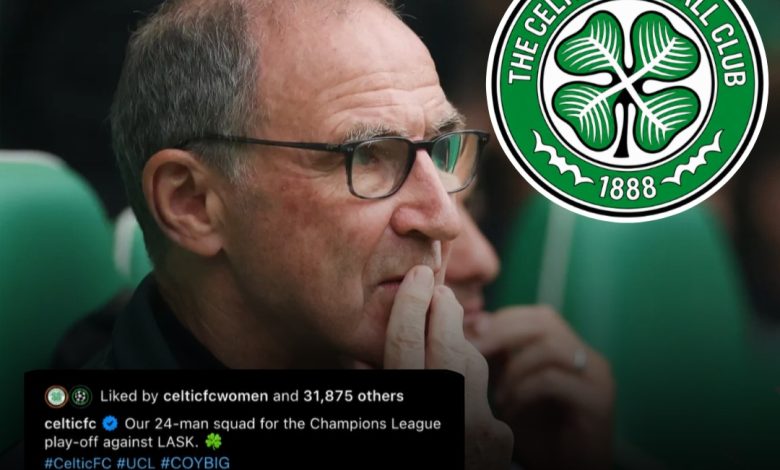
Celtic have confirmed their Champions League play-off squad ahead of the crucial two-legged meeting with Austrian champions LASK, with Martin O’Neill making a number of significant selection decisions that have immediately caught the attention of supporters.
The biggest talking point is not necessarily who has been included, but who has been left out of the travelling group and what those omissions could mean for Celtic’s preparations for one of the most important European ties of their season.
Despite reports and social-media discussion referring to a 24-man list, the squad officially reported for the LASK play-off currently stands at 25 players. Celtic have nevertheless retained some flexibility, with O’Neill able to make limited changes before the registration deadline.
The timing could hardly be more important. Celtic are attempting to navigate the Champions League qualifying rounds and reach the league phase, while O’Neill is simultaneously overseeing a major rebuild of the squad.
The experienced manager has already overseen an aggressive summer recruitment programme, bringing in Kasper Høgh, Camilo Durán, Haissem Hassan and Mika Baur as Celtic look to address some of the attacking shortcomings that affected the side last season.
Yet the squad announcement has demonstrated that adding players is only one part of the challenge. O’Neill must now decide which players can be trusted for European football, which players are fit enough to contribute and which members of the existing squad may have uncertain futures.
Alistair Johnston’s absence raises eyebrows
One of the most significant omissions is Alistair Johnston, whose absence could leave Celtic supporters feeling particularly uneasy ahead of the first leg.
Johnston has established himself as an important right-back for Celtic, but his current situation is complicated by injury concerns and reported transfer interest. The latest squad reports indicate that he has not been included for the LASK tie, with Anthony Ralston expected to provide cover on the right side of the defence.
That decision has naturally prompted questions among supporters.
European play-off matches are rarely forgiving, and the right-back position can become especially important against opponents capable of attacking in transition. Johnston’s ability to contribute defensively while also providing an outlet going forward has made him a valuable member of Celtic’s squad.
His absence therefore creates an immediate tactical question for O’Neill.
Can Ralston step into the role without Celtic losing any attacking momentum? Will O’Neill change the team’s shape to protect the position? Or could another player be asked to perform a role that is not necessarily his natural position?
For now, Ralston appears to be the obvious solution.
But there is another layer to the story.
Johnston’s future has also reportedly attracted attention from Everton, meaning Celtic’s decision cannot be considered purely from a footballing perspective. If a transfer is developing at the same time as an important European tie, O’Neill and the Celtic hierarchy must carefully balance short-term Champions League ambitions with longer-term squad planning.
Arne Engels included despite transfer speculation
Perhaps the most intriguing selection is the inclusion of Arne Engels.
The Belgian midfielder has been heavily linked with a move to West Ham, with reports suggesting a potential transfer worth around £22 million. Yet O’Neill has still named him in the Champions League squad.
That decision tells supporters plenty about the manager’s immediate priorities.
O’Neill needs his strongest possible squad for the LASK tie. Qualification for the Champions League league phase carries enormous sporting and financial significance, and the manager clearly does not want to weaken his options unnecessarily.
Engels’ inclusion could therefore be interpreted as a simple footballing decision: until a transfer is completed, he remains a Celtic player and is available for selection.
However, it also creates an interesting situation.
If West Ham’s interest develops rapidly, Celtic could potentially find themselves preparing for a major European match while simultaneously negotiating the sale of one of their midfield options.
That uncertainty is hardly ideal.
For O’Neill, though, the message appears straightforward: concentrate on the players who are available and worry about transfers when they actually happen.
Oxlade-Chamberlain included but unavailable for the first leg
Another interesting name on the list is Alex Oxlade-Chamberlain.
The former England international has been included in Celtic’s Champions League squad, but he will not be available for the first leg because of a suspension dating back to an incident during his time with Besiktas in 2023.
His inclusion nevertheless makes sense because the registration covers the tie and potentially allows him to play in the return fixture, assuming the suspension does not extend further.
It is another example of the complicated squad-management decisions O’Neill faces.
The manager has to consider not only injuries and form, but suspensions, transfers and the possibility of players becoming unavailable between the two legs.
New signings provide a major boost
If the omissions have generated concern, the inclusion of Celtic’s new arrivals provides a significant reason for optimism.
Kasper Høgh, Camilo Durán, Mika Baur and Haissem Hassan have all been registered for the Champions League play-off.
The recruitment represents a clear attempt by Celtic to improve a team that struggled for attacking consistency during the previous campaign.
Høgh has already provided supporters with an indication of what he can offer.
The Danish striker scored a remarkable hat-trick in Celtic’s 5-1 victory over Kilmarnock, responding emphatically after an uncertain debut against Dundee. His performance immediately raised expectations surrounding his role in the new Celtic attack.
That form could be particularly important against LASK.
European football requires a different level of efficiency. Celtic may dominate possession for long stretches, but chances can be limited, especially away from home. Having a striker capable of converting opportunities could make the difference between progressing and suffering another frustrating European exit.
Hassan is another player who could add a different dimension.
The Egyptian winger arrived from Real Oviedo after helping the Spanish club secure promotion. His ability to operate in wide areas gives O’Neill another attacking option and could help Celtic stretch LASK’s defensive structure.
Baur, meanwhile, provides additional versatility in midfield.
The German Under-21 international played an important role in Paderborn’s promotion campaign and is capable of operating centrally or from wider positions. His arrival gives O’Neill another player who can potentially change the dynamic of a match from the bench.
Durán also represents part of the club’s attempt to refresh its attacking options.
Taken together, the four signings underline the direction Celtic are taking under O’Neill: greater athleticism, more attacking variety and increased competition for places.
Michel-Ange Balikwisha’s situation remains intriguing
One player whose situation deserves particular attention is Michel-Ange Balikwisha.
The winger was reportedly facing an uncertain future after struggling for regular playing time following his move to Celtic. Reports have suggested interest from clubs including Monza, Basel and SV Elversberg, with his limited involvement making him a potential departure candidate.
Interestingly, however, Balikwisha has still been included in the Champions League squad.
That could mean several things.
It could simply be a precaution while transfer negotiations remain unresolved. Alternatively, O’Neill may still regard him as a useful squad player despite the competition created by Celtic’s new arrivals.
There is also a practical consideration.
A player who remains registered gives Celtic another option should injuries or suspensions occur. Until his future is settled, there is little reason to remove him from the European squad if he remains eligible.
His inclusion therefore does not necessarily mean that his future at Celtic is secure.
But it does mean that O’Neill has not completely closed the door on him.
O’Neill’s biggest challenge is finding balance
The squad announcement illustrates the difficult balancing act facing the Celtic manager.
O’Neill has to prepare for LASK while also dealing with a transfer window that remains active.
Celtic are still looking at potential additions, with O’Neill recently indicating that work is continuing behind the scenes. The manager has made it clear that he wants further reinforcements and that the club is attempting to strengthen before the European deadline.
That creates an unusual situation.
A manager normally wants to establish his strongest XI as early as possible. But Celtic’s squad is still evolving.
New players are arriving.
Existing players are attracting transfer interest.
Others are recovering from injuries.
And some players who have been important in previous seasons now face greater competition for their positions.
O’Neill therefore cannot simply pick a squad based on last season’s hierarchy.
He has to judge the players available to him right now.
What the squad tells us about Celtic’s priorities
The makeup of the Champions League group also offers some clues about how O’Neill sees his team.
The squad contains two goalkeepers, nine defenders, seven midfielders and seven forwards, according to the latest published breakdown.
That is a relatively balanced group, although the absence of Johnston immediately places additional pressure on the full-back positions.
The large number of attacking players is particularly notable.
After a campaign in which Celtic were sometimes criticised for a lack of cutting edge, O’Neill has clearly prioritised attacking depth.
Høgh’s arrival has given the club a new focal point in attack, while Durán and Hassan provide additional options in the final third.
That could allow Celtic to approach LASK differently from some of their previous European encounters.
Rather than relying heavily on individual moments from established players, O’Neill has the opportunity to rotate his attacking options and maintain intensity throughout the match.
Why the LASK tie matters so much
For Celtic, this is about far more than simply winning another European qualifier.
Reaching the Champions League league phase would represent a major boost for the club.
There are sporting benefits, financial rewards and increased prestige. It also makes Celtic more attractive to players and strengthens the club’s ability to compete in the transfer market.
The opposite is also true.
Failure would represent a significant disappointment, particularly after the level of investment made during the summer.
That makes the selection of the squad particularly important.
O’Neill’s experience in European football will be tested once again. During his previous spell at Celtic, he led the club to the UEFA Cup final in 2003 and enjoyed some of the most memorable European nights in the club’s modern history.
Now, more than two decades later, he is attempting to help Celtic navigate another European challenge.
The circumstances are obviously very different, but the expectation remains enormous.
Fans’ concerns are understandable
Celtic supporters are unlikely to be completely relaxed after seeing the squad.
Johnston’s absence is particularly significant because it comes at a position where depth has already been a talking point.
There is also uncertainty surrounding Engels and other players whose futures could change before the transfer window closes.
At the same time, however, supporters have genuine reasons for optimism.
The new signings have strengthened the attacking department, Høgh has already demonstrated his finishing ability and O’Neill has shown that he is prepared to make difficult decisions based on what he believes the team needs.
The squad is therefore not necessarily weaker because one prominent player has been left out.
It may simply be different.
And that distinction could prove important.
O’Neill still has room to manoeuvre
Celtic’s reported registration deadline provides O’Neill with an opportunity to make further adjustments.
According to the latest reports, the manager can make up to two changes before the squad is locked for the later stages of the tie.
That gives Celtic some breathing room.
If a new signing is completed in time, the club can potentially make an adjustment. Equally, if a player leaves, O’Neill will have to assess whether the squad needs to be reshaped.
It means that the published list should not necessarily be viewed as the final word on Celtic’s European squad.
The situation remains fluid.
The bigger picture
Ultimately, the squad announcement tells the story of a Celtic team undergoing significant change at exactly the moment when stability is desperately needed.
O’Neill has inherited expectations of success, but he is also overseeing a squad rebuild.
The manager must integrate four major summer arrivals while maintaining the form of established players. He must deal with injuries, suspensions and transfer speculation while preparing for a LASK side that will be determined to make Celtic’s route to the Champions League as difficult as possible.
The omission of Alistair Johnston is therefore significant, but it should not be interpreted in isolation.
It is part of a much wider picture.
Celtic have deliberately increased competition throughout the squad. They have invested heavily in attack. They have retained players who could potentially leave. And they have left themselves room to make further changes before the registration deadline.
For O’Neill, the challenge now is turning all of those individual pieces into a coherent team.
The LASK tie will provide the first major test.
Celtic’s supporters will want to see whether the new attacking additions can deliver immediately, whether the defensive reshuffle can hold firm and whether O’Neill’s experienced hand can guide the club through another demanding European qualification campaign.
The manager’s decision to leave Johnston out has certainly created questions.
But the answers will ultimately come on the pitch.
If Celtic reach the Champions League league phase, the selection decisions will quickly be forgotten. If they fail, every omission and every transfer decision will be examined in microscopic detail.
That is the nature of European football at Celtic.
The margin for error is small, the expectations are enormous and every selection decision carries weight.
For now, O’Neill has made his call.
The new-look Celtic squad is assembled, the European stage is waiting, and the LASK showdown is rapidly approaching.