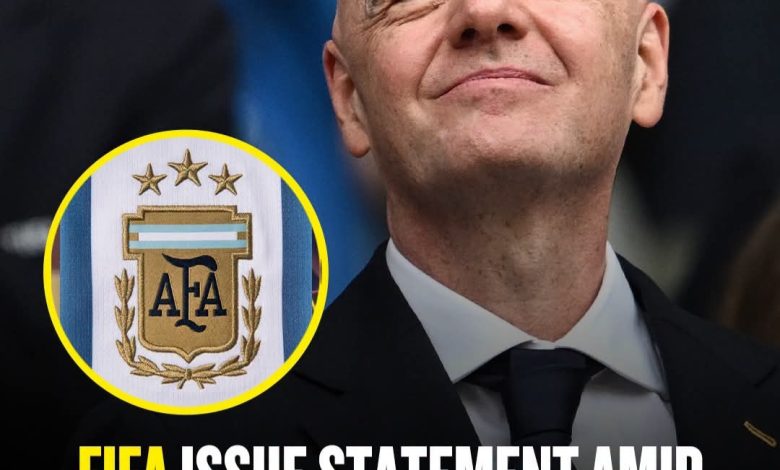
FIFA ISSUE STATEMENT AMID CALLS TO BAN ARGENTINA STARS FROM FOOTBALL
The 2026 FIFA World Cup has delivered unforgettable moments of football brilliance, emotional victories, and dramatic storylines. However, as the tournament approaches its conclusion, attention has shifted from events on the pitch to a controversy that has generated intense debate across the football world. FIFA has found itself under pressure after Argentina’s players displayed a politically sensitive banner following their World Cup semi-final victory over England, prompting calls from some politicians and campaign groups for disciplinary action.
Although social media has been flooded with claims that Argentina’s stars could face bans from football, FIFA has moved to clarify its position by confirming that the matter has been referred to its Disciplinary Committee for review. Importantly, the governing body has not announced any suspension or ban on Argentina’s players. Instead, it has confirmed that it is following its established disciplinary procedures while assessing the circumstances surrounding the incident.
The controversy began shortly after Argentina secured a memorable victory over England to book their place in the FIFA World Cup final. During the post-match celebrations, several Argentina players were photographed with a banner carrying the message “Las Malvinas son Argentinas,” which translates to “The Falkland Islands are Argentine.”
While the message has long been used within Argentina as an expression of the country’s claim over the Falkland Islands—known in Argentina as Las Malvinas—it immediately attracted international attention because of the long-standing sovereignty dispute between Argentina and the United Kingdom.
For many Argentine supporters, the slogan represents national pride and reflects a position that has been maintained by successive Argentine governments for decades. However, for many people in the United Kingdom and particularly residents of the Falkland Islands, the display was viewed as introducing a sensitive political issue into football’s biggest tournament.
The reaction was swift.
Several political figures and representatives associated with the Falkland Islands publicly urged FIFA to investigate the incident, arguing that football should remain free from political messaging. Some commentators went even further, calling for sanctions against players who participated in displaying the banner.
Within hours, social media platforms were filled with passionate opinions from supporters on both sides of the debate.
Some believed the players were simply expressing patriotism toward their homeland.
Others argued that international sporting events should avoid becoming platforms for political statements.
As public discussion intensified, attention quickly turned toward FIFA, the organization responsible for governing world football and enforcing regulations designed to keep political issues separate from the sport.
Recognizing the growing controversy, FIFA released a statement confirming that its Disciplinary Committee had opened a review into the matter.
The governing body explained that it would examine the available evidence and determine whether any FIFA regulations relating to political messages had been breached.
Significantly, FIFA did not announce any immediate punishment.
Neither individual players nor the Argentine Football Association were suspended.
No player was removed from the World Cup.
Instead, FIFA emphasized that any disciplinary process would follow its normal procedures, allowing the committee to consider all relevant information before reaching a decision.
That distinction is extremely important.
In today’s social media environment, headlines often move faster than verified facts.
Posts claiming that Argentina’s stars had already been banned quickly spread online despite no such announcement being made by FIFA.
The governing body’s official response made clear that the situation remained under review rather than already decided.
This measured approach reflects FIFA’s long-standing disciplinary framework.
Throughout its history, FIFA has investigated a wide variety of incidents involving players, coaches, national associations, supporters, discriminatory behaviour, crowd disturbances, and political expressions.
In each case, investigations generally begin with fact-finding before any conclusions are reached.
The organization rarely announces disciplinary measures before completing that process.
For Argentina, the controversy arrives at an unfortunate moment.
The national team has enjoyed another outstanding World Cup campaign, displaying resilience, tactical intelligence, and exceptional individual performances.
Having already established themselves among the tournament favourites, Argentina once again demonstrated why they remain one of international football’s strongest teams.
Their journey to the final has featured disciplined defending, creative midfield play, and clinical finishing in attack.
Throughout the competition, experienced leaders have combined effectively with younger talents to produce consistent performances under enormous pressure.
The victory over England represented one of Argentina’s biggest achievements of the tournament.
Players celebrated passionately with supporters after securing their place in the World Cup final.
It was during those celebrations that the banner appeared, transforming what had initially been scenes of sporting joy into an international political discussion.
Football has frequently found itself intersecting with politics throughout history.
Major tournaments often involve nations carrying historical disputes, cultural rivalries, and diplomatic tensions that extend far beyond the football pitch.
While FIFA maintains strict regulations discouraging political demonstrations during official competitions, distinguishing between expressions of national identity and prohibited political messaging is not always straightforward.
That complexity helps explain why FIFA has chosen to investigate carefully before reaching any conclusions.
The governing body must balance its commitment to political neutrality with ensuring disciplinary decisions remain fair, consistent, and based upon its regulations.
Meanwhile, football supporters across the world continue debating the issue.
Some believe players should have complete freedom to express national pride, particularly when representing their countries on the world’s biggest sporting stage.
Others insist that international football should remain focused exclusively on sport, avoiding messages that risk inflaming political disagreements or international disputes.
The discussion has therefore expanded well beyond Argentina itself.
It has become part of a broader conversation about where the boundaries should exist between sport, patriotism, freedom of expression, and FIFA’s responsibility to maintain political neutrality during global competitions.
As the World Cup final approaches, Argentina’s players continue preparing for the biggest match of their careers while FIFA’s disciplinary review proceeds independently.
The outcome of that review remains unknown.
What is clear, however, is that no official decision to ban Argentina’s players has been announced.
Instead, FIFA has reaffirmed that its established disciplinary procedures will determine whether any regulations were violated and, if necessary, what measures—if any—may follow.As FIFA’s disciplinary review continues, the football world remains divided over what the appropriate response should be. The governing body now faces the difficult task of balancing its commitment to political neutrality with the rights of players to express national identity. Whatever decision is eventually reached, the case has already become one of the most talked-about controversies of the 2026 FIFA World Cup.
One of the biggest reasons the story attracted so much attention is the enormous global profile of Argentina’s national team. As reigning world champions and one of football’s most successful nations, every action involving the team is scrutinized by supporters, journalists, and governing bodies. When Argentina celebrates, the images travel across the world within minutes. Likewise, any controversy quickly becomes an international talking point.
Many football experts have urged caution while discussing the issue. They point out that FIFA’s disciplinary process exists to ensure that decisions are based on evidence and regulations rather than public pressure or emotional reactions. Throughout its history, FIFA has investigated incidents involving players, coaches, supporters, and national associations before determining whether any rules were broken.
For that reason, many analysts believe it is important not to confuse an investigation with a finding of guilt.
Simply opening disciplinary proceedings does not automatically mean that punishments will follow. Instead, it allows FIFA’s Disciplinary Committee to gather information, review photographs and videos, consider official reports from match officials and tournament delegates, and determine whether the governing body’s regulations were breached.
The committee may also consider the context in which the banner was displayed. Questions such as who introduced the banner, whether players actively promoted it, and whether FIFA’s political neutrality rules apply in the specific circumstances are all likely to form part of the review.
Because of these considerations, disciplinary investigations often require time before conclusions are reached.
Meanwhile, Argentina’s players have remained focused on football.
Despite the growing media attention surrounding the controversy, the squad has continued preparing for the World Cup final. Coaches and senior players understand that distractions can affect performance, particularly before the biggest match in international football.
Inside the dressing room, the emphasis remains on tactics, fitness, recovery, and maintaining the unity that has carried Argentina through another outstanding tournament.
The players are aware that winning another World Cup would further cement this generation’s place among the greatest in Argentine football history. Every training session, tactical meeting, and preparation has therefore remained centred on achieving success on the pitch rather than responding to off-field debate.
Supporters inside Argentina have also reacted strongly to the controversy.
Many have defended the players, arguing that the slogan displayed on the banner reflects a long-standing national position and should not be interpreted as an attempt to provoke political conflict during the tournament. They believe the players were celebrating an emotional victory while expressing feelings shared by many citizens of their country.
Others, however, have acknowledged that football’s global audience makes such displays especially sensitive.
With billions of viewers watching the World Cup, even brief moments during celebrations can carry enormous international significance.
Outside Argentina, reactions have varied considerably.
Some football supporters believe FIFA should enforce its regulations consistently whenever political messages appear during official competitions.
Others argue that players from many different nations have previously expressed opinions relating to social or political issues and that governing bodies should avoid becoming involved unless actions clearly violate tournament rules.
This diversity of opinion illustrates just how complicated modern international sport has become.
Football no longer exists in isolation.
Every major tournament unfolds in front of a worldwide audience connected through television, digital media, and social networking platforms. Images spread instantly, discussions develop rapidly, and governing bodies often face pressure to respond before complete information is available.
FIFA’s decision to follow its disciplinary procedures rather than issue an immediate judgment reflects an effort to maintain fairness while protecting the integrity of the competition.
For the organization itself, consistency remains essential.
Any disciplinary action taken in one case inevitably becomes a reference point for future incidents involving other national teams. FIFA must therefore ensure that whatever conclusion it reaches aligns with its regulations and previous disciplinary decisions.
That responsibility extends beyond this single tournament.
Future World Cups, continental championships, and international competitions may all look back at this case when interpreting FIFA’s rules concerning political messages and player conduct.
As a result, the committee’s decision could have implications extending well beyond Argentina.
At the same time, it is important to separate verified facts from speculation.
Numerous reports circulating online have claimed that Argentina’s players have already been banned or that FIFA has announced severe sanctions.
Those claims are inaccurate.
At the time of FIFA’s statement, no bans had been imposed, and no players had been suspended. The governing body confirmed only that the matter had been referred to its Disciplinary Committee for review.
That distinction is critical.
Investigations exist to determine whether disciplinary measures are necessary—not to assume wrongdoing before evidence has been examined.
As the World Cup reaches its dramatic conclusion, football supporters everywhere hope that attention can once again focus primarily on the sport itself.
The tournament has produced remarkable goals, unforgettable performances, emotional victories, and compelling stories that remind the world why football remains the planet’s most popular game.
Argentina now stands just one victory away from another historic World Cup triumph.
Whether FIFA’s disciplinary review ultimately results in sanctions, warnings, or no further action at all, the controversy serves as another reminder that international football often reflects issues extending far beyond the ninety minutes played on the field.
Until FIFA completes its investigation, speculation will undoubtedly continue.
However, the most important fact remains unchanged: FIFA has confirmed only that the incident is under review. It has not announced any ban on Argentina’s players or declared them guilty of violating its regulations.
For now, the football world waits for two outcomes: the conclusion of FIFA’s disciplinary process and the result of the World Cup final itself. Both decisions will shape how this extraordinary chapter in World Cup history is remembered, but only one will determine who lifts football’s most prestigious trophy.