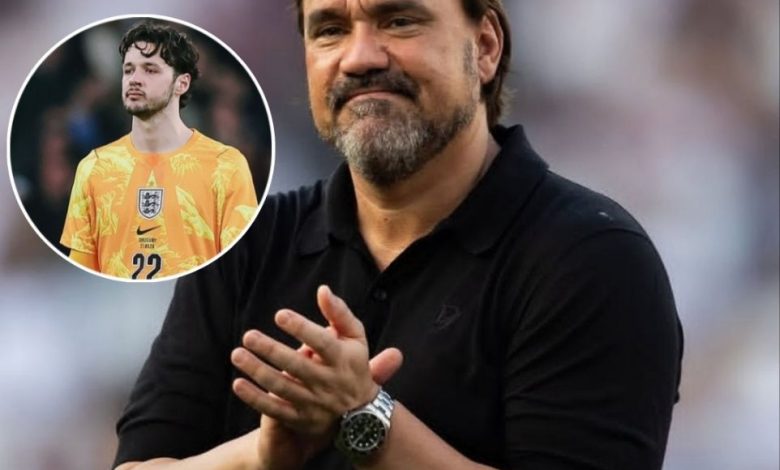
LEEDS LOOK READY TO SIGN A BIGGER ENGLISH TALENT THAN JAMES TRAFFORD
Leeds United’s summer transfer activity has already delivered a clear statement of ambition. The club-record capture of England international goalkeeper James Trafford from Manchester City for an initial £40 million (rising with add-ons) has been widely viewed as one of the most significant pieces of Premier League business in the 2026 window. Yet even as that deal is completed and Trafford prepares to become the long-term number one at Elland Road, reports and internal discussions suggest the club’s recruitment team continues to monitor other high-calibre English talents who could further reshape Daniel Farke’s squad.
The context for any additional English target is important. Trafford, still only 23, arrives with a strong pedigree. He impressed during Burnley’s promotion campaign, returned to Manchester City, earned a place in England’s World Cup squad, and is regarded as a genuine long-term contender for the national team’s number-one jersey. For Leeds, the signing addresses a clear need after the departures of Karl Darlow and Illan Meslier, while also signalling that the club is prepared to compete financially for premium domestic talent. The fee itself set a new club record and ranked among the highest ever paid for a British goalkeeper.
Against that backdrop, talk of a “bigger” English talent does not necessarily imply a more expensive or higher-profile name than Trafford. In football recruitment language it often refers to a player with greater immediate impact potential, superior current form, or a profile that fills a different positional gap with equal or greater upside. Leeds have already added Harry Wilson on a free transfer and centre-back Tarik Muharemovic for a substantial fee. Further reinforcements remain possible before the window closes, particularly in areas where the squad still requires depth or quality.
Farke’s side finished the previous Premier League season in mid-table and reached the latter stages of the FA Cup. The objective now is consolidation and gradual upward progress. English players who understand the intensity of the domestic game, require less adaptation time, and can contribute quickly remain attractive. Recruitment sources have previously linked Leeds with a range of English options across positions, from goalkeepers such as Carl Rushworth earlier in the window to midfielders and attackers who could add creativity or physical presence.
Any move for another high-level English player would need to satisfy several criteria. Financially, Leeds must balance ambition with sustainability under Profit and Sustainability Rules. Sporting directors and analysts will weigh playing time guarantees, long-term resale value, and fit within Farke’s preferred tactical structure. The German manager favours organised, high-pressing football with technical security in possession. Targets who can execute those demands while offering leadership or positional flexibility are prioritised.
Supporters have reacted positively to the Trafford arrival, viewing it as proof that the club is no longer content to operate solely in the lower end of the transfer market. A subsequent English signing of comparable stature would reinforce that narrative. It would also demonstrate that Leeds can attract players who might otherwise choose more established “big six” destinations or clubs with recent European experience. The ability to convince Trafford to choose Elland Road over other interested parties was already a notable success; repeating that process with another English prospect would further strengthen the club’s reputation in the domestic market.
Challenges remain. Competition for proven English talent is fierce. Clubs with greater financial resources or more immediate European football can often offer higher wages or faster pathways to silverware. Leeds must therefore sell a project based on regular first-team football, a clear tactical role, and the opportunity to develop in a high-pressure environment. Trafford’s decision suggests that message is landing with at least some high-calibre players.
From a squad-building perspective, the addition of further English talent would also help meet any informal preferences for a balanced mix of domestic and international players. Homegrown or English-qualified footballers can ease registration pressures in certain competitions and often adapt more readily to the physical and cultural demands of the Premier League. Whether the next target is a midfielder capable of controlling tempo, a versatile defender, or an attacker with proven goal threat, the underlying principle appears consistent: Leeds are prepared to invest in quality when the right profile becomes available.
The timing of any further move will be critical. With the season already under way and the transfer window still open, medicals, personal terms and agreement with selling clubs must be completed efficiently. Leeds have shown they can move decisively when opportunities arise, as evidenced by the Wilson, Muharemovic and Trafford deals. That operational capability will be tested again if a new English target is prioritised in the coming weeks.
Broader market trends also favour clubs willing to act early and decisively on English talent. The success of young English players at the recent World Cup and in domestic competitions has increased demand and, in many cases, valuations. Clubs that identify and secure such players before prices escalate further stand to benefit both on the pitch and in future transfer negotiations. Leeds’ willingness to meet a club-record fee for Trafford indicates they understand that reality.
Looking ahead, the true measure of the summer window will be how the new arrivals integrate and perform under Farke. Trafford will be expected to establish himself quickly as the first-choice goalkeeper. Any additional English signing would face similar expectations of immediate contribution. The coaching staff will assess training performances, tactical understanding and physical readiness before deciding on selection.
For now, the focus remains on consolidating the progress already made. The capture of Trafford has raised the bar for what Leeds can achieve in the transfer market. Continued interest in further English talent, whether ultimately successful or not, underlines a recruitment strategy that prioritises quality, domestic familiarity and long-term potential. If the club can complete another significant English addition before the window closes, it would represent a further step in the evolution of the squad and a clear signal of intent for the seasons ahead.
The coming days and weeks will reveal whether talks with any specific “bigger” English target advance to formal negotiations. Until then, supporters can reflect on a window that has already delivered a record goalkeeper signing and other notable reinforcements. Leeds United are no longer operating solely as a club reacting to necessity; they are actively shaping a squad capable of competing at a higher level. The pursuit of elite English talent sits at the heart of that ambition.